
The High Priestess Tarot Card Meaning: Intuition & Reversed
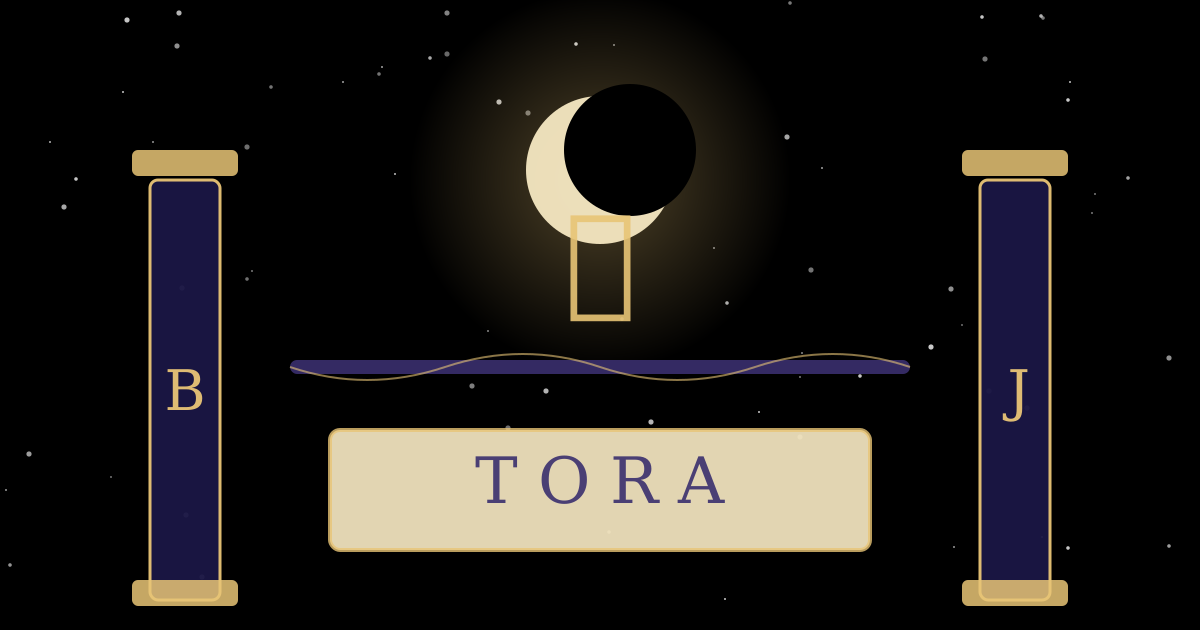
Meet the High Priestess: Guardian of the Veil
If the Magician is the tarot's voice — all action, speech, and will — the High Priestess is its silence. Card two of the Major Arcana sits enthroned between two pillars, black and white, holding a scroll she has only half-read and wearing a crown that phases from new moon to full. She does not gesture, bargain, or explain. She waits. In the oldest decks she was called the Popess, a figure of quiet authority at a time when authority was anything but quiet.
Her number is two, and the card is built around duality: light and dark, conscious and unconscious, known and unknowable. Behind her hangs a veil embroidered with pomegranates — the threshold between the everyday world and the deeper one. The pillars are marked with the letters B and J, from the temple pillars Boaz and Jachin, the established order of the seen world flanking a seat that belongs to the unseen. Everything about this card says the same thing in different dialects: not everything true is visible, and the most important information is the kind you feel before you can prove.
This is why the High Priestess is the card of intuition in its purest tarot form. Not hunches about lottery numbers, but the deeper knowing — the way you can feel a room's tension before anyone speaks, the dream that replays a waking problem until you finally listen, the certainty in your stomach that contradicts every spreadsheet. Readers call her the inner voice, the dream keeper, the moonlit half of the mind. Where the Magician asks what you can do, the High Priestess asks what you already know and haven't admitted.
The High Priestess Upright: Trust What You Already Know
When the High Priestess appears upright, the message is disarmingly simple and annoyingly hard to follow: stop asking everyone else. The card shows up when you already hold the answer and are spending your energy collecting outside opinions, researching the question to death, or waiting for a sign that will make the decision feel safe. Her counsel is to withdraw — not from life, but from the noise — and consult the one authority you keep skipping: yourself.
In practical terms, this is the card of patient observation. It favors waiting over forcing, listening over announcing, and letting a situation develop before you act on it. If you're deciding something, the upright Priestess suggests the missing piece will surface on its own if you give it room — a piece of information, a shift in the other person's behavior, a dream that clarifies the pattern. Many readers treat her as a "not yet" card in timing questions, and that's accurate to her spirit: the veil parts on its own schedule.
There is a dream and meditation dimension that belongs to this card more than any other. The High Priestess rules the threshold states — dreams, reverie, the hypnagogic drift before sleep, the sudden insight that arrives in the shower. When she appears, pay unusual attention to your dreams for the next few nights and write them down before they evaporate. The scroll on her lap is half-hidden because half of your wisdom is already written down somewhere inside you. Keep a notebook by the bed and you may be surprised how often the morning page contains advice the waking mind hadn't formulated.
One caution comes with her, and it is a gentle one: stillness is not avoidance. The High Priestess favors reflection, but she does not bless endless rumination. There is a difference between listening to your intuition and marinating in anxiety. If the "waiting" has stretched for months while nothing changes, you may be using her energy as a permission slip for inaction — and that's a conversation for the reversed meaning below.
The High Priestess Reversed: The Voice You Ignored
Reversed, the High Priestess describes a very specific and very common human failure: you knew, and you didn't listen. Broadly there are three versions — the overridden intuition, the repressed feeling, and the hidden truth.
The overridden intuition is the famous one. You had the gut feeling about the person, the offer, the apartment, the timing — and you talked yourself out of it with logic that later proved hollow. The reversed Priestess doesn't scold; she replays the tape. Her question is practical, not punitive: what did the signal feel like, and what story did you tell yourself to dismiss it? For entertainment and reflection, treat this as a training exercise. The only way to calibrate intuition is to log its hits and misses honestly.
The repressed feeling is the quieter reading. Something emotional has been pushed downstairs where it keeps banging on the pipes — grief that never got its week, anger you're too reasonable to feel, desire that doesn't fit the current life. The reversed Priestess suggests the symptom (the insomnia, the irritability, the restlessness) is the message. Feelings that aren't processed don't disappear; they go underground and start running the machinery.
The hidden truth is the outward-facing version: someone isn't telling you everything, or a situation contains a fact you haven't been shown. Note the card's restraint here — offered for reflection and entertainment, never as a verdict. It counsels observation rather than accusation: watch for inconsistencies between words and behavior, let time reveal what questions can't extract, and notice who changes the subject when certain doors open.
The High Priestess in Love: Listen Beneath the Words
In love readings, the upright High Priestess asks you to read the relationship the way she reads everything — beneath the surface. For singles, she often suggests that the right connection is forming quietly, not through grand gestures. Pay attention to the person who listens well, who remembers the small thing you mentioned once. The card can also describe a period of welcome solitude: she is complete on her throne, and sometimes the message is that you don't need the relationship to complete anything.
For couples, the Priestess points to the unspoken layer. There may be something your partner isn't saying — not necessarily something sinister; often it's vulnerability they're still wrapping. The card's advice is to create safety rather than interrogate: the truths behind her veil are offered, never extracted. Shared dreams, late-night honest conversation, and actually listening instead of rehearsing your reply all belong to her medicine.
Reversed in love, return to the two classic warnings. Are you ignoring your gut about this person or this dynamic? Is there a conversation you've been rehearsing in your head for weeks that still hasn't happened out loud? Sometimes the reversed Priestess simply describes emotional distance — two people performing a relationship while the real one goes unmaintained. The remedy is unglamorous and effective: say the true thing, plainly, and see what happens. For entertainment and reflection: the card never convicts a partner; it just suggests you stop pretending you don't notice what you notice.
The High Priestess in Career and Money: The Patient Professional
Career-wise, the upright High Priestess favors the long game and the quiet competence. She describes the professional whose judgment others trust because it has been right too many times to be luck — the analyst who reads the room, the researcher who senses which thread to pull, the creative whose instincts about an audience prove correct. If you're choosing between paths, she suggests the one that feels right in your body, even if the other looks better on paper. Paper can't feel.
Financially, her counsel is conservative and wise: wait for clarity before the big move, read the fine print twice, and don't let urgency — yours or a salesperson's — compress your timeline. This is not the card of bold investment; it is the card of the decision that still looks good in the morning. She also governs hidden value: the opportunity nobody else has noticed, the skill you undervalue that the market would pay for, the savings account quietly compounding while flashier ventures flame out.
Reversed, the career warning is specific: you've been ignoring information your instincts flagged. The colleague whose promises never quite cash out, the project's numbers that don't add up, the role that looks prestigious and feels wrong. Slow down and audit what you've been avoiding. If the block is internal — imposter syndrome, or a fear of your own capability — her reversed form asks the uncomfortable question: what would you do if you trusted yourself? Then she suggests you start doing it in small increments.
Symbols to Notice: Reading the Picture
The High Priestess's card is a dense little temple. Here is what to look for:
- The moon crown: waxing, full, and waning moons across her brow — she rules cycles, phases, and the feminine lunar mysteries of feeling and dreaming.
- The pillars B and J: Boaz and Jachin, the temple pillars of establishment and strength. She sits between opposites without belonging to either.
- The veil of pomegranates: hanging behind her throne, embroidered with the fruit of the underworld — the boundary between the known world and the hidden one, which opens only to the patient.
- The scroll of TORA: half-hidden on her lap, partly covered by her robe. Sacred law exists, she implies, but the full text isn't for the casual reader. Some knowledge must be earned by living.
- The blue robe: in traditional decks her flowing blue garments tie her to water — emotion, the subconscious, the deep sea of memory beneath the surface mind.
- The solar cross on her chest: the meeting of the vertical (spirit) and horizontal (matter) — balance between the worlds she straddles.
When this card appears in your reading, notice which detail your eye lands on first. Drawn to the moon crown? The question is about timing and cycles. To the veil? About something hidden. To the scroll? About knowledge you're ready to receive — or already have.
Try This: The Three-Minute Listening Practice
The High Priestess is a card of practice, so here is one — quiet, honest, and designed to rebuild the channel to your own intuition:
- Sit still for three minutes: no phone, no music, no multitasking. Hands in your lap, feet on the floor. The Priestess's throne is the point: stillness is the instrument.
- Name the question once: state the thing you're deciding, out loud or in writing, in one plain sentence. Then stop rehearsing it. One naming is enough.
- Write the first sentence: without editing, write the first complete sentence that arrives — the one you'd say if you had to answer immediately. Don't argue with it; just record it.
- Check it in 48 hours: revisit the sentence after two days of ordinary life. Was it closer to the truth than the analysis that followed? Log the result. Intuition is a muscle; this is the gym.
Repeat weekly. Over a few months you'll build a personal record of when your first signal was right — and just as usefully, the patterns of when it wasn't. That record is worth more than any single reading, because it's calibrated to you.
Combinations: The High Priestess Meets Other Cards
The High Priestess deepens whatever she touches — she adds a hidden layer to every card beside her:
- High Priestess + Magician: the complete circuit — inner knowing and outer action in balance. Trust the signal, then move.
- High Priestess + Moon: double lunar energy. Dreams and intuition are running hot; confusion is also possible, so verify before you act.
- High Priestess + Hermit: the wisdom of deliberate solitude. A retreat, a sabbatical, or simply a quiet weekend could change your read on everything.
- High Priestess + Seven of Swords: secrets with an edge. Something hidden may not stay hidden — watch, document, and don't confront prematurely.
- High Priestess + Star: authentic hope confirmed by inner knowing. The quiet certainty that things are genuinely turning.
- High Priestess + Two of Swords: the stalemate of refusing to see. The blindfold is self-tied; the answer is the one you've been avoiding.
As always, these are starting points. Your own experience with the cards will teach you pairings no book lists — the Priestess rewards the practitioner who listens, after all.
Closing: The Answer Was Never Loud
Here is the High Priestess's whole sermon in one line: you already know more than you think you do. Every person who has ever made a decision they didn't regret has stood where she sits — between the pillars of logic and feeling, veil half-drawn, listening for the signal beneath the noise.
So when this card appears for you, take the quiet seriously. Sit still for three minutes. Name the question once. Write the first sentence. Then give the answer the respect it deserves — it came from the part of you that has been watching all along. The universe, the High Priestess suggests with the faintest smile, whispers. The wand belongs to the Magician. She has something better: she has the ears to hear what everyone else is too busy to notice. Sit down. Listen. You know.
Frequently asked questions
Is the High Priestess a yes or no card in tarot?
The High Priestess is famously a 'not yet' card rather than a simple yes or no. It suggests the answer exists but is not ready to be revealed — something is still unfolding behind the veil, and forcing a verdict now would be premature. In entertainment-style yes/no draws, treat her as a soft maybe: wait, watch, and let more information surface.
What does the High Priestess reversed mean in love?
Reversed in love, the High Priestess often points to ignored intuition — the gut feeling you overrode, the red flag you explained away. It can also flag secrets or emotional withdrawal between partners. The card's counsel is to trust what you already sense and have the honest conversation you've been postponing. For entertainment and reflection only.
What moon phase is associated with the High Priestess?
The High Priestess wears a crown of the waxing, full, and waning moon, so all lunar phases belong to her — but she is most associated with the full moon and the deep lunar mysteries. Her number is two, and her traditional astrological association is with the Moon itself, governing emotions, memory, dreams, and the subconscious.
How do you strengthen your intuition like the High Priestess?
Classic practice mirrors the card: stillness, journaling first impressions, dream recall, and acting on small inner signals so the pattern of accuracy builds. The three-minute listening practice in this article is a beginner-friendly way to start. Treat it as a reflective exercise rather than a predictive technique.
How is the High Priestess different from the Magician?
The High Priestess and the Magician are the tarot's great pair: action and stillness. The Magician masters the outer world with tools, words, and will. The High Priestess guards the inner world — intuition, dreams, and mysteries that reveal themselves only to the patient. One asks 'what can I do?'; the other asks 'what do I already know?' Most readings worth remembering need both.
Keep exploring
The Fool Tarot Card Meaning: Upright & Reversed
The Fool tarot card meaning fully explained — upright & reversed symbolism, love, career, spiritual guidance, and card combinations for beginners. Start
Read the meaning →
The Magician Tarot Card Meaning: Manifestation & Reversed
The Magician tarot card meaning fully explained — upright & reversed symbolism, love, career, manifestation, card combinations, and a simple beginner ritual.
Read the meaning →
The Tower Tarot Card Meaning: Destruction, Truth & Rebirth
The Tower tarot card meaning — sudden change, truth & rebirth, upright and reversed. Love, career advice and a grounding practice for upheaval. Includes
Read the meaning →
Angel Number 1111: Meaning for Love, Career & Money
Seeing 11:11 everywhere? Explore the angel number 1111 meaning for love, career, and money — the famous spiritual wake-up call of alignment and manife
Read the meaning →