
The Star Tarot Card Meaning: Hope, Healing & Reversed
Meet The Star: The Card of the First Calm Night
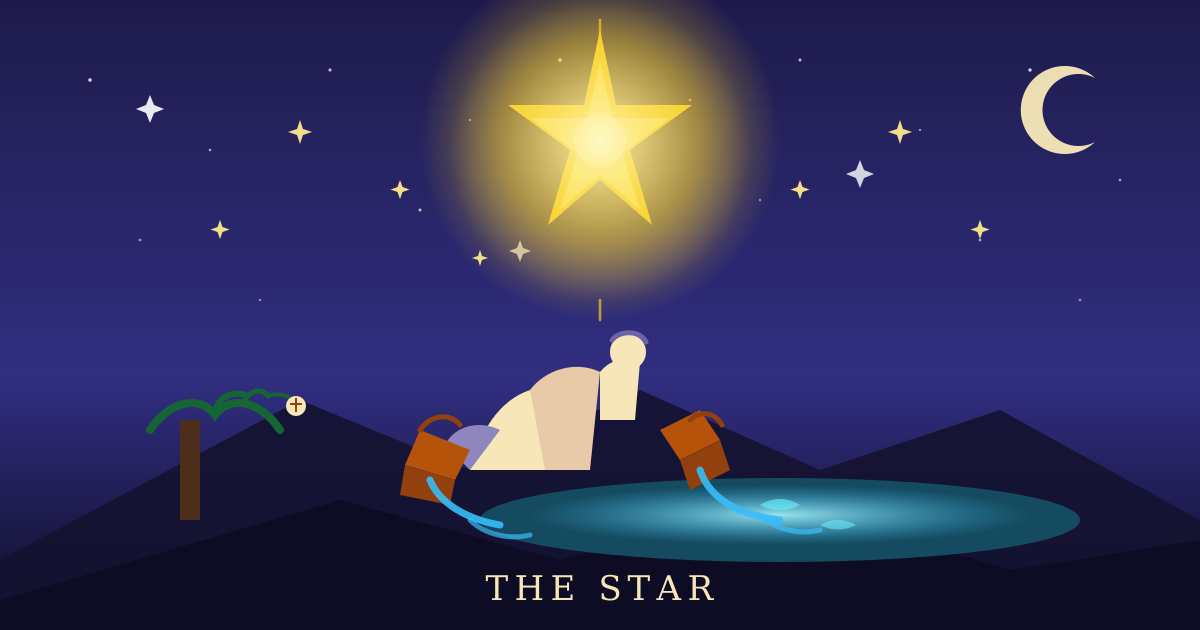
A figure kneels naked and unguarded beside a pool under a vast night sky, pouring water from two pitchers — one stream onto the land, one into the water. Above her burns a great eight-pointed star, ringed by seven smaller stars, and behind her a tree holds a single bird, singing. There is no armor here, no wall, no crown. The Star is the most vulnerable image in the deck, and that is exactly its power: after the Tower, there is nothing left to hide behind, and the card says you do not need anything left to hide behind.
The card's place in the deck is the whole story. The Star follows The Tower — and that is no accident. The Tower is the lightning, the collapse, the night everything false falls down. The Star is the first calm night after it, when the dust has settled and you can finally see the sky again. Readers sometimes wonder why the deck does not go straight from disaster to triumph. It does not, because that is not how healing works. Between the collapse and the rebuilding there is a still, starlit season: the season of pouring water, of tending what survived, of learning to breathe in the open air again. The Star is that season, given a name and a picture.
Notice what the figure is doing. She is not praying, not fighting, not waiting for rescue. She is pouring — steadily, with both hands, in two directions at once. One pitcher feeds the land, the world of work and body and daily life. The other feeds the pool, the world of dreams and feelings and the inner life. Healing, the card insists, is not a feeling that arrives one day. It is a practice: water poured, day after day, onto both halves of a life, until something green comes back. The nakedness is honesty — nothing to prove, nothing to perform, nothing left to pretend. The bird on the tree is the soul, singing again, quietly, for no audience at all.
The Star Upright: Hope, Healing, and the Return of Light
When The Star appears upright, it is the deck's gentlest good news — and its most honest. The card's first message is about timing: the worst is behind you. Not forgotten, not erased, not retroactively fine — behind you. The Tower already happened. The storm already passed. What remains is the long, unglamorous, beautiful work of recovery, and The Star says that work is already underway, even if you cannot feel it yet. Hope in this card is not a mood. It is a direction: the light is ahead, and you are walking toward it, even on the days you walk slowly.
The upright card's second message is about the pouring. The Star does not ask you to believe harder or to wait for a sign. It asks you to pour: water on the land and water in the pool, the outer life and the inner life, at the same time. Drink the water, take the walk, answer the message, write the page, sleep the full night — the small faithful acts are the whole ritual. People waiting for a grand turning point often miss the Star entirely, because the Star's turning point is quiet: the morning you wake up and realize the grief has loosened its grip by one notch. The morning the old song does not hurt the same way. The Star counts those mornings. It counts them as victories.
There is also a deeper upright meaning that readers cherish: The Star as inspiration returned. The card so often appears for artists, writers, and makers after a long dry season — the idea that finally comes back, the voice that finally returns, the project that finally feels alive again. Aquarius, the card's sign, is the water-bearer: the visionary who pours ideas out for everyone. The Star's inspiration is never private property. Like the figure's water, it is meant to be poured out — shared, given away, allowed to feed something larger than the person who found it. For entertainment and reflection: hope kept to yourself goes stale. Hope poured out multiplies.
The Star Reversed: When Hope Feels Far Away
Reversed, The Star describes hope gone dim — and the card is careful about the distinction. Dim is not out. Lost is not gone. The reversed Star is the card of the person who knows, intellectually, that things can get better, and cannot feel it in their chest. Faith has been shaken by a long hard season. Self-doubt is louder than self-trust. The healing that was supposed to be underway feels stalled, or worse, like it never started. The star is still there. Clouds are in the way.
The first reversed reading is the shaken faith: the disappointment that curdled into cynicism. The job that fell through, the relationship that ended, the prayer that seemed unanswered — and now every new hope feels naive, every optimistic thought feels like a setup for another fall. Reversed Star in this form warns against the armor of hopelessness: the belief that expecting nothing is safer than hoping. It is safer, in the short term. It is also a drought. Nothing grows in soil that is never watered, and the card's counsel is blunt: pour anyway. One small hope, watered daily, beats a grand certainty that never arrives.
The second reversed reading is the stalled healing: the recovery that is taking longer than the storybooks promised. The grief that is not linear. The creative block that outlasted the inspiration quotes. The card's counsel here is patience with a different shape — not passive waiting, but honest pacing. Healing that stalls is usually healing that is doing invisible work: roots growing underground, in the dark, where no one applauds. The reversed Star asks for one kept promise to yourself per day, not a transformation per week. A glass of water. A walk around the block. A page written badly. The clouds thin by inches, not by miles. For entertainment and reflection: a reversed Star is not a closed sky. It is a sky, waiting for weather to pass.
The Star in Love: The Healing After the Heartbreak
In love readings, The Star upright is one of the deck's kindest cards — it is the card of the heart learning to trust again.
For singles, The Star describes the season after the heartbreak, when the wound has closed enough for curiosity to return. Not the frantic search, not the bitter withdrawal — the quiet moment of noticing that a stranger's laugh does not hurt, that the future has a shape again, that you can imagine a hand in yours without flinching. The card favors the slow open: the date taken without an agenda, the friendship allowed to deepen at its own pace, the honesty about what you actually want now that the old story is over. If you have been telling yourself that love is finished for you, The Star suggests the story is not finished. It is only resting.
For couples, upright Star is the card of the relationship healing in the open — two people pouring water together after a hard chapter. It describes the apology that finally landed, the conversation that finally went somewhere new, the tenderness that returns after the storm like the bird returning to the tree. The card also names the shared hope: the couple that can talk about the future again, not as a fantasy but as a plan — the trip, the home, the project, the ordinary tomorrow, imagined together. For entertainment and reflection: love after the Tower is not love despite the damage. It is love that knows what the damage taught, and pours water on the garden anyway.
Reversed in love, the card describes hope dimming between two people or within one. The relationship where the future has stopped being discussed. The single person who has decided, quietly, that wanting love is the problem — and has mistaken that decision for wisdom. In dating, reversed Star often marks the refusal to heal in public: the wound nursed in private until it becomes an identity, the heart kept behind glass where nothing can touch it, including joy. The card's counsel is the same in every case: pour one small stream. One honest conversation. One evening out. One risk, sized to fit a human hand.
The Star in Career and Money: The Vision Returning
Career-wise, The Star upright is the card of the vision returning. The professional who, after a layoff, a failed venture, or a long season of burnout, feels the first spark of direction again — not the frantic hustle of before, but a calmer ambition, aimed at work that actually matters. If you are rebuilding a career from the Tower's rubble, the card's advice is the pouring: one skill learned, one connection renewed, one application sent, one honest conversation about what you want now. The Star's career path is built the way gardens are built — a little water, every day, in both directions: the outer work and the inner clarity.
The card also favors the creative and humanitarian callings of its sign: the work that pours something out for others — teaching, healing, art, community building, the project that helps strangers. In negotiations and big decisions, the card suggests the long view: choose the path that leaves you more hopeful in a year, not the one that merely looks impressive this week. Decisions made in Star-light are slower and truer; decisions made in Tower-panic are faster and regretted.
Money-wise, The Star is the card of the honest recovery: the budget rebuilt after the crisis, the debt faced without flinching, the savings started again from zero without shame. It favors the steady drip over the grand gesture — the small automatic transfer, the one subscription cancelled, the emergency fund built a dollar at a time. Reversed in career and money, the card warns of the dimmed vision's professional form: the worker who stopped believing the work could ever matter again, the founder who stopped pouring because the last venture dried up, or the saver who stopped saving because the goal felt too far away. For entertainment and reflection: the Star's money advice is the oldest in the book — water the garden you have, not the one you lost.
Symbols to Notice: Reading the Picture
The Star rewards a slow look. Here is what the details are saying:
- The great eight-pointed star: the card's heart — the star of hope, larger than all the rest, burning steady in the center of the sky. Eight points for regeneration, for the world remade after the fall. When the big star is all you see, the message is simple: look up. The light is still there.
- The seven smaller stars: the seven chakras, the seven planets of the old sky, the seven days of a week made whole again. They are the card's reminder that hope is not one big light but many small ones, and that a sky full of small lights is still a sky full of light.
- The two pitchers: the conscious and the unconscious, the outer life and the inner life, poured at the same time. One stream feeds the land you walk on; the other feeds the pool you dream in. Healing that pours only one way leaves half the garden dry.
- The pool: the unconscious, the deep water where dreams and feelings live. The water poured into it does not disappear — it joins the whole, it ripples outward, it returns. What you pour into your inner life eventually waters everything.
- The naked figure: honesty without armor. After the Tower there is nothing left to hide behind, and the card says that is a gift, not a wound. Vulnerability here is not weakness. It is the condition of real healing.
- The tree and the bird: growth and the soul, singing again. The tree is what survives the storm; the bird is the part of you that still knows how to sing after it. Together they are the card's quiet promise: life returns, and it returns singing.
- The five streams: the five senses, the five points of the human star — the body, brought back into the picture. The Star is not a card of escape from the body. It is a card of the body, watered and tended, coming back to life.
When this card appears in your reading, notice which detail your eye lands on first. Drawn to the great star? The question is about hope — what light is already burning, waiting to be looked at. To the pitchers? About balance — which stream, the land or the pool, have you been neglecting. To the pool? About the inner life — what dream or feeling needs pouring into. To the bird? About the soul's song — what part of you is ready to sing again, quietly, for no audience at all.
Try This: The Seven-Day Star Practice
The Star is a practice card, so here is a practice — one small daily act of pouring:
- Day one — the look up (five minutes): step outside after dark and find one star, or one bright thing in the sky. Stand under it and name one thing you still hope for, out loud. The Star begins with looking up.
- Day two — the two pitchers (ten minutes): write two short lists: one thing you will do today for your outer life, one thing for your inner life. A walk and a journal page. A bill paid and a feeling named. Pour both streams.
- Day three — the honest inventory (thirty minutes): list what survived the storm. Not what was lost — what remains. The friend, the skill, the roof, the heartbeat. This is the garden you are watering. Read it twice.
- Day four — the small hope (one act): do one small thing that assumes a future: plant something, book something, start something that will take a month. Hope is not a feeling you wait for. It is a seed you plant.
- Day five — the poured-out gift (one act): give something away — encouragement, help, attention, a word someone needs. The Star's water multiplies when it is poured out. Notice how giving changes the giver.
- Day six — the pool (twenty minutes): sit beside water, real or imagined — a bath, a river, a glass of water held in both hands — and let one feeling surface without fixing it. The pool does not need advice. It needs attention.
- Day seven — the bird's song (ten minutes): do one thing purely because it makes you sing, quietly, for no audience: the song, the sketch, the dance in the kitchen. The Star's final lesson is that joy is not a reward for healing. Joy is part of the healing.
After seven days you will have something the card always offers the patient: a garden, watered twice daily, with green shoots you can point to. The star never promised to fix the night. It promised that the night would end, and that the morning would find you pouring.
Combinations: The Star Meets Other Cards
The Star lends its quiet hope — or its warning about hope gone dim — to whatever it touches:
- Star + Tower: the full arc — the collapse and the calm after it, in one spread. If both appear, the reading is telling a story in order: the fall already happened, and the star already rose. Trust the sequence.
- Star + Moon: hope meeting the unconscious — dreams, intuition, and the shadows that still need naming. The Star lights the path; the Moon reminds you the path has depths. Walk it with both eyes open.
- Star + Hermit: the guided hope — solitude feeding the light. The lantern and the star, together, are the deck's gentlest pairing: the inner light and the outer light, agreeing.
- Star + Sun: hope fulfilled — the brightest pairing in the deck. The star's promise kept by the sun's joy. When these two meet, the reading is allowed to be simply good news.
- Star + Death: the healing after the ending — the rebirth that follows the real loss. The Star does not rush the grief. It pours water on the ground the ending cleared, and waits for green.
- Star + World: hope completed — the journey's end, under a friendly sky. The Star's promise, kept at last: the garden grown, the water poured, the song sung, the circle closed.
As always, these are starting points. Your own readings will teach you pairings no book lists — The Star rewards the reader who learns that the quietest hope at the table is usually the truest.
Closing: The Night Will End
Here is The Star's whole teaching in one image: a figure kneeling in the open, pouring water in two directions, beneath a sky full of stars.
The great star, the seven small ones, the pitchers, the pool, the naked honesty, the tree, the bird: the card is a portrait of hope as it actually looks — not a grand rescue but a steady pouring, done daily, in both directions, without armor and without applause. Every glass of water is the card working. Every small hope planted is the light growing steadier. Every morning the grief loosens by one notch is the night ending.
The Star does not ask you to be healed already, hopeful already, or finished. It asks you to kneel, briefly, on purpose — to pour water on the land and water in the pool, and to trust the slow work. The star never promised to fix the night. It promised that the night would end. And the light? The light was never somewhere else. It was above you all along, waiting for you to look up.
Frequently asked questions
Is The Star a yes or no tarot card?
The Star is one of the deck's clearest yes cards — especially when the question is about healing, hope, or a fresh start after a hard season. It does not promise a date or a guaranteed outcome; it says the conditions for a yes are forming, the light is returning, and the honest next step is worth taking. For entertainment and reflection: a Star yes is a yes with a watering can attached.
What does The Star reversed mean?
Reversed, The Star describes hope gone dim rather than hope gone: faith shaken by a long hard season, self-doubt louder than self-trust, or healing that feels stalled. The star has not gone out — clouds are in the way. The card's counsel is small and practical: one honest step, one kept promise to yourself, one night of real rest, and the light comes back into view. For entertainment and reflection only.
What zodiac sign is associated with The Star?
The Star is ruled by Aquarius, the fixed air sign of the water-bearer — the visionary, humanitarian sign that pours its ideas out for the collective. Aquarius gives the card its forward-looking hope and its faith in a better future, while the card teaches Aquarius its own lesson: hope must be poured, not just imagined. It is card seventeen (XVII) of the Major Arcana, following the Tower's collapse with the first calm night.
Why does The Star follow The Tower in the tarot?
Because after the lightning comes the quiet. The Tower tears down what was false; The Star is the first calm night after the collapse, when the dust settles and you can finally see the sky again. The deck's journey is honest about the order: destruction first, then the long stillness, then the star. Hope that arrives before the Tower is fantasy. Hope that arrives after it is earned.
What do The Star's two pitchers mean?
One pitcher pours water onto the land — the conscious, material life: work, body, daily choices. The other pours into the pool — the unconscious, the inner life: dreams, feelings, intuition. The figure pours both at once, and that is the teaching: healing is not choosing the inner life over the outer one, or the outer over the inner. It is tending both streams, at the same time, without holding either back.
Keep exploring
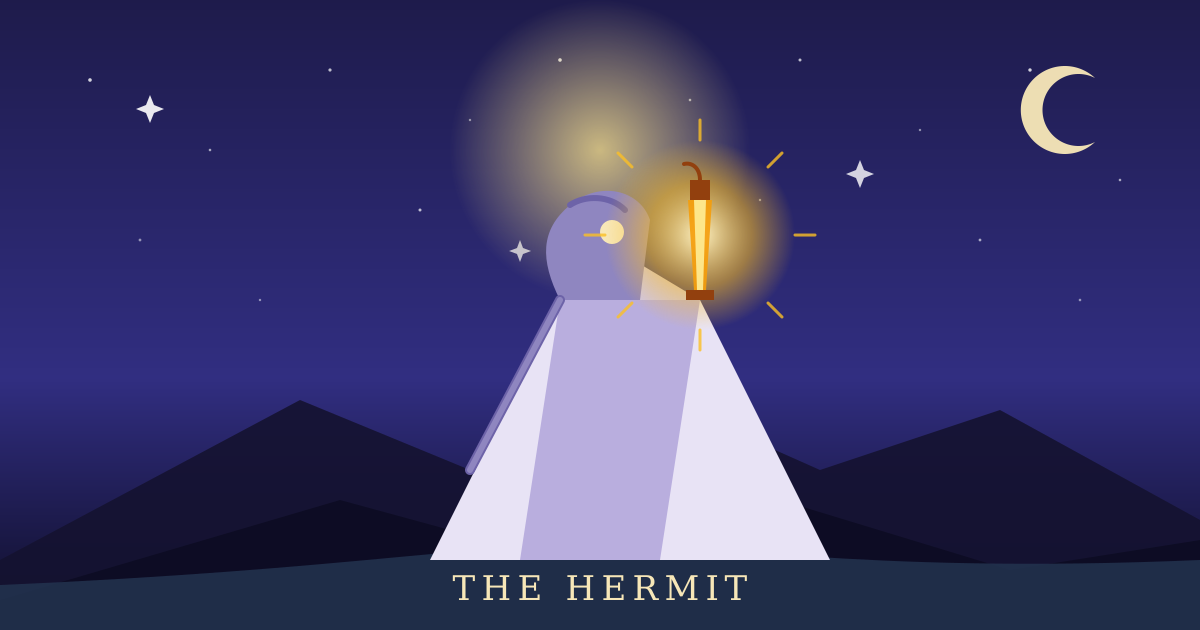
The Hermit Tarot Card Meaning: Solitude, Inner Light & Reversed
The Hermit tarot card meaning fully explained — upright & reversed symbolism, solitude, inner wisdom, love, career, card combinations, and a 7-day solitude practice.
Read the meaning →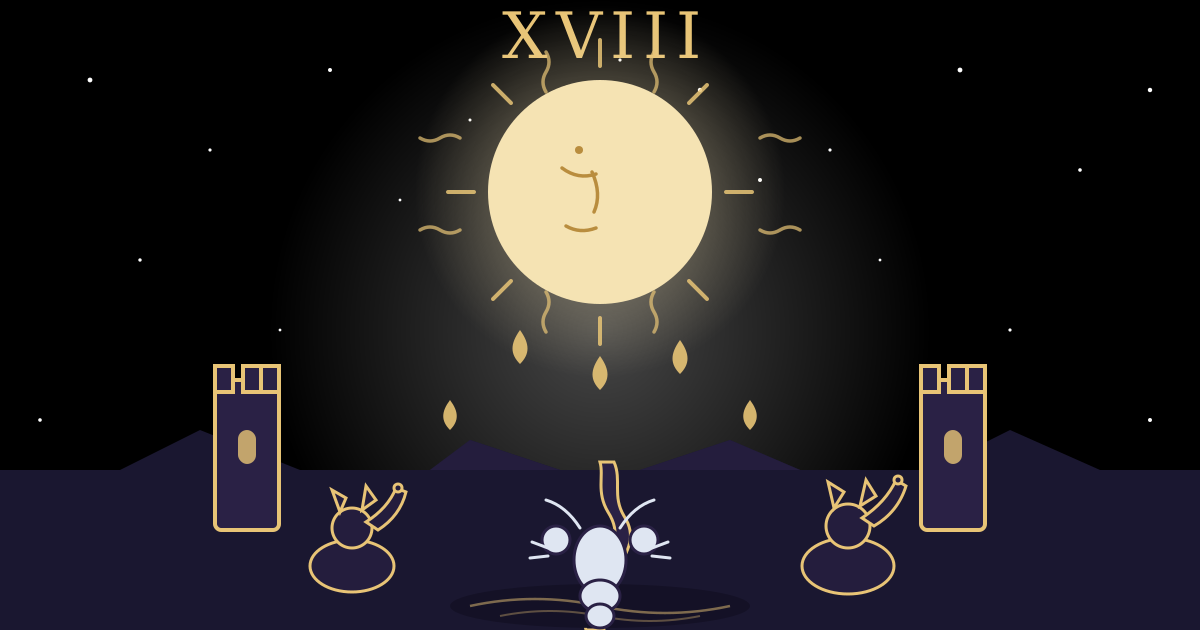
The Moon Tarot Card Meaning: Dreams, Illusions & Reversed
The Moon tarot card meaning fully explained — upright & reversed symbolism, dreams, intuition, confusion & illusions, love, career, card combinations, and a moonlit dream-journal practice.
Read the meaning →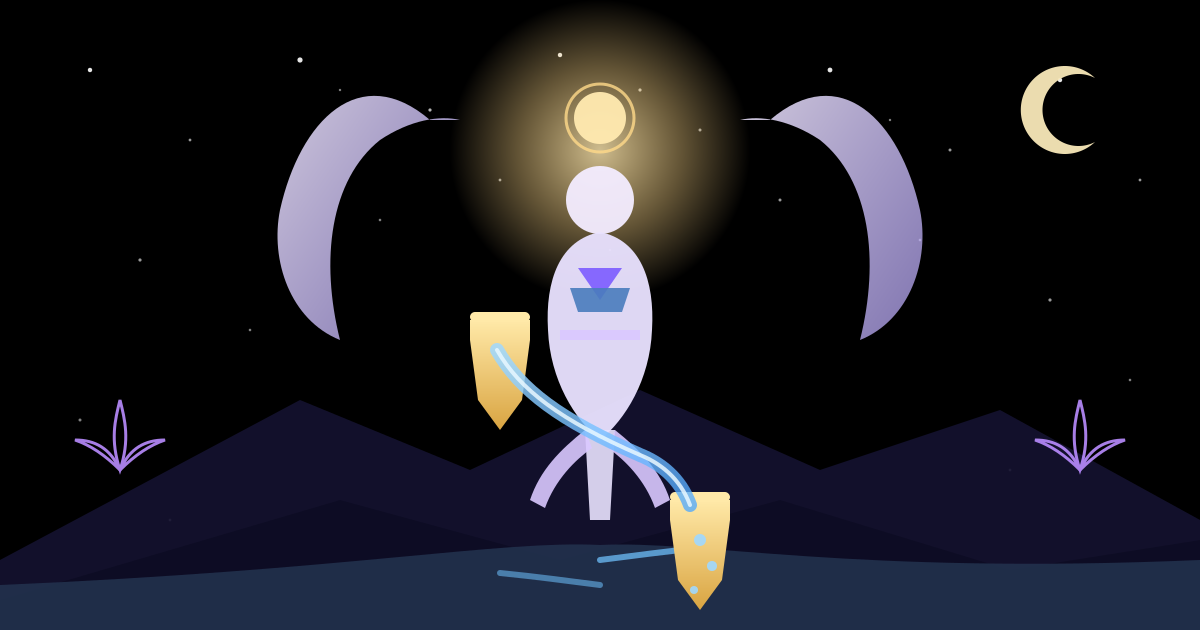
The Temperance Tarot Card Meaning: Balance, Patience & Reversed
The Temperance tarot card meaning fully explained — upright & reversed symbolism, balance, patience, alchemy, love, career, card combinations, and a 7-day blending practice.
Read the meaning →
The Strength Tarot Card Meaning: Courage, Patience & Reversed
The Strength tarot card meaning fully explained — upright & reversed symbolism, courage, patience, inner power, love, career, card combinations, and a 7-day soft-strength practice.
Read the meaning →