
The Sun Tarot Card Meaning: Joy, Vitality & Reversed
Meet The Sun: The Card of the Morning After
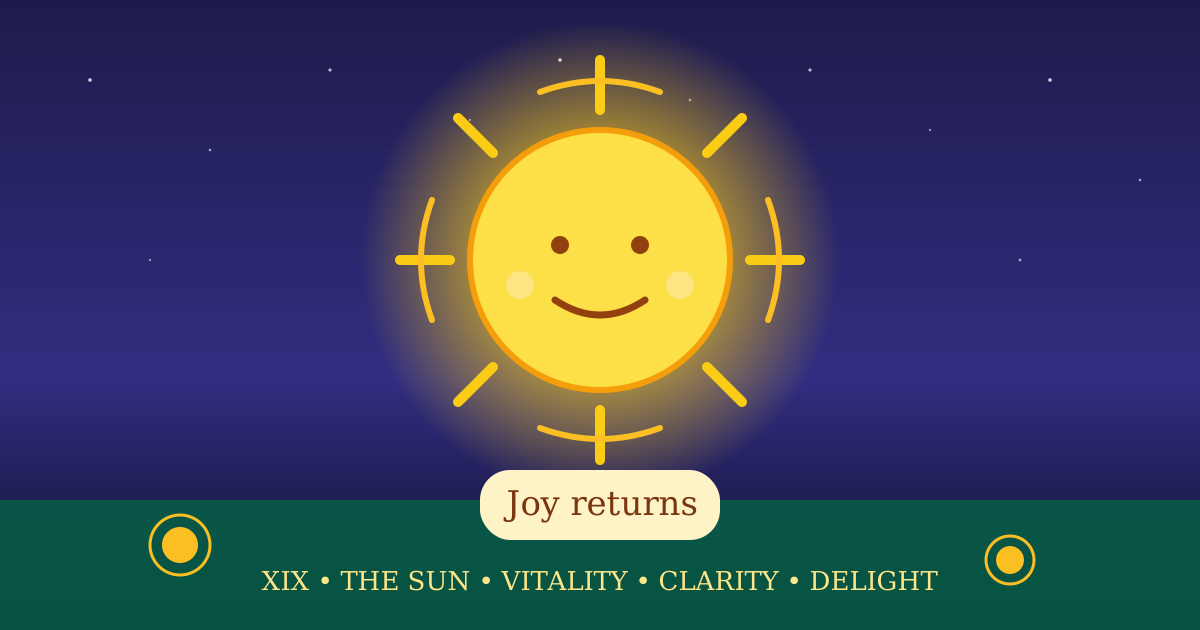
A great golden sun fills the sky, its face calm and smiling, its rays alternating straight and wavy like light and warmth made visible. Below it, a naked child rides a white horse in the open air, arms spread wide, a red banner streaming behind. Sunflowers grow along a low garden wall, tall and bright, turned toward the light. There is no shadow in this card. No hidden corner, no locked door, no figure lurking at the edge of the frame. The Sun is the most openly joyful image in the deck, and its message is as plain as its picture: after the night, there is a morning, and the morning is good.
The card's place in the deck is the whole story. The Sun follows The Moon — and that is no accident. The Moon is the card of the long night: dreams, illusions, fears that grow large in the dark, the path that winds between two towers while dogs bay at something you cannot quite see. The Sun is the dawn that ends that walk. The same landscape, seen in daylight, turns out to be a garden. The fears of the night shrink to their true size. Readers sometimes ask why the deck does not skip the Moon and go straight to the Sun. It does not, because that is not how clarity works. The joy that comes after confusion is different from the joy that never met confusion at all. It is deeper, because it has been tested. It knows what the dark looks like, and it chooses the light anyway.
Notice what the child is doing. The child rides without a saddle, without reins, without fear — and that is the card's teaching in miniature. The Sun's joy is not the joy of control. It is the joy of trust: the body relaxed, the arms open, the horse carrying you because you have stopped clutching at it. The nakedness is not vulnerability this time, as it was in The Star. It is freedom — nothing to hide, nothing to prove, nothing to perform. The red banner is life force itself, streaming behind the rider like a flag. The sunflowers are the card's quietest wisdom: they do not chase the sun. They simply turn toward it, and grow.
The Sun Upright: Joy, Vitality, and Things Seen Clearly
When The Sun appears upright, it is the deck's simplest good news — and its most complete. The card's first message is about clarity: whatever was confused is now plain. The Moon's illusions have burned off like morning mist, and the situation can finally be seen for what it is. This is not the cold clarity of a verdict. It is the warm clarity of daylight: the conversation where everyone finally says what they mean, the diagnosis that finally has a name, the project whose next step is suddenly obvious. The Sun does not complicate. It illuminates, and illumination turns out to be most of the solution.
The upright card's second message is about vitality: energy returning to the body and the life. The Sun so often appears after illness, exhaustion, or a long season of running on empty — and it describes the morning the appetite comes back, the walk feels good again, the work feels possible again. This is not manic energy or forced positivity. It is the natural energy of a living thing in its proper light, the way a plant perks up when it is finally moved to the window. People waiting for a dramatic transformation often miss the Sun entirely, because the Sun's transformation is ordinary and glorious at once: the good night's sleep, the meal eaten with pleasure, the afternoon spent doing something simply because it delights you. The Sun counts those afternoons. It counts them as the whole point.
There is also a deeper upright meaning that readers cherish: The Sun as success in the open. The card favors the achievement that can stand in daylight — the work published, the relationship made public, the talent finally shown to other people without apology. Leo, the card's sign, is the sign of wholehearted self-expression, and the Sun's success is never a secret hoarded in a drawer. Like the child's banner, it streams behind you for everyone to see. For entertainment and reflection: joy kept hidden goes dim. Joy shared in daylight grows brighter.
The Sun Reversed: When the Light Feels Far Away
Reversed, The Sun describes joy delayed — and the card is careful about the distinction. Delayed is not denied. Cloudy is not dark. The reversed Sun is the card of the person who knows, intellectually, that good things exist, and cannot quite feel their warmth. The light is still there. Something is standing in front of it: exhaustion, self-doubt, a lingering shadow from the Moon that has not finished clearing, or simply a season that is grayer than the storybooks promised.
The first reversed reading is the dimmed delight: the pleasure that used to come easily and now requires effort. The hobby that feels flat, the celebration that feels like a chore, the good news that lands without the lift it should have carried. Reversed Sun in this form warns against the conclusion that joy has left for good. It has not left. It is behind a cloud, and clouds move. The card's counsel is blunt and gentle at once: do not chase a grand happiness. Let one small pleasure back in — the song, the walk, the meal cooked slowly — and let the small pleasure do its quiet work.
The second reversed reading is the hidden success: the achievement that is real but not yet visible, or the success that is being kept small out of fear. The promotion not yet announced, the work not yet shown, the happiness not yet admitted because admitting it feels like tempting fate. The card's counsel here is courage of a particular kind — not the courage to fight, but the courage to be seen enjoying something. Step into the light in one small way: tell one person the good news, show one person the work, take one afternoon off without guilt. For entertainment and reflection: a reversed Sun is not a dark sky. It is a sky with weather, and weather passes.
The Sun in Love: The Relationship in Daylight
In love readings, The Sun upright is one of the deck's happiest cards — it is the card of the relationship that can stand in daylight.
For singles, The Sun describes the season when attraction is simple again: no games, no decoding, no wondering what the other person meant. The card favors the open heart — the date where you laugh without calculating the laugh, the person who likes you plainly and says so, the rediscovery that you are, in fact, delightful company. If you have been telling yourself that love must be complicated to be real, The Sun suggests the opposite. The real thing, this card says, feels like morning: warm, clear, and easy to see by.
For couples, upright Sun is the card of the relationship enjoying itself in public — the partnership that laughs together, that travels well, that can be itself in front of other people without a performance. It describes the shared joy: the holiday, the project finished together, the ordinary evening that turns golden for no special reason. The card also names the warmth between two people that has survived its Moon season: the couple that walked through confusion or distance and came out the other side able to see each other clearly again. For entertainment and reflection: love in sunlight is not love without shadows. It is love that has learned the shadows are not the whole story.
Reversed in love, the card describes joy dimming between two people or within one. The relationship where the fun has gone quiet, where every date feels like an obligation, where the future is discussed but never delighted in. The single person who has decided, quietly, that happiness is something other people get — and has mistaken that decision for realism. In dating, reversed Sun often marks the refusal to be seen happy: the guardedness that keeps every new connection at arm's length, the heart kept indoors where nothing can disappoint it, including joy. The card's counsel is the same in every case: one small daylight act. One honest laugh. One afternoon in the open.
The Sun in Career and Money: Success You Can See
Career-wise, The Sun upright is the card of visible success. The professional who, after a long Moon season of uncertainty, finally gets the clear win: the promotion, the launch that lands, the work recognized by people whose opinion matters. If you are building something from the Moon's confusion, the card's advice is the daylight: show the work, name the achievement, let the results speak in the open. The Sun's career path is built the way gardens are built — in sunlight, steadily, with the results visible to anyone walking past.
The card also favors the creative and public callings of its sign: the work that shines in front of an audience — performance, teaching, leadership, the project that puts your name on it. In negotiations and big decisions, the card suggests the transparent path: choose the option you would be happy to explain in daylight, not the one that only works in the dark. Decisions made in Sun-light are cleaner and longer-lasting; decisions made in Moon-shadow tend to unravel at dawn.
Money-wise, The Sun is the card of the honest abundance: the budget that finally balances, the debt faced and shrinking, the income growing because the work is good and people can see it is good. It favors the generous use of money over the fearful hoard — the investment in the thing that grows, the gift given freely, the savings built without panic. Reversed in career and money, the card warns of the dimmed light's professional form: the worker whose success is real but unacknowledged, the founder whose launch is good but under-celebrated, or the saver who cannot enjoy the security already built because the goal keeps moving. For entertainment and reflection: the Sun's money advice is the oldest in the book — let the garden be seen, and let the harvest be enjoyed.
Symbols to Notice: Reading the Picture
The Sun rewards a slow look. Here is what the details are saying:
- The smiling sun face: the card's heart — consciousness itself, awake and benevolent, looking directly at you without flinching. When the face is all you see, the message is simple: the light is not distant. It is looking at you, and it is glad.
- The straight and wavy rays: light and heat, clarity and warmth, alternating around the face. The card insists that truth and kindness travel together: the straight rays show you what is real, the wavy rays make it bearable to look at.
- The naked child: innocence regained — the self before it learned to be guarded, riding without fear. The child is not naive. The child has already walked through the Moon and come out the other side, still willing to be open.
- The white horse: purity and strength in service of joy. The horse carries the child without saddle or rein, because the Sun's power does not need to be gripped to be trusted. Strength that carries joy is the card's definition of real power.
- The red banner: life force, streaming behind the rider. Red is the color of blood and vitality, and the banner says the Sun's joy is not a mood. It is a living force, moving, visible, impossible to fold away.
- The sunflowers: the card's quietest wisdom — the flowers that turn toward the light without chasing it. They are the garden's answer to the question of how to grow: face the sun, and let the growing take care of itself.
- The garden wall: the boundary that protects without imprisoning. The Sun's joy is not wild and unbounded. It is a garden: tended, walled, safe enough for a child to ride in without fear.
When this card appears in your reading, notice which detail your eye lands on first. Drawn to the face? The question is about clarity — what truth is already shining, waiting to be looked at. To the child? About innocence — what part of you is ready to be open again. To the horse? About strength — what power in your life is ready to carry joy instead of conquering. To the sunflowers? About growth — what in your life is already turning toward the light, quietly, without your permission.
Try This: The Seven-Day Sunlight Practice
The Sun is a daylight card, so here is a daylight practice — one small act of stepping into the light per day:
- Day one — the morning light (ten minutes): step into real sunlight before noon, even through a window, and name one thing you are glad is true. The Sun begins with looking up and letting the light land.
- Day two — the clear sentence (one act): say one thing plainly that you have been circling: the feeling, the ask, the truth. Write it, speak it, send it. Daylight starts with one clear sentence.
- Day three — the body in the sun (thirty minutes): move your body outdoors — a walk, a stretch, a swim, a garden task. The Sun is a card of the body, and the body remembers joy faster than the mind does.
- Day four — the small delight (one act): do one thing purely because it delights you, without justifying it: the song, the meal, the silly purchase, the afternoon off. The Sun's final lesson is that delight needs no defense.
- Day five — the shared light (one act): tell one person a piece of good news, or show one person something you made. The Sun's joy multiplies when it is shared. Notice how telling changes the teller.
- Day six — the sunflower turn (twenty minutes): list what in your life is already growing toward the light — the friendship, the skill, the project, the habit — and give it one hour of attention. Face the sun, and let the growing take care of itself.
- Day seven — the garden wall (ten minutes): name one boundary that protects your joy without imprisoning it: the hour kept free, the person kept close, the habit kept sacred. The Sun's garden is walled for a reason — joy needs a safe place to ride.
After seven days you will have something the card always offers the patient: a garden, sunlit and walled, with flowers turned toward the light and a child riding through it without fear. The Sun never promised a life without nights. It promised that mornings keep coming, and that the morning is good.
Combinations: The Sun Meets Other Cards
The Sun lends its bright clarity — or its warning about light delayed — to whatever it touches:
- Sun + Moon: the full arc — the night and the dawn, in one spread. If both appear, the reading is telling a story in order: the confusion already happened, and the clarity already rose. Trust the sequence.
- Sun + Star: hope fulfilled — the brightest pairing in the deck. The star's promise kept by the sun's joy. When these two meet, the reading is allowed to be simply good news.
- Sun + World: joy completed — the journey's end, under a friendly sky. The Sun's delight, kept at last: the garden grown, the banner streaming, the circle closed in daylight.
- Sun + Fool: the joyful leap — innocence and daylight together, the new beginning taken with arms open. The Fool's first step, lit by the Sun, is the deck's bravest picture of trust.
- Sun + Lovers: love in daylight — the relationship seen clearly and chosen freely. The Lovers' choice, made in sunlight, is the deck's warmest picture of two people seeing each other truly.
- Sun + Tower: the rebuilding after the fall — the garden replanted on the ground the lightning cleared. The Sun does not deny the Tower. It plants sunflowers in the rubble, and waits for morning.
As always, these are starting points. Your own readings will teach you pairings no book lists — The Sun rewards the reader who learns that the brightest joy at the table is usually the simplest.
Closing: The Morning Is Good
Here is The Sun's whole teaching in one image: a child riding a white horse in the open, beneath a smiling sun, past a wall of sunflowers.
The face, the rays, the child, the horse, the banner, the flowers, the wall: the card is a portrait of joy as it actually looks — not a grand triumph but a morning, lived in the open, without armor and without apology. Every clear sentence is the card working. Every small delight is the light growing steadier. Every afternoon spent simply because it delights you is the morning proving itself good.
The Sun does not ask you to be joyful already, successful already, or finished. It asks you to step outside, briefly, on purpose — to let the light land, to ride without gripping the reins, and to trust the slow work of turning toward it. The Sun never promised a life without nights. It promised that mornings keep coming. And the morning? The morning is good.
Frequently asked questions
Is The Sun a yes or no tarot card?
The Sun is the deck's brightest yes card — a clear, warm yes to questions about joy, growth, new beginnings, and anything that needs light to thrive. It does not guarantee a specific outcome or date; it says the conditions are sunny, the path is clear, and the honest answer leans strongly toward yes. For entertainment and reflection: a Sun yes is a yes you can say out loud, in daylight.
What does The Sun reversed mean?
Reversed, The Sun describes joy delayed rather than joy denied: a cloudy day, not a dark night. The light is still there, but something — exhaustion, self-doubt, a lingering shadow from the Moon — is standing in front of it. The card's counsel is gentle and practical: rest, simplify, let one small pleasure back in, and the clouds thin. For entertainment and reflection only.
What zodiac sign is associated with The Sun?
The Sun is ruled by Leo, the fixed fire sign of warmth, courage, and wholehearted self-expression. Leo gives the card its radiance and its delight in being seen, while the card teaches Leo its own lesson: true radiance is generous — it warms everyone in the room, not just the one who shines. It is card nineteen (XIX) of the Major Arcana, following the Moon's night with the first clear morning.
Why does The Sun follow The Moon in the tarot?
Because dawn follows the darkest hour. The Moon is the card of dreams, illusions, and the fears that grow in the dark; The Sun is the morning after, when the same landscape is suddenly plain to see. The deck's journey is honest about the order: first the night of confusion, then the clarity that only comes after you have walked through it. Joy that arrives after the Moon is not naive. It is tested.
What do the child and the horse mean in The Sun?
The naked child is innocence regained — the self before it learned to be guarded, riding without fear or saddle. The white horse is purity and strength in service of that innocence: power that carries joy rather than conquering. Together they say that the Sun's joy is not reckless and not naive — it is strength and innocence riding in the same direction, in the open, in daylight.
Keep exploring
The Star Tarot Card Meaning: Hope, Healing & Reversed
The Star tarot card meaning fully explained — upright & reversed symbolism, solitude, inner wisdom, love, career, card combinations, and a 7-day hope practice.
Read the meaning →
The Moon Tarot Card Meaning: Dreams, Illusions & Reversed
The Moon tarot card meaning fully explained — upright & reversed symbolism, dreams, intuition, confusion & illusions, love, career, card combinations, and a moonlit dream-journal practice.
Read the meaning →
The Temperance Tarot Card Meaning: Balance, Patience & Reversed
The Temperance tarot card meaning fully explained — upright & reversed symbolism, balance, patience, alchemy, love, career, card combinations, and a 7-day blending practice.
Read the meaning →
The Strength Tarot Card Meaning: Courage, Patience & Reversed
The Strength tarot card meaning fully explained — upright & reversed symbolism, courage, patience, inner power, love, career, card combinations, and a 7-day soft-strength practice.
Read the meaning →