
The Wheel of Fortune Tarot Card Meaning: Cycles, Luck & Reversed
Meet the Wheel: The Card That Never Stops Turning
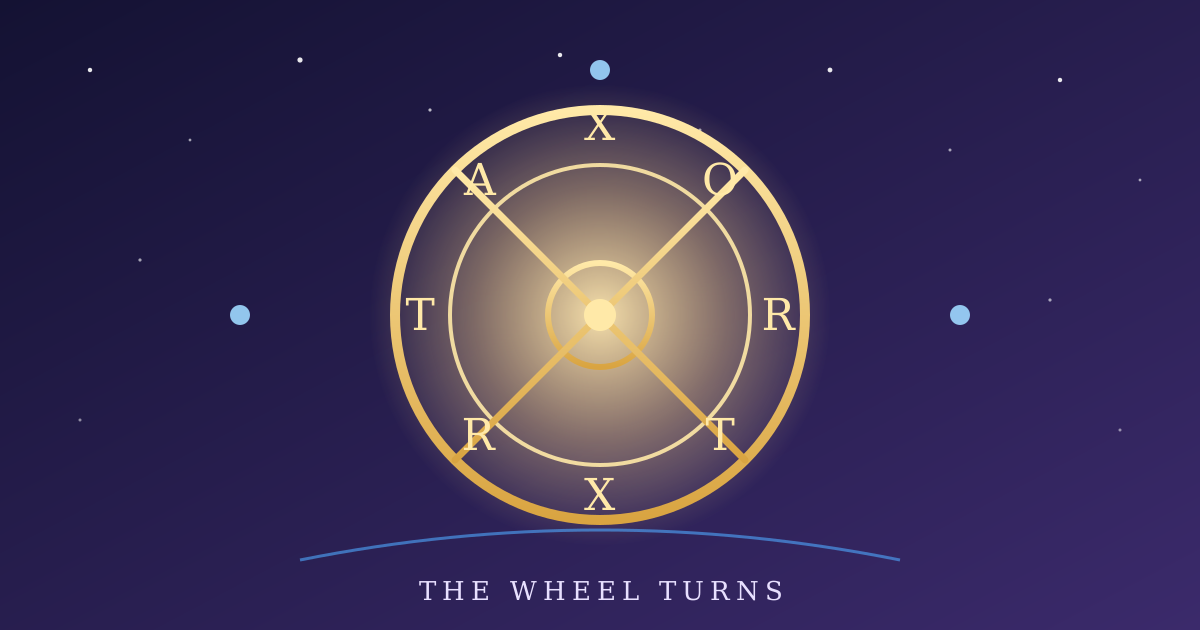
At the center of the card spins a great wheel, ringed with strange letters and symbols — TARO, ROTA, the Hebrew letters of the divine name, the signs of alchemy. On top of the wheel sits a sphinx, sword in hand, perfectly still while everything beneath it moves. Down one side descends a serpent; up the other climbs a dog-headed figure, rising as the serpent falls. In the four corners, beyond the wheel's reach, four winged creatures sit calmly reading books: an angel, an eagle, a lion, and a bull. Above it all, the sky is crowded with clouds and stars, as if heaven itself is watching the spin.
This is the Wheel of Fortune, card ten of the Major Arcana — and it is the only card in the deck that is honest about how life actually works. Every other card pretends, for a moment, that a state is permanent: the Emperor's order, the Lovers' choice, the Hermit's solitude. The Wheel refuses the pretense. It says: everything turns. The promotion and the layoff, the wedding and the breakup, the lucky streak and the dry spell — all of them are positions on the same wheel, and the wheel does not ask permission before it moves. The sphinx on top is the card's secret: the only stable seat is the center, the place that watches the turning without being thrown by it.
Notice what the wheel is not. It is not a slot machine. The old fortune-tellers who named this card knew the difference between luck and fate, and the card holds both at once. Some turns are genuinely outside your control — the market shifts, the letter arrives, the stranger walks in. But the card also insists that your position on the wheel is partly yours: the serpent descends because it clings, the dog-figure ascends because it climbs, and the four creatures in the corners stay calm because they learned to read the book of cycles instead of riding every revolution. For entertainment and reflection: the Wheel does not promise that you will win. It promises that the game will change — and that change is your opening.
The Wheel Upright: The Season Turns in Your Favor
When the Wheel appears upright, the season is changing — and the change is, on balance, good news. This is the card of the favorable turn: the job offer after months of silence, the relationship that suddenly deepens, the project that finds its audience, the door you stopped knocking on swinging open on its own. Upright, the Wheel often arrives just after a long flat stretch, and its first message is simple: the flat stretch was a phase, not a verdict. Wheels turn. That is what they do.
The upright card's second message is about timing, and it is the one most readers miss. The Wheel does not reward the person who pushes hardest; it rewards the person who is positioned when the turn comes. The surfer does not make the wave — she paddles into position and stands up at the right second. So the card's practical counsel is about readiness: keep the resume updated, keep the savings buffer, keep the skill warm, keep the door unlocked. When the wheel reaches the top for you, the opportunity will not wait while you get ready. Readers call this the luck of the prepared, and it is the most honest definition of good fortune the tarot offers.
There is a third upright meaning, quieter and more important: the invitation to trust cycles. If you are at the top of the wheel right now — the good run, the golden stretch — the card asks you to enjoy it without clutching it. Bank some of the harvest, be generous with the surplus, and remember the bottom, because humility at the top is what keeps the next turn from being a fall. If you are climbing — and most of us, most of the time, are climbing — the card says to notice the ascent. The small improvements, the returning energy, the doors cracking open: these are the wheel moving, even before the big turn arrives. For entertainment and reflection: the Wheel upright is not a promise that everything will be easy. It is the news that the season has changed, and that the change favors the ready.
The Wheel Reversed: When the Turn Stalls
Reversed, the Wheel describes a turn that will not come, or a turn that keeps coming back to the same place — and like many reversed cards, it splits into two readings worth telling apart.
The first is the stalled wheel: bad timing that feels personal. The launch that keeps missing its window. The move delayed by one thing after another. The relationship stuck in the same argument for the third year. Reversed, the card often marks a season where effort seems to produce nothing — not because the effort is wrong, but because the wheel is at the bottom of its arc, where every push feels like pushing uphill. The counsel here is patience with a deadline: keep the readiness, but stop forcing the turn. Some wheels cannot be pushed; they can only be waited for, and the waiting is itself the work.
The second reversed reading is the repeating loop: the same turn, the same lesson, the same outcome, again. The same kind of partner, the same kind of job, the same kind of crisis, wearing different clothes. Where the stalled wheel is about timing, the loop is about pattern — and patterns, unlike timing, are yours to break. The card's question for the loop is blunt: what choice are you making, over and over, that keeps putting you back at the same point on the wheel? The answer is rarely comfortable, and it is almost always the way out. For entertainment and reflection: a reversed Wheel is not a curse. It is either a season to endure or a pattern to break — and knowing which one changes everything.
The Wheel in Love: Turning Points of the Heart
In love readings, the Wheel upright is the card of the turning point — the moment a relationship changes its season.
For singles, the Wheel upright often marks a change of romantic weather: a dry spell breaking, a new kind of person appearing, or an old pattern finally losing its grip. It favors the unexpected meeting — the friend of a friend, the chance conversation, the person who arrives when you stopped auditioning strangers. The card's advice is to say yes to the turn: go to the gathering, answer the message, take the trip. The wheel is offering a new position; the only wrong move is staying seated out of habit.
For couples, upright the Wheel describes a relationship entering a new cycle — and cycles, in love, are usually good news. The couple that survives the first hard year enters a deeper one. The long-distance stretch ends. The routine that went stale gets a new chapter: a shared project, a move, a recommitment. The card also names the honest truth of long love: it has seasons, and the winter of a relationship is not its death. Couples who understand the wheel stop panicking at every downturn and start tending the turn instead.
Reversed in love, the card describes the loop: the same argument, the same breakup-and-return, the same unavailable person in a new face. In dating, reversed Wheel often marks the pattern of choosing the familiar wound over the unfamiliar health — the wheel spinning, but always landing on the same number. In a partnership, it can mark a turn resisted: the conversation that needs having, the change that needs making, postponed until the wheel forces it. The card's counsel is the same in every case: name the pattern out loud. A loop named is a loop half-broken. For entertainment and reflection: love, like everything else, turns. The question is never whether it will change, but whether you will turn with it or be turned by it.
The Wheel in Career and Money: Riding the Cycle
Career-wise, the Wheel upright is the card of the well-timed move. The industry shifts and your skill is suddenly the one everyone needs. The reorganization opens the role you wanted. The side project finds its moment. If you have been waiting for a sign to act, the upright Wheel is the closest thing the tarot gives to a green light — with one condition: act on the turn, not on the fantasy of the turn. The wheel favors the application sent, the pitch made, the negotiation opened. It does not favor the lottery ticket.
The card also teaches the economics of cycles. Every career has seasons — the building years, the harvest years, the fallow years — and the professionals who last are the ones who plan for all three. In a harvest season, the Wheel's counsel is to save, to diversify, to build the buffer that will carry the next fallow stretch. In a fallow season, its counsel is to learn: the skill acquired at the bottom of the wheel is the one that pays at the top. The wheel punishes only one strategy, and it punishes it reliably: spending the harvest as if harvests were permanent.
Money-wise, the Wheel upright favors the turning of financial fortune: a debt cleared, an income stream starting, an investment maturing, a windfall handled wisely. It also warns, gently, that windfalls are turns, not transformations — the money that arrives by luck leaves by habit unless the habit changes with it. Reversed in career and money, the card warns of the stalled turn — the promotion that keeps slipping a quarter, the market that will not cooperate — or the repeating loop of the same financial mistake. Either way, the counsel is to separate what you control from what you do not, and to work only on the first list. For entertainment and reflection: the market, like the wheel, does not care about your schedule. It cares about your position when it turns.
Symbols to Notice: Reading the Picture
The Wheel rewards a slow look. Here is what the details are saying:
- The wheel itself: the cycle of life — fortune, fate, karma, the turning year. Its rim carries the letters TARO and ROTA, which read the same forward and backward: the wheel's message does not change no matter which way you read it. Everything turns.
- The sphinx on top: the still center — wisdom, balance, the part of you that watches the turning without being thrown. The sphinx holds a sword: discernment. The goal is not to stop the wheel but to sit at its hub, where the spin is gentlest.
- The descending serpent: the figure sliding down the wheel's side — the force of decline, the old Typhon of tradition. It is not evil; it is the necessary descent. What goes down makes room for what comes up.
- The ascending dog-headed figure: Anubis, climbing the wheel's other side — the force of ascent, the guide of souls through change. Where the serpent falls, Anubis rises: every descent has its counterpart, and the wheel never moves in only one direction.
- The four winged creatures: angel, eagle, lion, and bull — the fixed signs Aquarius, Scorpio, Leo, and Taurus, each reading a book. They sit outside the wheel, calm amid the spin: the wisdom that studies cycles instead of being spun by them. When you feel dizzy, be the creature with the book.
- The Hebrew letters and alchemical signs: Yod, He, Vau, He — the divine name — written around the rim, with symbols for mercury, sulfur, water, and salt between them. The message: the turning is not random. It has a pattern, a chemistry, a name — even when you cannot read it yet.
- The clouds and the sky: the wheel turns under heaven, not under your management. Some of the turning belongs to forces larger than you. The card's humility is also its comfort: not every turn is your fault, and not every turn is your job to fix.
When this card appears in your reading, notice which detail your eye lands on first. Drawn to the wheel? The question is about the cycle itself — where are you on it, and which way is it moving? To the sphinx? About the center — the calm you need to find while everything spins. To the serpent? About what is descending — the thing to release before it drags you with it. To Anubis? About what is rising — the ascent to prepare for. To the four creatures? About the book — the pattern you need to study before you act. To the clouds? About surrender — the turn that is not yours to control.
Try This: The Seven-Day Turning-Point Practice
The Wheel is a practice card, so here is a practice — one small daily act of working with cycles instead of against them:
- Day one — the position (ten minutes): name where you are on the wheel in one area of life: rising, at the top, descending, or at the bottom. Write it down without arguing with it. The sphinx does not argue with the wheel; it sits and sees.
- Day two — the pattern (fifteen minutes): list three times a similar turn has happened in your life — the same kind of opportunity, crisis, or relationship. What repeats? The pattern is the book the four creatures are reading. Read yours.
- Day three — the readiness (one hour): do one thing that positions you for the next turn: update the resume, make the call, fix the budget, learn the skill. The wheel rewards the ready. This hour is your paddle into position.
- Day four — the release (fifteen minutes): name one thing that is descending and let it descend. Cancel the subscription, close the chapter, forgive the debt you keep collecting in your head. Descents are not failures; they are the wheel making room.
- Day five — the small turn (as long as it takes): make one small change you have been postponing — the rearranged room, the new route, the honest sentence. Small turns teach the wheel your direction. Big turns follow small ones.
- Day six — the gratitude at the top (thirty minutes): if anything is going well, bank some of it: save a little, thank someone, write down what is working. If nothing is going well, write down one thing that is not going badly. Harvests, even small ones, are for storing.
- Day seven — the center (fifteen minutes): sit quietly and imagine yourself at the hub of the wheel, not on the rim. The rim spins; the hub watches. Ask: what would I do if I were not afraid of the turn? Write the answer down. That is the sphinx speaking.
After seven days you will have something the card always offers the honest: your position, your pattern, and your readiness, in your own handwriting. The wheel will keep turning. That was never the problem. The question was always whether you would ride it or be ridden by it.
Combinations: The Wheel Meets Other Cards
The Wheel lends its turning — or its warning about stalled cycles — to whatever it touches:
- Wheel + Fool: the great leap at the turning point — a new cycle beginning with a beginner's courage. The wheel turns and the Fool jumps. This is the start of a whole new revolution.
- Wheel + Death: the double turn — an ending and a cycle-change at once. The old wheel stops; a new one starts. Do not try to repair what the turn has already replaced.
- Wheel + Tower: the sudden turn — the change that arrives as lightning rather than season. The wheel does not always turn slowly. Sometimes it jerks. Hold the hub.
- Wheel + Star: the blessed turn — fortune turning toward hope. After the hard cycle, the sky clears. One of the deck's most reassuring pairings for a fresh start.
- Wheel + Devil: the stuck turn — the loop that will not break, the habit that keeps the wheel spinning in place. The turn exists; the chain is what stops it. Name the chain.
- Wheel + Temperance: the tempered turn — change handled with patience and measure. The wheel turns, and the angel pours steadily through the spin. Change without panic.
As always, these are starting points. Your own readings will teach you pairings no book lists — the Wheel rewards the reader who learns that every turn, even the frightening one, is the wheel doing its only job.
Closing: The Wheel Keeps Turning
Here is the Wheel's whole teaching in one image: a great wheel, turning under a crowded sky, with a sphinx sitting still at its top.
The wheel, the sphinx, the serpent, Anubis, the four creatures with their books, the letters on the rim, the clouds: the card is a portrait of life as it actually moves — not in straight lines but in revolutions. Every rise prepares a fall, and every fall prepares a rise, and the wise person is not the one who stops the wheel but the one who learns to sit near its center, read the pattern, and be ready when the turn comes.
The Wheel does not ask you to be lucky, fearless, or finished. It asks you to be positioned — to know where you are on the turn, to break the loops that keep you spinning in place, and to trust that the season will change. It always has. It always will. And the turn that is coming may be the one you have been waiting for all along.
Frequently asked questions
Is the Wheel of Fortune a yes or no tarot card?
The Wheel of Fortune is a yes — but a conditional one. It favors the question when the cycle is turning in your direction and you are willing to move with it rather than cling to the old position. It often means the outcome depends on timing: yes, when the wheel reaches the top. For entertainment and reflection: the yes arrives with the turn, not before it.
What does the Wheel of Fortune reversed mean?
Reversed, the Wheel describes a turn that stalls or repeats: bad timing, a cycle you keep reliving, or change resisted until it forces itself. It can also mark a run of poor luck that feels personal but is really cyclical — what is down will rise again, though rarely on the schedule you demanded. The work is to tell a stalled season (wait, stay ready) from a repeating loop (name the pattern, break it). For entertainment and reflection only.
What zodiac sign is associated with the Wheel of Fortune?
The Wheel of Fortune is ruled by Jupiter, the planet of expansion and good fortune, and is traditionally linked to Sagittarius. Jupiter gives the card its sense of big, generous turns — the lucky break, the widening horizon, the door that opens wider than expected. It is card ten (X) of the Major Arcana, following the Hermit and preceding Justice.
What do the creatures around the wheel represent?
The four winged creatures in the corners — angel, eagle, lion, and bull — are the fixed signs of the zodiac (Aquarius, Scorpio, Leo, Taurus). They sit calmly outside the turning wheel, each reading a book: wisdom that watches the cycles without being spun by them. The sphinx on top holds the still center; the serpent descending and the dog-headed Anubis ascending mark the two directions every turn contains.
Does the Wheel of Fortune mean good luck?
Usually, yes — but the card is about cycles, not jackpots. Upright, it signals a favorable turn: a door opening, a season changing, a run of timing that finally works in your favor. It is the luck of the prepared: the turn rewards those positioned to catch it. Reversed, it warns that the wheel is still turning — the low point is a phase, not a verdict. For entertainment and reflection only.
Keep exploring
The Temperance Tarot Card Meaning: Balance, Patience & Reversed
The Temperance tarot card meaning fully explained — upright & reversed symbolism, balance, patience, alchemy, love, career, card combinations, and a 7-day blending practice.
Read the meaning →
The Strength Tarot Card Meaning: Courage, Patience & Reversed
The Strength tarot card meaning fully explained — upright & reversed symbolism, courage, patience, inner power, love, career, card combinations, and a 7-day soft-strength practice.
Read the meaning →
The Chariot Tarot Card Meaning: Willpower, Victory & Reversed
The Chariot tarot card meaning fully explained — upright & reversed symbolism, willpower, victory, love, career, card combinations, and a focus practice for taking the reins.
Read the meaning →
The Fool Tarot Card Meaning: Upright & Reversed
The Fool tarot card meaning fully explained — upright & reversed symbolism, love, career, spiritual guidance, and card combinations for beginners.
Read the meaning →