
Atmakaraka Planet: Meaning, How to Find Your Soul Planet & What It Reveals
Every chart has a loud planet and a quiet one. The loud planet is the one everybody notices first — the Sun sign you introduce yourself with, the Moon sign that explains your moods, the rising sign that shapes your face to the world. But the Jaimini school of Vedic astrology, one of the oldest and most distinctive branches of Jyotish, asks a different question: which planet has travelled furthest? Which one, at the moment of your birth, was deepest into its sign, closest to completing its journey through that stretch of sky? That planet, the tradition says, is the one carrying the soul itself.
The word tells the story. Atma means soul, self, the innermost essence. Karaka means significator, the planet that stands for something. Put them together and you get the significator of the soul — not the soul in some abstract theological sense, but the living, wanting, learning part of you that chose this life, in the folk framework, to work on one particular thing. Where the Moon shows how you feel and the Sun shows how you shine, the Atmakaraka shows what you are here to learn. It is the planet the rest of the chart keeps orbiting, even when you are not looking.
This is why two people with the same Sun sign can feel like entirely different species. One has a Sun Atmakaraka and spends a lifetime learning to lead without needing applause; the other has a Saturn Atmakaraka and spends the same decades learning that discipline is not the same as punishment. The sign you were born under is the stage. The Atmakaraka is the play. Let us walk through how to find yours, what each planet means when it holds the role, and how the tradition reads it in houses, signs, and the Navamsa chart.
How to Find Your Atmakaraka: The Degree Ranking
The method is beautifully simple, which is part of its charm. Take your sidereal Vedic birth chart — not a Western tropical chart, which places every planet roughly 24 degrees off and would give you a different ranking entirely. For each of the seven visible planets, note how far it has travelled through its sign, from 0 degrees at the start of the sign to just under 30 degrees at its end. Then rank them. The planet with the highest degree is your Atmakaraka. The next highest is the Amatyakaraka, the significator of career and counsel, then come the Bhratrukaraka (siblings), Matrukaraka (mother), Putrakaraka (children), Gnatikaraka (relatives and rivals), and Darakaraka (spouse) — the seven Chara Karakas, or moving significators, of Jaimini astrology.
Two rules matter. First, Rahu and Ketu are excluded. They are shadow points, not physical bodies, and their degrees are always measured backwards, so including them would distort the ranking. The classical system ranks only the seven grahas with bodies: Sun, Moon, Mars, Mercury, Jupiter, Venus, and Saturn. Second, only the degree within the sign counts, not the sign itself. A planet at 28 degrees of Aries outranks a planet at 12 degrees of Leo, even though Leo sits further around the zodiac. It is progress through the current sign that matters — how far along its own road the planet has come.
In practice, you do not need to do this by hand. Most free Vedic chart calculators display the Chara Karakas in a small table beside the chart, and many label the Atmakaraka outright. If yours does not, look for the planetary degrees table, ignore Rahu and Ketu, and pick the largest number. That is your soul planet. It is fixed at birth and never changes — what changes, the tradition says, is how consciously you live with it.
Atmakaraka by Planet: What Each Soul Planet Reveals
Here is the folk reading for each planet in the Atmakaraka role. Read yours first, then read the others — the tradition says the planet you most resist is often the lesson you most need, and the one that feels like home is often the gift you take for granted.
- Sun Atmakaraka: the lesson of rightful selfhood. The soul, the tradition says, came to learn the difference between ego and essence — to stand in its own light without dimming others or demanding their applause. Early life may bring authority struggles, strong fathers, or a hunger for recognition; maturity brings a quieter authority that needs no audience. The gift is natural leadership; the trap is performing the self instead of being it.
- Moon Atmakaraka: the lesson of feeling fully. The soul came to learn emotional honesty — to feel without drowning, to nurture without dissolving, to let the inner tides move without building dams against them. The folk texts describe deep sensitivity, powerful memory, and a bond with the mother that shapes the whole emotional education. The gift is empathy that heals; the trap is mistaking every passing mood for a permanent truth.
- Mars Atmakaraka: the lesson of right action. The soul came to learn courage with restraint — how to fight for what matters without turning life into a battlefield. The tradition links this placement to strong will, quick temper, and a body that demands expression through movement, work, or sport. The gift is unstoppable drive; the trap is anger spent on the wrong target, or courage that never learns patience.
- Mercury Atmakaraka: the lesson of true communication. The soul came to learn that words create worlds — to speak precisely, listen completely, and let curiosity lead without turning everything into a debate. The folk reading describes quick minds, many interests, and a lifelong tension between cleverness and wisdom. The gift is a mind that connects ideas others miss; the trap is using wit as armour and never saying the simple, vulnerable thing.
- Jupiter Atmakaraka: the lesson of living wisdom. The soul came to learn that knowledge must become conduct — to turn belief into generosity, teaching into service, and faith into something a stranger could lean on. The tradition calls this one of the kindest placements: teachers, guides, and good fortune arriving through others. The gift is moral clarity; the trap is preaching what you have not yet practised, or wisdom that stays in the library.
- Venus Atmakaraka: the lesson of love without possession. The soul came to learn devotion that frees rather than binds — beauty that uplifts, pleasure that does not apologise, and relationships built on delight rather than need. The folk texts describe artistic talent, romantic intensity, and a lifelong education in the difference between wanting someone and loving them. The gift is a heart that beautifies everything it touches; the trap is love that clings, or beauty used as a bargain.
- Saturn Atmakaraka: the lesson of patience and endurance. The soul came to learn that time is a teacher, not an enemy — to build slowly, carry responsibility without bitterness, and find dignity in difficulty. The tradition is frank about this placement: early life often feels heavy, delayed, or lonely, and the rewards arrive late. The gift is a character that cannot be broken by circumstance; the trap is turning discipline into self-punishment, or endurance into martyrdom.
Notice the pattern the tradition keeps returning to: the Atmakaraka is never the easy planet. It is the planet whose themes keep recurring — in relationships, in work, in the same argument with different faces — until the lesson is learned. The folk texts are oddly tender about this. They do not describe the soul planet as a punishment. They describe it as the curriculum the soul itself chose, the one subject it most wanted to master.
Atmakaraka in Houses and Signs: Where the Lesson Lives
The planet tells you what the lesson is. The house tells you where it will be taught, and the sign tells you how it will be dressed. A Venus Atmakaraka in the 7th house learns its lesson about love through partnership itself — marriage, close alliances, the mirror of another person. The same Venus in the 10th house learns it through public life and career: creativity offered to the world, reputation built on charm, the question of whether applause is love. A Saturn Atmakaraka in the 4th house learns patience at home, with family and roots; in the 11th, it learns it among friends, networks, and long-held hopes that take decades to ripen.
The sign colours the style. A Mars Atmakaraka in fiery Aries acts first and reflects later; the same Mars in watery Cancer fights protectively, for home and family, and may struggle to admit its own anger. A Mercury Atmakaraka in Gemini talks brilliantly and widely; in Virgo it analyses, edits, and perfects. The tradition reads these combinations the way a teacher reads a student: the planet is the subject, the house is the classroom, the sign is the accent in which the lesson is spoken. None of it predicts a single event. All of it sketches a terrain you will recognise when you walk it.
One placement gets special attention in the classical texts: the Atmakaraka in the Navamsa chart, the D9 divisional chart read as the fruit of the birth chart. Jaimini astrology pays close attention to the sign the Atmakaraka occupies in Navamsa — called the Karakamsa — because it is said to reveal the soul's deeper direction, especially in the second half of life and in spiritual matters. A Karakamsa in a water sign is read as a devotional, feeling-led path; in a fire sign, as a path of action and leadership; in an earth sign, as service and building; in air, as teaching and ideas. It is a refinement, not a contradiction: the same soul, seen from a deeper angle.
Atmakaraka and Relationships: The Darakaraka Mirror
The seven Chara Karakas form a little court around the soul planet, and the most famous courtier is the last one: the Darakaraka, the planet with the lowest degree, significator of the spouse or closest partner. The folk tradition reads the Atmakaraka–Darakaraka axis as the central relationship story of a life — the soul's lesson meeting the partner who will, knowingly or not, teach it. A person with a Saturn Atmakaraka and a Venus Darakaraka may find that love keeps arriving in the form of patience lessons; a person with a Jupiter Atmakaraka and a Mars Darakaraka may find that wisdom keeps being tested by a partner's fire.
This is not a compatibility verdict, and the honest astrologers say so plainly. It is a mirror. The partner's significator shows the qualities the soul most needs to integrate, which is why the people who teach us most are rarely the people who comfort us most. Read the axis as a question, not a sentence: what does this relationship keep asking me to become? The tradition's answer is almost always the Atmakaraka's lesson, wearing someone else's face.
How to Work With Your Atmakaraka
The folk tradition pairs each soul planet with practices meant to honour it — not to buy its favour, but to live its lesson consciously. They are shared here as cultural and reflective practice, not as guarantees of any outcome:
- Sun: practise self-respect without performance — keep one promise to yourself daily, and let recognition arrive rather than chasing it.
- Moon: keep a feeling journal and a regular sleep rhythm; name emotions before acting on them, and spend time near water when the inner weather turns.
- Mars: move the body daily, and pause before answering in anger; channel drive into one hard, worthy project rather than ten skirmishes.
- Mercury: listen completely before replying, and say one honest, unguarded thing each day; let curiosity outrun the need to be right.
- Jupiter: teach something you know, give without keeping score, and let your beliefs be tested by real generosity.
- Venus: make something beautiful for its own sake, and practise loving without keeping a ledger of what love owes you.
- Saturn: keep small, unglamorous promises over long stretches, and rest without guilt — endurance includes recovery.
And the practical caution that applies to every karaka alike: beware anyone selling you a purchased outcome for your soul planet. Gemstones, rituals, and remedies are real cultural commerce, and they cost real money. The classical texts describe remedies as posture, not payment — a way of taking the lesson seriously, not a way of skipping it. No stone, ritual, or reading has any verifiable effect on your future. Do it for the meaning, and pay only what the experience itself is worth to you.
Myths About Atmakaraka, Debunked
Atmakaraka is your Sun sign with a fancier name. It is not. The Sun sign is a sign; the Atmakaraka is a planet, chosen by degree, and it can be any of the seven. Many people discover their soul planet is a planet they had barely noticed in their chart — which is rather the point.
A Saturn Atmakaraka means a cursed life. The tradition says the opposite. Saturn as soul planet is described as the mark of an old, serious soul — one that chose the hard curriculum precisely because it could carry it. The folk texts reserve some of their warmest language for the late-blooming Saturn soul, whose rewards arrive after the lessons are earned.
Your Atmakaraka decides your career or your spouse. It sketches themes, not casting decisions. The Amatyakaraka speaks to career and the Darakaraka to partnership, and even those are read as tendencies in a whole chart, not as single-planet verdicts. A chart is a conversation among many voices; the Atmakaraka is simply the voice that keeps returning to the same subject.
Two people with the same Atmakaraka are the same person. House, sign, aspects, and the Navamsa placement reshape everything. Two Venus Atmakarakas — one in the 2nd house of resources, one in the 12th of solitude — will live entirely different love stories. The planet is the subject; the rest of the chart is the life in which it is studied.
The Atmakaraka endures as a symbol because the hunger for a life with a theme is real, whatever you believe about the stars. Everybody knows what it feels like to keep meeting the same lesson in different disguises, to sense that some part of the self is both the wound and the gift. The soul planet, in the tradition's telling, simply gives that feeling a name and a face: the planet that travelled furthest, carrying the question you came here to answer. Read it as a lens for reflection and entertainment, walk its lesson with open eyes, and let the planet that knows you best teach you, gently, who you already are.
Frequently asked questions
What is Atmakaraka in Vedic astrology?
Atmakaraka is the planet with the highest degree in a Vedic birth chart, excluding Rahu and Ketu. The word breaks down as Atma (soul) and Karaka (significator), so it is traditionally called the soul planet — the planet said to carry the soul's deepest desires, lessons, and purpose in this lifetime, read as spiritual symbolism for reflection and entertainment.
How do I find my Atmakaraka?
Look at the degrees of the seven visible planets (Sun, Moon, Mars, Mercury, Jupiter, Venus, Saturn) in your sidereal Vedic chart. The planet with the highest degree within its sign — from 0 to 30 degrees — is your Atmakaraka. Most free Vedic chart calculators list the Chara Karakas, including Atmakaraka, automatically.
Why are Rahu and Ketu excluded from Atmakaraka?
Rahu and Ketu are shadow points, not physical bodies, and in the classical Jaimini system their degrees are always measured backwards, which would distort the ranking. The tradition therefore ranks only the seven grahas with bodies — Sun, Moon, Mars, Mercury, Jupiter, Venus, and Saturn — and treats Rahu and Ketu as karmic axes that colour the chart in other ways.
Is Atmakaraka the same as my Sun sign or Moon sign?
No. Your Sun sign is the sign the Sun occupied at birth, and your Vedic Moon sign is the sign of the Moon. Atmakaraka is a different measure: whichever planet travelled furthest through its sign, regardless of which sign that is. Your Atmakaraka could be any of the seven planets, and it often differs from both your Sun and Moon signs.
Can my Atmakaraka change over time?
No — your Atmakaraka is fixed at birth, because it is read from your natal chart. What changes is how you relate to it: the tradition says the soul planet's lessons unfold across a lifetime, often becoming clearer in midlife, and its expression matures as you do. Transits and dasha periods may highlight it at different times, but the planet itself never changes.
Keep exploring

Vedic Dasha Periods: Understanding Your Planetary Timeline
Vimshottari Dasha explained: the 120-year Vedic timeline of planetary periods. Meanings of all 9 mahadashas and how to find your current dasha.
Read the meaning →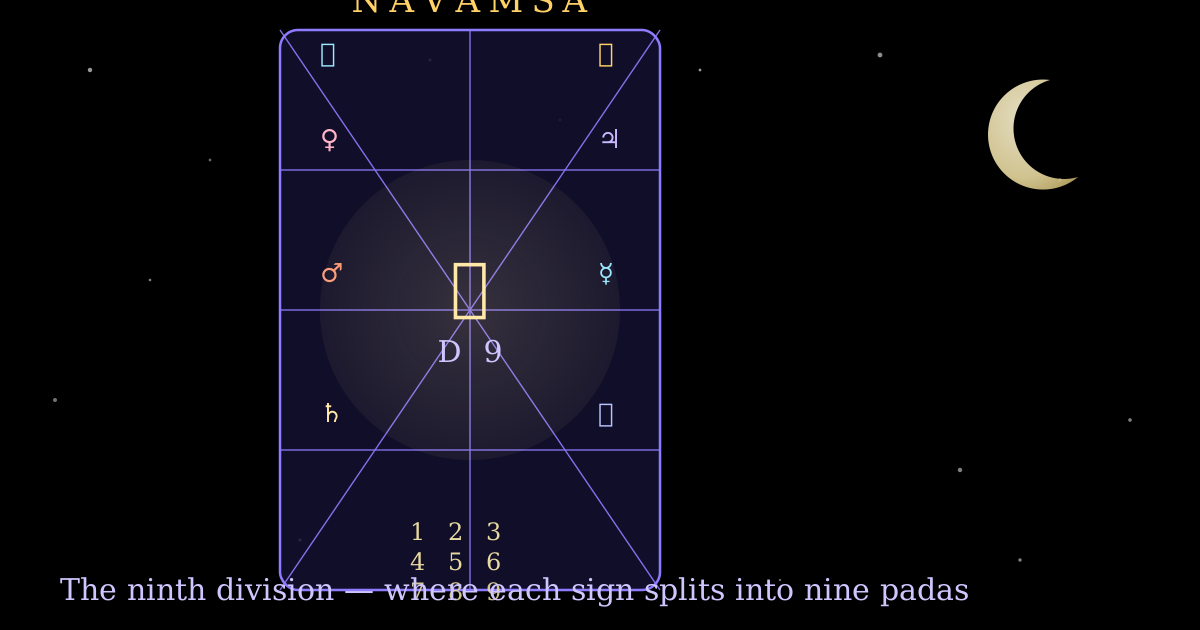
Navamsa Chart (D9): Meaning & How to Read Your Fruit Chart
The birth chart is the tree, the Navamsa is the fruit. Learn how each sign divides into nine padas, what D9 reveals about planetary strength and partnership, and the 5 checks to read your own chart.
Read the meaning →
Your Vedic Moon Sign: Meaning & How to Find It
Find your Vedic Moon sign (Rashi) and discover what it reveals about your emotions, mind, and life timing. Meanings for all 12 Moon signs explained.
Read the meaning →
Sade Sati: Meaning, Phases & Remedies Explained
What is Sade Sati? The 7.5-year Saturn transit explained — its three phases, how to tell if it is active for you, and traditional remedies.
Read the meaning →