
Gajakesari Yoga: Meaning, How to Find It in Your Chart & What It Really Promises
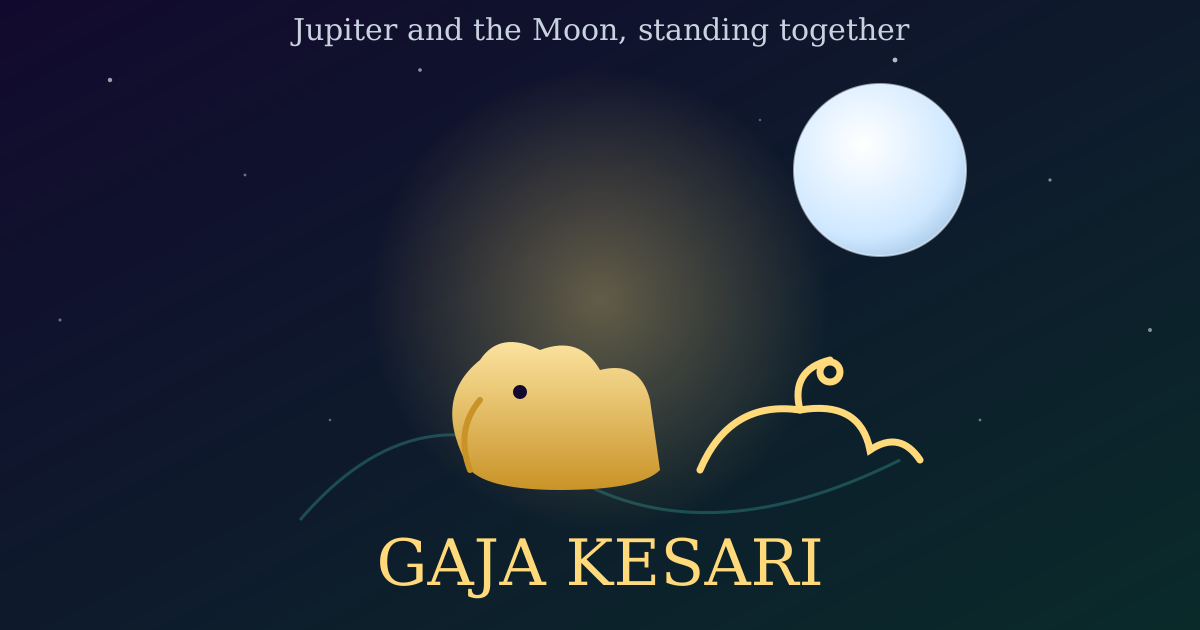
Ask any Vedic astrologer to name the first yoga they look for in a chart, and most will answer before you finish the sentence: Gajakesari. It is the combination every student learns early, the one clients ask about by name, and the one whose classical description reads like a royal proclamation — intelligence, generosity, lasting reputation, a name that endures after death. The texts are not shy about it. They describe a person with this yoga as virtuous, wealthy, learned, and honoured by rulers, a person whose fame spreads like the scent of a flowering tree.
That grandeur is exactly why the yoga deserves a careful reading. Gajakesari is common — roughly a third of all charts carry it in some form — yet the lives it supposedly blesses look nothing alike. Some people with the yoga become respected teachers and steady pillars of their communities. Others live entirely ordinary lives, kind and clever but unremarkable, and wonder what went wrong. Nothing went wrong. The tradition itself grades this yoga, carefully and in detail, and the grade matters far more than the mere presence of the combination. A weak Gajakesari is a whisper. A strong one is a voice you can hear across a room. Let us walk through what the yoga actually is, how to check your own chart, and how the classical astrologers judged its strength.
What Is Gajakesari Yoga? The Elephant and the Lion
In Vedic astrology, a yoga is simply a combination — two or more planets standing in a meaningful relationship that the tradition reads as a theme in a life. Gajakesari is a combination of the two gentlest, most benefic forces in the chart: Jupiter, the planet of wisdom, teaching, and good counsel, and the Moon, the planet of mind, feeling, and public perception. The name joins two animals that classical India admired for different kinds of power. Gaja, the elephant, stands for immense strength carried with calm and patience — power that does not need to shout. Kesari, the lion, stands for majesty, courage, and command — power that others recognise on sight. Put them together and you get the yoga's promise in a single image: strength that is both wise and felt, a mind that commands respect without demanding it.
The technical rule is simple. Take the Moon's position as your starting point, and count the houses from the Moon to Jupiter. If Jupiter sits in the 1st, 4th, 7th, or 10th house from the Moon — the angular houses, called kendras — the yoga is formed. In sign terms, that means Jupiter is in the same sign as the Moon, or three, six, or nine signs ahead of it. The kendras are the pillars of a chart: the houses of self, home, partnership, and career, the places where life is most visible and most consequential. Jupiter standing in one of those pillars, measured from the Moon, is read as wisdom supporting the mind from a position of structural strength.
Why measure from the Moon rather than from the ascendant? Because in Vedic astrology the Moon is the mind itself, and the tradition treats the Moon chart — the chart redrawn with the Moon sign as the first house — as a second, equally important reading of a life. A yoga counted from the Moon describes the inner weather: how a person thinks, feels, and is perceived by others. Gajakesari is therefore read first as a quality of character — sound judgement, emotional steadiness, a mind that others trust — and only secondarily as outer fortune. That distinction is the key to everything that follows.
How to Check Your Chart for Gajakesari Yoga
You need a sidereal Vedic birth chart, not a Western tropical one. The two systems place every planet roughly 24 degrees apart, which can shift the Moon or Jupiter into a different sign and change the count entirely. Most free Vedic chart calculators will generate the sidereal chart if you enter your birth date, time, and place, and many of them list yogas automatically. If yours does not, the check takes less than a minute by hand.
- Step 1 — Find the Moon's sign. Look for the Moon in your chart and note its sign. This is your Vedic Moon sign, the starting point of the count.
- Step 2 — Find Jupiter's sign. Locate Jupiter and note its sign.
- Step 3 — Count from the Moon. Count forward from the Moon's sign to Jupiter's sign, including the Moon's sign as 1. If the count lands on 1, 4, 7, or 10, Gajakesari Yoga is present in your chart.
- Step 4 — Check the strength. Presence alone tells you little. Note Jupiter's dignity, the Moon's brightness, and whether malefic planets aspect either one — the grading in the next section is where the real reading begins.
Worked example: suppose the Moon sits in Taurus and Jupiter sits in Scorpio. Counting forward from Taurus — Taurus (1), Gemini (2), Cancer (3), Leo (4), Virgo (5), Libra (6), Scorpio (7) — Jupiter lands in the 7th from the Moon, a kendra. The yoga is present. If Jupiter instead sat in Virgo, the 5th from the Moon, it would not be — the 5th is a trine, a fine placement in its own right, but not a kendra, and not Gajakesari.
Gajakesari by Kendra: Where Jupiter Stands From the Moon
Not all kendras are equal, and the classical texts shade the yoga's flavour by which pillar Jupiter occupies. The differences are subtle — the same wisdom-and-steadiness theme, expressed through a different doorway of life — but they shape how the yoga is felt day to day.
- Jupiter in the 1st from the Moon (conjunct the Moon): wisdom fused directly with the mind. The tradition describes a person whose judgement and feeling move together — intuitive, learned, and visibly composed, with a presence others find reassuring. This is the most intimate form of the yoga, and also the one most coloured by the sign both planets share.
- Jupiter in the 4th from the Moon: wisdom rooted at home. The folk reading emphasises emotional security, property, education, and a strong inner foundation — the person whose steadiness comes from deep roots, family learning, or a well-built inner life. Contentment is the signature here rather than public display.
- Jupiter in the 7th from the Moon: wisdom reflected through others. Partnership, public dealings, and reputation take centre stage: the person is read as someone whose counsel is sought, whose alliances are fortunate, and whose public standing grows through relationships. The tradition links this form most closely to fame and social honour.
- Jupiter in the 10th from the Moon: wisdom expressed through work. Career, public role, and visible achievement carry the yoga's signature — the respected professional, the teacher whose name travels, the person whose work itself becomes their reputation. Of the four, this is the form most often quoted when the texts speak of lasting renown.
Read your form as a doorway, not a destiny. A 4th-house Gajakesari does not forbid a public career, and a 10th-house one does not guarantee it. The kendra tells you where the yoga's theme most naturally shows itself — at home, in partnership, in work, or in the self — and where you are most likely to notice it operating in your own life.
Strong or Weak? How the Tradition Grades Gajakesari Yoga
Here is where the honest reading begins, because the tradition is far more demanding than the popular version. A yoga is not a switch that is either on or off. It has strength, and strength comes from the condition of both planets involved. The classical astrologers weighed at least five factors before calling any Gajakesari powerful.
First, Jupiter's dignity. Jupiter exalted in Cancer is the strongest form of all, and the texts reserve their most extravagant praise for it. Jupiter in its own signs, Sagittarius and Pisces, is strong and steady. Jupiter in a friendly sign is moderately strong. Jupiter debilitated in Capricorn, or combust — too close to the Sun to be seen — is weak, and a debilitated Jupiter can drain the yoga of much of its lustre, unless a cancellation of debility (neecha bhanga) applies. Second, the Moon's condition. A waxing Moon, growing toward full, is stronger than a waning one. A Moon in its own sign of Cancer or exalted in Taurus adds strength, while a Moon hemmed in by malefics, or sitting in a difficult house from the ascendant, weakens the combination. Third, aspects and afflictions. Saturn or Mars aspecting the Moon or Jupiter, or Rahu and Ketu joining the combination, are read as stains on the yoga — not cancellations, but complications that make its expression harder, later, or more uneven. Fourth, the houses involved. A yoga formed from strong houses of the ascendant chart as well as the Moon chart is read as doubly supported. Fifth, the navamsa. If Jupiter and the Moon are also well placed in the D9 divisional chart, the tradition reads the yoga as deep-rooted rather than superficial.
The practical upshot is a spectrum. At one end sits the textbook case: exalted Jupiter in a kendra from a bright, unafflicted Moon — the chart the classical verses were written about. At the other end sits a debilitated, combust Jupiter in a kendra from a dark, afflicted Moon — technically Gajakesari, but so weakened that its classical promises barely register. Most real charts sit somewhere in between, and most real lives do too. If you found the yoga in your chart and your life feels merely decent rather than dazzling, the tradition would not be surprised. It would ask you to check the grade.
Gajakesari Yoga and the Dasha Periods
Even a strong yoga does not express itself evenly across a lifetime. Vedic astrology reads life as a sequence of planetary periods, the Vimshottari dasha system, in which each planet takes a turn running the timeline for a set number of years — sixteen for Jupiter, ten for the Moon. The tradition says a yoga's themes come forward most visibly during the dasha and antardasha periods of the planets that form it. For Gajakesari, that means Jupiter periods and Moon periods are the seasons when wisdom, reputation, learning, and public regard are most likely to ripen, and when the decisions made in those years carry the longest consequences.
That timing matters for a humble reason: it explains why the yoga can feel dormant for years and then suddenly visible. A person may carry a strong Gajakesari through a long Saturn or Rahu period, when life's themes are endurance or upheaval rather than honour, and only feel the yoga's signature when Jupiter's period arrives. It also explains why two people with similar yogas diverge: their dasha sequences differ, so the same combination flowers in different decades. None of this is a prediction about any particular event. It is the tradition's way of saying that character strengths have seasons, and that patience with the calendar is part of reading a chart honestly.
How to Work With Gajakesari Yoga
The folk tradition pairs this yoga with practices meant to honour its two planets — not to purchase an outcome, but to live the theme consciously. They are shared here as cultural and reflective practice, not as guarantees of any result:
- Study as a discipline: Jupiter's gift is wisdom, and the tradition says it grows by use. Read deeply, teach what you learn, and let your opinions be tested by people who disagree with you.
- Steady the mind: the Moon's gift is feeling, and the tradition pairs it with routine — regular sleep, time outdoors, and a habit of naming emotions before acting on them.
- Counsel generously: the yoga's social signature is trusted advice. Offer it freely, charge fairly for it when it is your work, and never use another person's trust as leverage.
- Keep the ledger honest: the classical warnings about this yoga are about pride — wisdom curdling into preaching, reputation into vanity. The remedy the texts suggest is plain: let your work speak, and keep one part of your life entirely unperformed.
And the caution that applies to every celebrated yoga alike: beware anyone selling you a purchased outcome for it. Gemstones, rituals, and remedies are real cultural commerce, and they cost real money. No stone, ritual, or reading has any verifiable effect on your future. Do it for the meaning, and pay only what the experience itself is worth to you.
Myths About Gajakesari Yoga, Debunked
Gajakesari Yoga guarantees wealth and fame. It does not. The classical verses describe an ideal case — strong planets, clean aspects, supportive dashas — and popular retellings quote the verses while dropping the conditions. The yoga sketches a theme of wisdom and steadiness; fortune, fame, and wealth depend on the whole chart and on a life's actual choices.
One third of people cannot all be special. They are not, and the tradition knows it. That is precisely why it grades the yoga so carefully. Presence is common; strength is not. Two charts can both carry Gajakesari and differ as much as a candle and a lighthouse — same kind of light, vastly different reach.
If you do not have it, your chart is missing something. No chart has every yoga, and the tradition never treats a single combination as the measure of a life. A chart without Gajakesari may carry other powerful combinations — wealth yogas, learning yogas, spiritual yogas — or its strength may lie in a single well-placed planet rather than any named combination at all. The absence of one famous yoga is not a verdict on anything.
A weak Gajakesari can be fixed by a remedy. The classical texts describe remedies as posture, not payment — a way of taking a theme seriously, not a way of rewriting a chart. No remedy has any verifiable effect on planetary positions or life outcomes, and anyone promising otherwise is selling something the tradition itself never claimed to sell.
Gajakesari endures as a symbol because the hunger it names is real, whatever you believe about the stars. Everybody knows what it feels like to want wisdom and steadiness in the same person — to be both the elephant and the lion, patient and commanding, learned and calm. The yoga, in the tradition's telling, simply gives that aspiration a shape in the sky: Jupiter standing beside the Moon, wisdom keeping company with feeling, strength that does not need to raise its voice. Read it as a lens for reflection and entertainment, check its grade honestly, and let the combination — strong, weak, or absent — teach you something true about the mind you actually live with.
Frequently asked questions
What is Gajakesari Yoga in Vedic astrology?
Gajakesari Yoga forms when Jupiter stands in a kendra — the 1st, 4th, 7th, or 10th house — counted from the Moon in a Vedic birth chart. Gaja means elephant and Kesari means lion, so the yoga is named for the strength and majesty of both animals. The tradition reads it as a combination of wisdom and emotional steadiness, shared here as spiritual symbolism for reflection and entertainment.
How do I check if I have Gajakesari Yoga?
Find the Moon's sign in your sidereal Vedic chart, then count forward to Jupiter's sign. If Jupiter sits in the same sign as the Moon, or 4, 7, or 10 signs away from it, the yoga is present. A free Vedic chart calculator will show both placements, but always confirm you are using a sidereal chart, not a Western tropical one.
Is Gajakesari Yoga rare?
No, it is one of the more common yogas. Because four of the twelve positions from the Moon qualify, roughly a third of all charts carry it in some form. What is rarer is a strong, unafflicted version — Jupiter dignified, the Moon bright and supported, and neither planet badly afflicted — which is why the tradition grades the yoga rather than treating every case the same.
Does Gajakesari Yoga guarantee wealth and fame?
No. The classical texts describe the yoga in glowing language — intelligence, respect, lasting reputation — but no placement guarantees any life outcome. The whole chart, the dasha periods, and the strength of both planets shape how the theme expresses. Read it as a symbolic strength in your chart, not as a promise of fortune or fame.
When is Gajakesari Yoga strongest?
The tradition says the yoga shines brightest when Jupiter is strong — exalted in Cancer or in its own signs Sagittarius and Pisces — and the Moon is waxing, well placed, and free from harsh aspects. Its themes are also said to come forward during Jupiter and Moon dasha periods, when those two planets take their turn running the Vedic timeline.
Keep exploring
Your Vedic Moon Sign: Meaning & How to Find It
Find your Vedic Moon sign (Rashi) and discover what it reveals about your emotions, mind, and life timing. Meanings for all 12 Moon signs explained.
Read the meaning →
Vedic Dasha Periods: Understanding Your Planetary Timeline
Vimshottari Dasha explained: the 120-year Vedic timeline of planetary periods. Meanings of all 9 mahadashas and how to find your current dasha.
Read the meaning →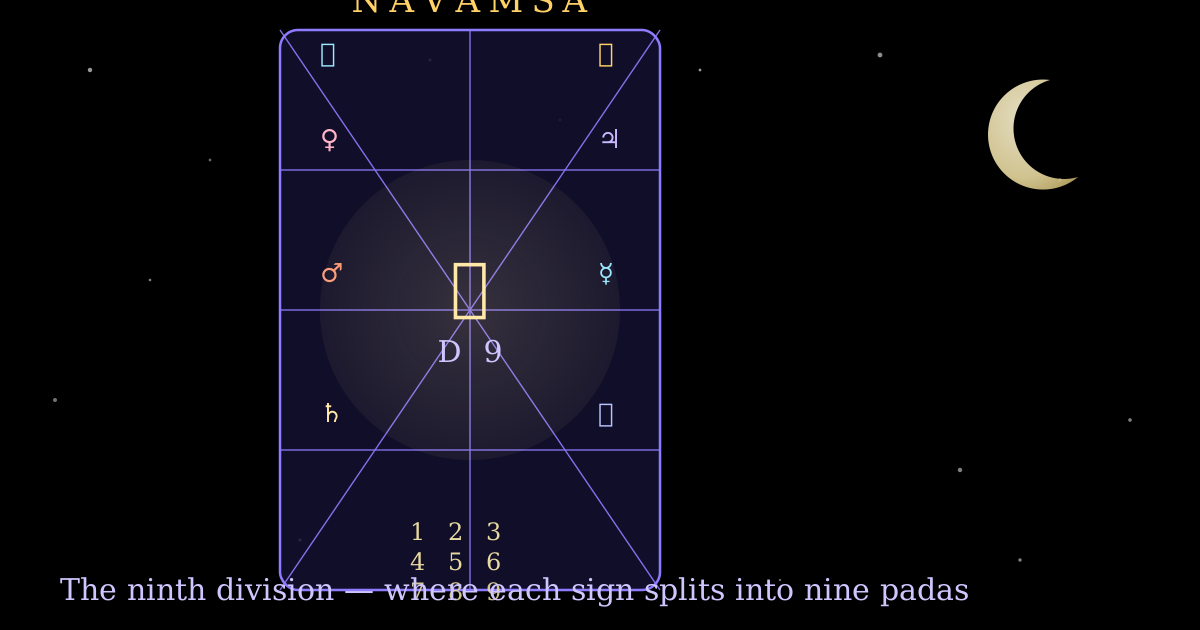
Navamsa Chart (D9): Meaning & How to Read Your Fruit Chart
The birth chart is the tree, the Navamsa is the fruit. Learn how each sign divides into nine padas, what D9 reveals about planetary strength and partnership, and the 5 checks to read your own chart.
Read the meaning →
Atmakaraka Planet: Meaning, How to Find Your Soul Planet & What It Reveals
What is Atmakaraka? The soul planet of Jaimini astrology explained — how to find the highest-degree planet in your chart, what each Atmakaraka reveals, and how it shapes your life path.
Read the meaning →