
Gandanta in Vedic Astrology: Meaning, the 3 Karmic Knots & Remedies
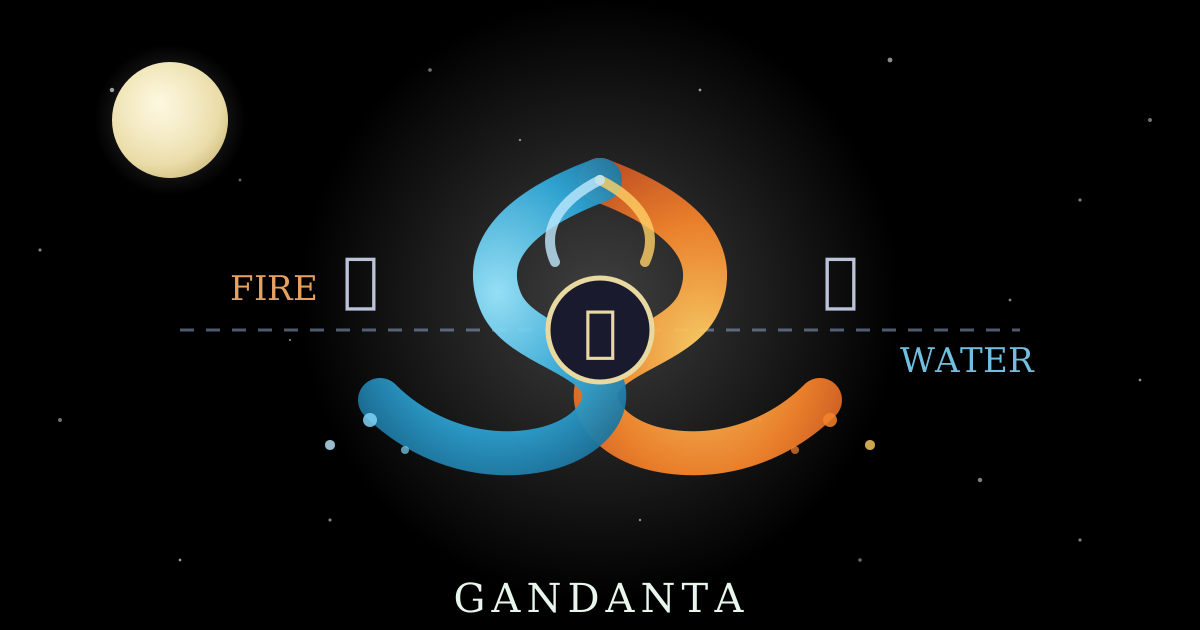
Some astrological concepts sound dramatic because someone wanted them to. Gandanta sounds dramatic because the Sanskrit word itself is the image: ganta (knot) at the anta (end) — a knot tied at the very end of something, the last gasp of water before fire begins. The tradition pictures a planet drowning at the shore between two elements that cannot agree, and it has been reading charts through that lens for centuries.
Here's the mechanics first, because the poetry only works once you see the map. The Vedic zodiac, like the Western one, runs through twelve signs — but Vedic astrology sequences them by element in a way that creates three strange seams. Three times in the wheel, a water sign is immediately followed by a fire sign: Cancer hands off to Leo, Scorpio hands off to Sagittarius, Pisces hands off to Aries. At each seam, the tradition marks a narrow strip — the last 3°20′ of the water sign and the first 3°20′ of the fire sign — and calls it gandanta. A planet standing in that strip is, in the tradition's language, "in the knot."
Why would that matter? Because water and fire are the zodiac's great opposites. Water signs feel, remember, and merge; fire signs act, declare, and blaze. A planet at the seam is symbolically asked to be both at once — to drown and to burn. The tradition's claim is that this creates a kind of psychic static: intensity without a clear channel, emotion that can't decide whether to weep or rage. Like every folk symbol, it works best as a mirror, not a meter. Let's walk the three knots.
The Three Gandanta Points
Each gandanta point is defined by the two nakshatras (lunar mansions) that straddle the seam. Because nakshatra boundaries don't align with sign boundaries, the knot always involves the last quarter (pada) of one star and the first quarter of the next.
- 1. Cancer–Leo gandanta (Ashlesha → Magha): the last pada of Ashlesha (the serpent star, ruled by Mercury, dwelling at the end of Cancer) into the first pada of Magha (the throne-room star, ruled by Ketu, at the start of Leo). This is the emotional knot — Cancer's deep waters pouring into Leo's proud fire. Tradition links it to struggles with pride, family entanglements, and emotions that come out sideways.
- 2. Scorpio–Sagittarius gandanta (Jyeshtha → Mula): the last pada of Jyeshtha (the eldest star, ruled by Mercury, at the end of Scorpio) into the first pada of Mula (the root star, ruled by Ketu, at the start of Sagittarius). This is considered the deepest and most intense of the three — Scorpio's underworld waters meeting Sagittarius's philosophical fire. The symbolism is transformation under pressure: the root being torn up so something can be replanted.
- 3. Pisces–Aries gandanta (Revati → Ashwini): the last pada of Revati (the star of completion, ruled by Mercury, at the end of Pisces) into the first pada of Ashwini (the swift healers, ruled by Ketu, at the start of Aries). This one sits at the very end of the entire zodiac — the last breath of Pisces before the wheel begins again. The tradition reads it as endings that refuse to end: grief about a closed chapter while a new one demands to start.
Notice the hidden architecture: the first two stars at every seam are ruled by Mercury (the mind, analysis, anxiety) and the second by Ketu (the south node — detachment, the past, letting go). So the knot is literally a handoff from the overthinking mind to the force of release. Read symbolically, gandanta describes the exact moment when analysis has to surrender — which is why the tradition keeps associating it with crises that end only when the person stops trying to think their way out.
Which Planets in Gandanta Matter Most
Not all gandanta placements are treated equally. The tradition has a clear hierarchy, and it makes sense once you think about speed.
- The Moon — the big one. The Moon moves through a nakshatra roughly every day, so a gandanta Moon is common (about one person in twelve has some gandanta placement, and the Moon is the usual suspect). Because the Moon rules the mind and emotions in Vedic astrology, a gandanta Moon is the placement the tradition discusses most: emotional intensity, vivid moods, a mind that feels pulled between feeling everything and wanting to feel nothing.
- The Ascendant (Lagna). Second in weight. A gandanta ascendant is read as a life theme rather than a mood — the person's whole orientation caught at a threshold, with the classic folk description being someone who reinvents themselves repeatedly, "untangling" their identity in stages.
- The Sun. The Sun rules vitality and the sense of self; in gandanta it's traditionally tied to a complicated relationship with authority and father figures, and to confidence that flickers.
- Other planets. Mars, Mercury, Jupiter, Venus, and Saturn in gandanta are noted but treated as background color — coloring that planet's domain with a little extra volatility. Rahu and Ketu themselves are shadow points, not planets, and the tradition generally doesn't apply gandanta to them.
One more technicality the tradition cares about: a planet at the exact junction — within a degree of the seam — is read as stronger than one merely inside the 3°20′ strip. Precision, in this folk system, equals potency.
How to Check If You Have Gandanta in Your Chart
You'll need a Vedic (sidereal) birth chart — a Western tropical chart puts every planet about 24 degrees off, which scrambles the seams completely. Free Vedic chart calculators are easy to find online; you need your birth date, exact birth time, and birthplace.
Then look at the degrees:
- Step 1: Find each planet's sign and degree. You're looking for planets at 26°40′–30°00′ of Cancer, Scorpio, or Pisces, or at 0°00′–3°20′ of Leo, Sagittarius, or Aries.
- Step 2: Note which planet it is. Moon first, then Ascendant, then Sun — those are the ones the tradition weighs heaviest.
- Step 3: Check the nakshatra padas. If the planet sits in the last pada of Ashlesha, Jyeshtha, or Revati, or the first pada of Magha, Mula, or Ashwini, you've found the knot exactly.
Don't be surprised if something shows up. With six 3°20′ strips across the wheel, a meaningful fraction of charts carry at least one gandanta placement — which is itself worth remembering the next time someone tries to frighten you with it.
The Traditional Effects People Talk About
Stripped of drama, the tradition's claims about gandanta cluster around a single theme: threshold turbulence. The folk descriptions repeat across texts and teachers: emotional extremes, a sense of never quite belonging to either side of a divide, relationships that swing between merging and burning, and life chapters that end messily — doors that don't close cleanly, goodbyes that echo.
But here's what the fear-mongers skip: the tradition's own favorite word for the gandanta native is transformative. The knot is not a life sentence; it is a task. Classical commentary keeps returning to the image of untying: the person who works through the threshold pattern — therapy, ritual, honest self-examination, time — is described as emerging with unusual depth, the way a knot pulled apart carefully yields a stronger rope. The serpent star Ashlesha gives way to the throne of Magha; the underworld of Jyeshtha gives way to the roots of Mula. Every gandanta point is literally positioned at a passage into something.
And the honest framing, as always: this is folk symbolism, not a diagnosis. "Your chart marks a threshold zone" is a story you can use to be patient with your own turbulence. It is not a weather forecast, and no planet is actually drowning.
Traditional Remedies for Gandanta
Because the Moon is usually the focus, the classic remedies are Moon-strengthening practices. They're shared here as folk and devotional tradition — cultural practices, not guarantees.
- Chandra mantra practice. Chanting the Moon's mantra — traditionally 108 times on Mondays, or during the waxing Moon — is the most prescribed remedy across all gandanta placements.
- Monday observances. The Moon's day: white clothing, calm routines, and devotional practices dedicated to Chandra. Folk tradition treats Monday as maintenance day for a turbulent Moon.
- Water rituals. Given the water–fire symbolism, water is the element the tradition leans into: offering water at sunrise, ritual bathing, and keeping the home's water sources clean and flowing.
- Honoring the mother. The Moon signifies the mother in Vedic astrology, so caring for one's mother — or for maternal figures — is framed as directly soothing the afflicted Moon.
- Silver and pearl — with caution. Silver and pearl are the Moon's metals and gems. But the tradition is explicit: never wear a gemstone for a dosha without a full chart reading by a competent astrologer, since strengthening the wrong planet can backfire symbolically and financially.
- The knot-untangling frame. The most psychologically honest remedy is the folk instruction to "untie the knot consciously": journaling through transitions, therapy during turbulent years, and deliberately closing chapters — writing the unsent letter, holding the small ceremony. Whether or not the stars notice, the mind does.
A practical caution: as with every dosha, remedy rituals range from free mantra practice to expensive multi-day ceremonies. No ritual has any verifiable effect on your future. If you choose one, do it for the meaning — the sense of ritually closing a chapter of anxiety — and pay only what the experience is worth to you.
Myths About Gandanta, Debunked
"Gandanta means you're cursed." The tradition itself frames the knot as a task to untie, with transformation as the promised outcome. A curse has no remedy list; gandanta comes with a long one.
"Only the Moon's gandanta counts." The Moon is the most discussed, but the tradition applies gandanta to the Ascendant, the Sun, and the other planets too — with a clear hierarchy of weight. Anyone telling you only one placement "counts" is simplifying.
"Gandanta and Abhukta Mula are the same thing." Abhukta Mula — the Moon specifically in Mula nakshatra — is a special case within gandanta with its own classical remedy (the Mula Shanti ritual, traditionally performed in infancy). Gandanta is the broader phenomenon: three junctions, any planet.
"It's a rare, terrible affliction." The math says otherwise. Six strips of 3°20′ each cover a real slice of the wheel, and the fast-moving Moon lands in one regularly. Millions of people carry a gandanta placement and live entirely ordinary lives. Rarity is part of the sales pitch, not the astronomy.
"An expensive puja is the only fix." The tradition's own list starts with free practices — mantra, Monday observances, conduct, honoring the mother. Any remedy framed as "pay this amount or else" is commerce, not cosmology.
Gandanta endures because its image is perfect: the knot at the end, water meeting fire, the threshold that pulls tight before it releases. It gives a name to the very human experience of standing between two chapters of life, belonging fully to neither. Used that way — as a story about navigating transitions with patience — it's genuinely useful. Feared as a curse, it's just theater. The knot in your chart is a symbol. The untying is yours.
Frequently asked questions
What is Gandanta in Vedic astrology in simple terms?
Gandanta means the knot at the end. It refers to the narrow 3°20′ zones at the three junctions where the Vedic zodiac passes from a water sign into a fire sign: Cancer–Leo, Scorpio–Sagittarius, and Pisces–Aries. A planet placed in one of these zones is traditionally called gandanta, symbolizing an energy caught between two opposite elements.
Which planet in Gandanta matters the most?
The Moon matters most, because it moves fastest, rules the mind and emotions, and changes nakshatra roughly every day — so a gandanta Moon is relatively common and is the placement the tradition discusses most. The Ascendant (Lagna) comes next, followed by the Sun. Other planets in gandanta are read as less intense.
Is Gandanta dangerous?
The tradition treats gandanta as a vulnerability to be worked through, not a curse. Classical readings describe emotional turbulence and a sense of being pulled in two directions, but they also pair the placement with a long list of remedies and a recurring theme of untangling the knot — difficulty that resolves. Read it as folk symbolism for reflection and entertainment, not as a prediction of misfortune.
What is the difference between Gandanta and Abhukta Mula?
Abhukta Mula is a special case within gandanta: the Moon in the Mula nakshatra (which spans Sagittarius at the Scorpio–Sagittarius junction) is treated as a distinct, more severe dosha in some classical texts, with its own prescribed remedy — the Mula Shanti ritual traditionally performed in infancy. Gandanta is the broader phenomenon covering all three water–fire junctions and any planet, not just the Moon.
What are the remedies for Gandanta?
Because the Moon is usually the focus, traditional remedies strengthen the Moon: chanting the Chandra mantra, Monday observances, donating white items, wearing silver or pearl only after a proper chart reading, honoring the mother, and water-based devotional practices. The remedies are shared as folk and devotional tradition — cultural practices, not guarantees.
Keep exploring
Sade Sati: Meaning, Phases & Remedies Explained
What is Sade Sati? The 7.5-year Saturn transit explained — its three phases, how to tell if it's active for you, and traditional remedies.
Read the meaning →
Kala Sarpa Yoga: Meaning, 12 Types, Effects & Remedies
All seven planets trapped between Rahu and Ketu — learn what Kala Sarpa Yoga means, the 12 serpent types, how to check your chart, and the classic remedies.
Read the meaning →
Nakshatras: The 27 Lunar Mansions Explained
Discover the 27 nakshatras — Vedic astrology's lunar mansions. Meanings, symbols, deities, and how to find your birth star (Janma Nakshatra).
Read the meaning →
Your Vedic Moon Sign: Meaning & How to Find It
Find your Vedic Moon sign (Rashi) and discover what it reveals about your emotions, mind, and life timing. Meanings for all 12 Moon signs explained.
Read the meaning →