
Kala Sarpa Yoga: Meaning, 12 Types, Effects & Remedies
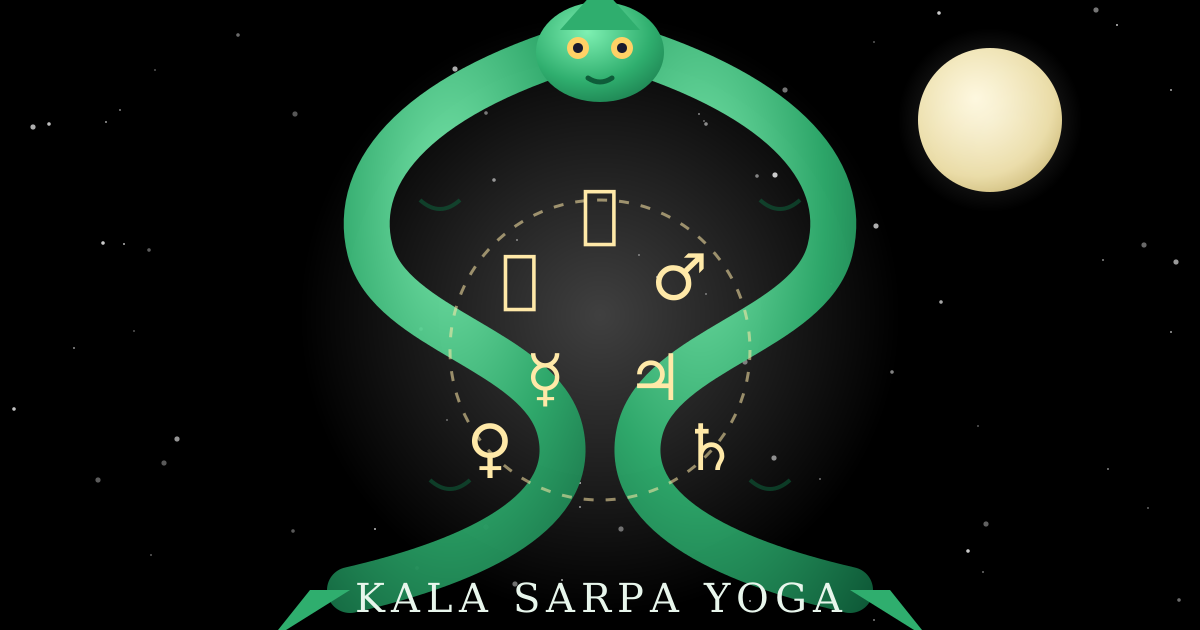
Few phrases in Vedic astrology land with quite the thud of Kala Sarpa Yoga. Where Manglik Dosha sends people running to matchmakers, Kala Sarpa sends them running to priests. The name itself is dramatic — Kala (time, or death), Sarpa (serpent), Yoga (combination): the serpent-of-time combination. The mental image is unforgettable: every planet in your chart caught inside the coils of a celestial snake, slowly squeezing.
But what is actually going on in the chart? The definition is geometric, not mystical. In Vedic astrology, Rahu and Ketu — the north and south nodes of the Moon, the two "shadow planets" — always sit exactly opposite each other. Draw a line through them and your chart splits into two halves. Kala Sarpa Yoga is said to form when all seven traditional planets — Sun, Moon, Mars, Mercury, Jupiter, Venus, and Saturn — fall on one side of that line, within the 180-degree arc between Rahu and Ketu. Rahu and Ketu themselves are excluded from the count (they are the ones doing the trapping, after all).
The symbolism is the point. Rahu is the serpent's head, Ketu the tail. When every planet sits inside the serpent's curve, the tradition reads it as a life where efforts keep circling back, where progress comes in coils rather than straight lines — intense inner pressure, and success that arrives late but, in the tradition's more optimistic tellings, arrives grand.
How to Check If You Have Kala Sarpa Yoga
You'll need a Vedic birth chart drawn with the sidereal zodiac (a tropical Western chart won't do). Free Vedic chart calculators are easy to find — you'll need your birth date, exact birth time, and birthplace.
Once the chart is in front of you, here's the check:
- Step 1: Find Rahu and Ketu. They're always 180 degrees apart. Draw an imaginary line between them through the chart.
- Step 2: Count the seven planets. Look at Sun, Moon, Mars, Mercury, Jupiter, Venus, and Saturn. Are all seven on the same side of the Rahu–Ketu line?
- Step 3: Check for strays. If even one planet sits outside the arc — on the other side of the line — the full yoga is broken. (That's partial, or Aanshik, Kala Sarpa Yoga — more on that below.)
- Step 4: Note Rahu's house. The house Rahu occupies names your type — one of the twelve below — and tells the tradition which life area the "coil" presses on most.
One technical caution: astrologers disagree on borderline cases — a planet exactly on the axis, or one conjunct Rahu or Ketu themselves. Most traditions count a planet conjunct the node as inside the arc. If your chart is a close call, different astrologers may genuinely read it differently.
The 12 Types of Kala Sarpa Yoga
The twelve types are named after mythic serpents, and the name comes entirely from Rahu's house. Find Rahu's house in your chart, and you have your type — each one is traditionally associated with struggles in that house's domain.
- 1. Anant Kaal Sarp (Rahu in the 1st house): pressure on self-image and identity — the tradition speaks of a lifelong sense of having to prove oneself.
- 2. Kulik Kaal Sarp (Rahu in the 2nd): the house of wealth and family — traditional readings mention financial ups and downs and family tensions.
- 3. Vasuki Kaal Sarp (Rahu in the 3rd): the house of courage and siblings — courage tested repeatedly, and friction with brothers or sisters.
- 4. Shankhapal Kaal Sarp (Rahu in the 4th): home and mother — the tradition links it to domestic unrest or distance from one's roots.
- 5. Padma Kaal Sarp (Rahu in the 5th): children and creativity — worries around progeny, romance, or speculative ventures.
- 6. Mahapadma Kaal Sarp (Rahu in the 6th): enemies, debts, and health — rivalry at work and recurring minor health complaints.
- 7. Takshak Kaal Sarp (Rahu in the 7th): marriage and partnerships — the tradition claims delays or turbulence in marriage and business partnerships.
- 8. Karkotak Kaal Sarp (Rahu in the 8th): the house of sudden events — unexpected setbacks, and an interest in the occult as compensation.
- 9. Shankhachood Kaal Sarp (Rahu in the 9th): fortune and father — the tradition speaks of luck that keeps slipping away, and a strained father relationship.
- 10. Ghatak Kaal Sarp (Rahu in the 10th): career and reputation — professional obstacles, credit denied to the deserving.
- 11. Vishdhar Kaal Sarp (Rahu in the 11th): gains and friends — income that arrives late, friendships that disappoint.
- 12. Sheshnag Kaal Sarp (Rahu in the 12th): the house of loss and the foreign — expenses, isolation, or life far from home.
Notice the pattern: each type is really just the ordinary meaning of Rahu in that house, dressed in serpent imagery. That observation matters, because it leads to the biggest question about this yoga — which we'll come to shortly.
The Traditional Effects People Worry About
Strip away the theatrics and the tradition's claims cluster around a few themes. Delay is the big one: things that should take a year take five — career recognition, marriage, financial stability. Repetition is the second: the same class of problem recurring — health flare-ups, betrayals, near-misses with success. The third is intensity: the native is said to feel life more sharply, swinging between high ambition and deep discouragement.
The tradition also has its hopeful counterweight, and it's worth hearing: the classic claim is that Kala Sarpa natives often rise late but rise high. The serpent coils, then releases. Folk lore loves pointing to famous people — politicians, film stars, spiritual leaders — whose charts are said to carry the yoga and who succeeded spectacularly after long struggle. (Treat such examples as storytelling, not data: famous people's birth times are rarely verified, and survivorship bias does the rest.)
And the honest framing: these are symbolic themes for self-reflection. "Your chart suggests a pattern of delayed-but-eventual success" is a story you can use to persist through a hard year. It is not a weather forecast. Nobody's life is actually squeezed by a sky snake.
Partial (Aanshik) Kala Sarpa Yoga
If one or two planets fall outside the Rahu–Ketu arc, the tradition calls it Aanshik (partial) Kala Sarpa Yoga — and it is far more common than the full form. Astrologers who take the yoga seriously generally treat the partial form as much weaker: the serpent's coil has a gap, and energy escapes through it.
In practice, "partial" covers a wide spectrum. One planet barely outside the axis is read very differently from three planets scattered across the other half — at which point many astrologers would say there is no yoga at all, just ordinary planetary distribution. If a priest or website tells you that you have Kala Sarpa Yoga, ask whether it's full or partial, and how many planets actually sit outside the arc. The answer often deflates the drama considerably.
The Controversy: Why Many Astrologers Doubt It
Here is the part the fear-mongering websites skip: Kala Sarpa Yoga is barely mentioned in the oldest classical texts of Vedic astrology. Scholars and traditionalist astrologers have noted that the great foundational works — Brihat Parashara Hora Shastra, Brihat Jataka, Phaladeepika — say little or nothing about it. The yoga appears to have risen to prominence in the 20th century, popularized by working astrologers and temple priests rather than handed down from the rishis.
The skeptical case is straightforward. Planetary clustering between the nodes is statistically common — with seven planets distributed across twelve houses, a noticeable share of charts will show this pattern by pure chance. And the "effects" are vague enough — struggle, delay, eventual success — to fit almost any biography. Critics argue the yoga functions less as a technique and more as a business model: frighten the client, sell the remedy.
None of this settles whether the symbolism is meaningful to you. Astrology has always mixed technique, psychology, and theater. But if someone uses Kala Sarpa Yoga to frighten you — especially to sell you an expensive ritual on the spot — you now know the counterargument, and it comes from within the tradition's own scholars.
Traditional Remedies for Kala Sarpa Yoga
For those who follow the tradition, the remedies are well established and widely practiced. They are shared here as folk and devotional tradition — cultural practices, not guarantees.
- Kaal Sarp Puja at Trimbakeshwar or Ujjain. The most famous remedy: a dedicated ritual performed by priests at the Trimbakeshwar temple near Nashik (Maharashtra) or at Mahakaleshwar in Ujjain. Many families time it for Nag Panchami, the festival honoring serpent deities, or for an Amavasya (new moon).
- Maha Mrityunjaya mantra. Chanting this Shiva mantra — traditionally 108 times daily, or in a structured jaap of 125,000 repetitions over time — is one of the most prescribed remedies across all "fearful" combinations.
- Nag Panchami observances. Offering milk to snake idols or images, visiting Shiva temples on Nag Panchami, and feeding birds — especially on Wednesdays — are classic folk practices tied to the serpent symbolism.
- Charity aligned with the nodes. Donating blankets or black sesame on Saturdays, feeding the poor, and supporting shelters — service framed as propitiating the shadow planets.
- Behavioral remedies. The tradition's grounded advice: honor commitments, avoid deceit (Rahu's domain), care for elders, and practice patience. Whether or not the nodes notice, your life improves.
A word of practical caution: remedy rituals range from modest temple offerings to expensive multi-day ceremonies. Prices vary enormously, and no ritual has any verifiable effect on your future. If you choose one, do it for the psychological and cultural meaning — the sense of doing something, of ritually closing a chapter of anxiety — and pay only what the practice is worth to you as experience.
Myths About Kala Sarpa Yoga, Debunked
"Kala Sarpa Yoga ruins your life." Even the tradition's own telling includes the late-bloomer success story. And the statistical view says the pattern is common enough that millions of thriving people have it. A yoga cannot ruin a life; at most it offers a symbolic theme.
"It comes from the ancient sages." As discussed, the classical texts are largely silent on it. Its prominence is modern. That doesn't make it meaningless — but it does puncture the "5,000-year-old curse" marketing.
"Only an expensive puja can fix it." The tradition itself lists free remedies — mantra chanting, fasting, charity, conduct. Any remedy framed as "pay this amount or else" is commerce, not cosmology.
"Western astrology confirms it." Western astrology has no Kala Sarpa Yoga. It has no Rahu and Ketu as chart-ruling shadow planets in the same sense, and no sidereal house system to compute it in. This is a Vedic-only concept.
"If you have it, marriage/career is doomed." The tradition's own 12-type system spreads the supposed effects across every life area — which is another way of saying the yoga predicts everything and therefore nothing specific. Read it as a mirror for reflection, not a verdict.
Kala Sarpa Yoga endures because its image is perfect: the serpent, the coil, the struggle, the eventual release. It gives a name to the very human experience of effort that doesn't pay off on schedule. Used that way — as a story about persistence through slow years — it's genuinely useful. Feared as a curse, it's just theater. The serpent in your chart is a symbol. The persistence is yours.
Frequently asked questions
What is Kala Sarpa Yoga in simple terms?
Kala Sarpa Yoga is a Vedic astrology combination formed when all seven visible planets — Sun, Moon, Mars, Mercury, Jupiter, Venus, and Saturn — fall within the 180-degree arc between Rahu and Ketu. The imagery is of the planets caught in the serpent's coil, and tradition links it to recurring struggles and delayed success.
How do I know which of the 12 types of Kala Sarpa Yoga I have?
The 12 types are named after serpents and determined by Rahu's house: Anant (1st), Kulik (2nd), Vasuki (3rd), Shankhapal (4th), Padma (5th), Mahapadma (6th), Takshak (7th), Karkotak (8th), Shankhachood (9th), Ghatak (10th), Vishdhar (11th), and Sheshnag (12th). Each type is traditionally tied to the life area of its house.
Is Kala Sarpa Yoga really dangerous?
Within the tradition, the claimed effects are about struggle and delay — not doom. Many well-known astrologers point out that Kala Sarpa Yoga is barely mentioned in the oldest classical texts and appears to be a relatively modern concept. Treat it as folk symbolism for reflection and entertainment, not as a prediction of misfortune.
What is the difference between Kala Sarpa Yoga and partial Kala Sarpa Yoga?
Full Kala Sarpa Yoga has all seven planets hemmed between Rahu and Ketu with no planet outside the arc. Partial (Aanshik) Kala Sarpa Yoga is when one or more planets fall outside the Rahu–Ketu axis. Tradition treats the partial form as weaker, and many astrologers read it as little more than ordinary planetary clustering.
What are the remedies for Kala Sarpa Yoga?
The most famous remedy is the Kaal Sarp Puja performed at Trimbakeshwar (near Nashik, Maharashtra) or Ujjain, often on Nag Panchami. Other traditional practices include chanting the Maha Mrityunjaya mantra, feeding birds on Wednesdays, donating to serpent-related causes, and wearing no gemstone without a full chart reading. These are devotional folk practices shared as cultural tradition.
Keep exploring
Your Vedic Moon Sign: Meaning & How to Find It
Find your Vedic Moon sign (Rashi) and discover what it reveals about your emotions, mind, and life timing. Meanings for all 12 Moon signs explained.
Read the meaning →
Vedic Dasha Periods: Understanding Your Planetary Timeline
Vimshottari Dasha explained: the 120-year Vedic timeline of planetary periods. Meanings of all 9 mahadashas and how to find your current dasha.
Read the meaning →
Sagittarius Zodiac Sign: Personality, Traits & Compatibility
Sagittarius (Nov 22–Dec 21) is an adventurous fire sign ruled by Jupiter. Discover Sagittarius traits, strengths, love compatibility, and career paths
Read the meaning →
What Does It Mean to Dream About Flying?
Flying dreams rank among our happiest. Discover what dreaming about flying means — freedom, ambition, confidence — and what turbulence reveals.
Read the meaning →