
Navamsa Chart (D9) in Vedic Astrology: Meaning & How to Read It
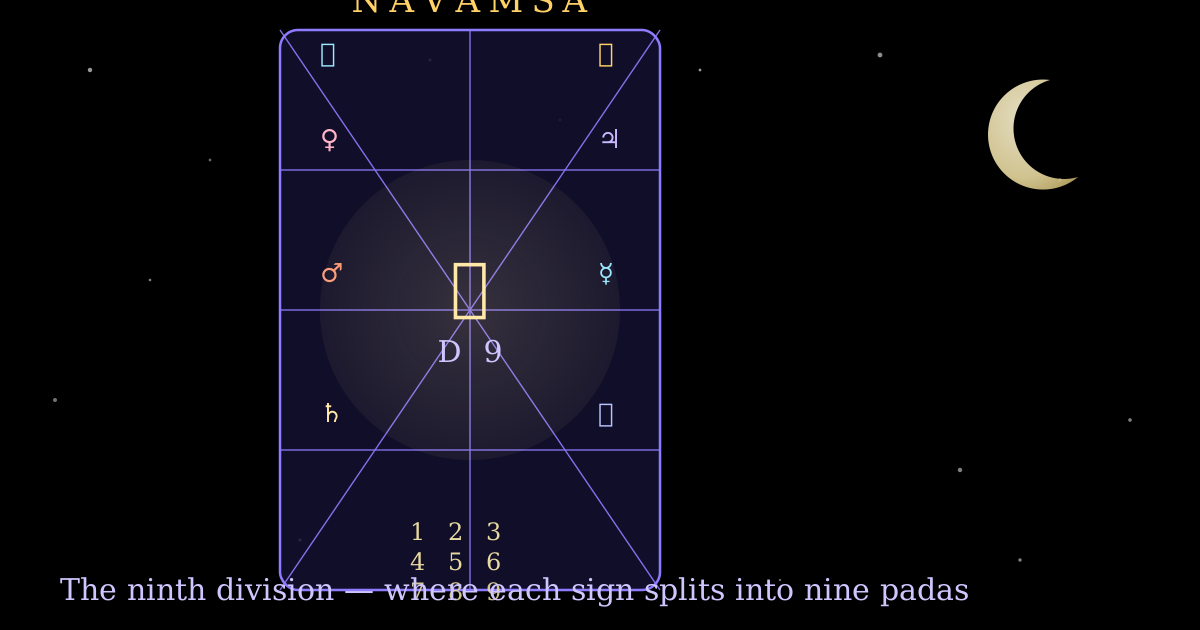
Ask a Vedic astrologer to look at your chart and watch what happens after the first glance: they study the birth chart, nod — and then they pull up a second chart. Smaller, same shape, planets in different signs. That second chart is the Navamsa, usually written as D9, and in this tradition it is never a footnote. The classical texts give it a reverent nickname: phala, the fruit. The birth chart (Rashi, or D1) is the tree; the Navamsa is the fruit the tree bears. A tree can look magnificent and bear bitter fruit, or look unimpressive and ripen something sweet — and the tradition insists you cannot judge the tree without tasting the fruit.
What makes D9 so trusted is a simple, elegant idea: the sign a planet sits in is only the beginning of the story. Each sign is thirty degrees wide, and a planet at 1° of a sign behaves differently from one at 29°. The Navamsa zooms in nine times closer than the birth chart, dividing every sign into nine equal slices of 3°20′ — each slice called a pada — and maps each planet into a second set of signs. The result is a second portrait of the same person: same planets, deeper resolution. Like every folk symbol here, it works best as a mirror for reflection, not a meter that measures your future.
The Math: How Each Sign Splits Into Nine Padas
The geometry is delightfully tidy. Thirty degrees per sign, divided by nine, gives exactly 3°20′ per pada — which is no coincidence: it is the same size as one quarter of a nakshatra. The Navamsa is built from the same atomic unit as the lunar-mansion system, which is why the two interlock so neatly.
The padas are not assigned randomly. Each sign's nine padas cycle through the zodiac starting from a fixed sign that depends on the element of the original sign:
- Fire signs (Aries, Leo, Sagittarius): the padas begin in the same sign and run forward — Aries's padas run Aries through Capricorn, Leo's run Leo through Aries, Sagittarius's run Sagittarius through Cancer.
- Earth signs (Taurus, Virgo, Capricorn): the padas begin in the ninth sign from the original and run forward — Taurus's padas run Capricorn through Scorpio, and so on.
- Air signs (Gemini, Libra, Aquarius): the padas begin in the fifth sign from the original — Gemini's run Libra through Gemini, a full circuit back to itself.
- Water signs (Cancer, Scorpio, Pisces): the padas begin in the first sign of the movable-fixed-mutable cycle within their element — Cancer's padas run Cancer through Pisces, ending where the water element completes its journey.
Don't memorize the tables — no working astrologer does. Chart software calculates the D9 instantly. The point of the math is what it means: your Venus at 14° of Taurus sits in Taurus's fifth pada, which maps to Scorpio — so your D9 Venus is a Scorpio Venus, intense and all-or-nothing, quite different in flavor from the steady Taurean Venus of the birth chart. Same planet, deeper layer.
Why the Tradition Reads D9 as the Fruit
The tree-and-fruit metaphor carries the whole philosophy. The birth chart shows the promise: what life offers, what raw materials you were given. The Navamsa shows the fulfillment: how those materials ripen with time and pressure. A planet strong in D1 but weak in D9 is, in the tradition's folksy phrasing, "a tree that never fruits" — impressive beginnings that don't deliver. A planet weak in D1 but strong in D9 is the late bloomer: the one that looked like nothing at twenty and surprised everyone by forty.
This is also why the D9 is associated with the second half of life. The folk reading goes: the birth chart dominates youth, when raw circumstances rule; the Navamsa takes over as character ripens, when what you do with the raw materials matters more. Whether or not you believe the timeline, the metaphor has genuine psychological bite — who among us hasn't watched strengths and weaknesses ripen into something their teenage chart couldn't have predicted?
The Marriage Connection (and What It Really Covers)
Yes — the Navamsa is famous as the marriage chart, and yes, that reputation is only half the story. The folk logic is that partnership is where character gets tested: you can perform for the world all day, but a spouse sees the fruit, not the tree. So the D9 is read for the deeper texture of committed partnerships — not just romance, but the capacity to merge your life with another person's.
In a D9 reading, tradition looks at:
- The 7th house of the D9: the house of partnership in the fruit chart — its sign, its lord, and the planets placed there are read as describing the quality of committed relationships.
- The D9 Lagna (ascendant): the rising sign of the Navamsa itself, read as the person's deeper nature as it emerges in intimate partnership — who you are when the performance drops.
- Venus and Jupiter in D9: Venus as the natural significator of romance and Jupiter of wisdom and blessing; their dignity in the D9 (own sign, exalted, debilitated) is weighed heavily in partnership readings.
- The D1 7th lord in D9: where the lord of the birth chart's 7th house lands in the Navamsa is read as a bridge between the two charts — the promise of partnership and its ripening, in one line of sight.
The honest framing, as always: none of this predicts an actual wedding date or the character of a real person you haven't met. It is folk symbolism for reflecting on how you partner — your patterns in closeness, what you bring to a merge of lives, and what tends to ripen or wither when you commit. Used as a mirror for that, it can be genuinely illuminating. Used as a guarantee, it is theater.
How to Read Your Own Navamsa: 5 Checks
You don't need to be an astrologer to do a first pass over your D9. Pull up your chart on any free Vedic calculator (it appears automatically next to the birth chart) and walk through these five traditional checks.
1. Find your D9 Lagna. Look at the sign rising in the Navamsa. Tradition reads this as your deeper operating system — the self that emerges in private, in partnership, and in the second half of life. If it differs from your birth-chart ascendant, the tradition says the difference itself is the story: the public face ripening into a different private truth.
2. Check each planet's dignity shift. This is the heart of D9 reading. Compare every planet's sign in D1 with its sign in D9. A planet exalted in the birth chart but fallen in the Navamsa is read as strength that fades under pressure; a planet debilitated in D1 but exalted or in its own sign in D9 is read as the great comeback — hidden reserves that surface late. Tradition holds this dignity shift as one of the most reliable signals in the whole system.
3. Look for Vargottama planets. A planet is Vargottama when it occupies the same sign in D1 and D9 — it "keeps its word," as the tradition puts it. Vargottama planets are read as unusually coherent and dependable: their promise and their fruit agree. A Vargottama Lagna — same ascendant in both charts — is read as an especially integrated personality, someone whose inner and outer selves match.
4. Read the D9 7th house. Find the seventh house of the Navamsa — its sign, its lord, and any planets sitting in it. Tradition reads this cluster as the portrait of partnership patterns: not a spouse's horoscope, but a description of the dynamics you tend to create in committed bonds — the fruit your relationships ripen into.
5. Note Venus and Jupiter's D9 strength. Where do the two great benefic planets land in the fruit chart? Tradition weighs their dignity in D9 as a read on grace under pressure: Venus in its own sign or exalted in D9 is read as warmth that survives difficulty; afflicted, as affection that needs conscious tending. Again — a mirror, not a meter.
Why Birth Time Matters More for D9 Than Almost Anything Else
Here's the technical catch that makes the Navamsa both powerful and perilous: D9 placements change fast. Each pada is only 3°20′ wide, and the ascendant races through a pada in roughly fourteen minutes of birth time. A birth time off by half an hour can move the D9 Lagna — and every D9 house — by two full padas, scrambling the entire reading.
This is why traditional astrologers obsess over birth-time rectification, cross-checking the D9 against known life events. For the casual reader, the takeaway is simpler: if your birth time is approximate (rounded to the hour, or "sometime in the morning"), treat the D9 Lagna and D9 houses as entertainment and focus on the slow-moving planets instead — Saturn, Jupiter, Rahu, and Ketu barely budge between adjacent padas over short time errors, so their D9 dignity readings stay reasonably stable.
Myths About the Navamsa, Debunked
"D9 is only about marriage." Marriage is its famous portfolio, but the fruit chart reads planetary strength, the second half of life, and all deep partnerships — business partners included. Reducing it to romance misses most of what the tradition actually uses it for.
"A bad D9 means a bad marriage." The tradition reads the Navamsa as tendencies and textures, not verdicts. A challenging D9 7th house is described as a pattern to work with consciously — the whole point of seeing the fruit is to tend the tree. No chart configuration determines the behavior of real people in a real relationship.
"The Navamsa replaces the birth chart." Never. The metaphor is tree and fruit — the D9 is read alongside D1, never instead of it. Any reading that discards the birth chart is discarding the tree while judging its fruit.
"You need special software to find your D9." Every free Vedic chart calculator generates it automatically, right beside the birth chart. If a site shows your Rashi chart, your Navamsa is one click away — usually labeled D9.
The Navamsa endures because its core image is undeniable: the difference between promise and ripening, between the tree and the fruit. Everyone has watched a strength fade and a weakness quietly become a gift. The D9 gives that universal experience a map — nine small rooms inside every sign, and a second chart drawn from the first. Whether you read it for marriage, for character, or for the sheer elegance of the geometry, it repays the look. Just remember the gardener's rule: the chart shows the fruit. The tending is yours.
Frequently asked questions
What is the Navamsa chart in Vedic astrology?
The Navamsa, or D9 chart, is one of Vedic astrology's divisional charts: each of the 12 zodiac signs is divided into nine equal parts (padas of 3°20′ each), and a planet's pada determines which sign it occupies in the D9. Tradition calls it the "fruit of the tree" — it is read as revealing a planet's deeper strength and the subtler themes of marriage and partnership.
Is the Navamsa chart only about marriage?
Marriage is its most famous portfolio, but the D9 is read far more broadly: it shows the inner strength or weakness of every planet, the flavor of the second half of life, and the deeper texture of partnerships of all kinds — business included. Think of the birth chart as the tree and the Navamsa as the fruit: the D9 reveals what the tree actually ripens into.
What does it mean if a planet is Vargottama?
A planet is Vargottama when it occupies the same sign in both the birth chart (D1) and the Navamsa (D9). Tradition treats this as a mark of unusual strength and integrity — the planet "keeps its word," delivering its promises cleanly. Vargottama Lagna (ascendant) is read similarly, as a sign of an especially coherent personality.
Can a debilitated planet be strong in the Navamsa?
Yes, and this is one of the D9's most quoted principles: a planet debilitated in the birth chart but exalted in the Navamsa is traditionally read as a story of resilience — the planet recovers, like a tree whose fruit turns out sweet despite poor soil. The reverse — exalted in D1 but debilitated in D9 — is read as strength that fades under pressure.
How do I find my Navamsa chart?
Any free Vedic chart calculator will generate it: enter your birth date, exact birth time, and birthplace, and the Navamsa (D9) appears alongside the birth chart (Rashi/D1). Because D9 placements change with every 3°20′ of planetary motion, an accurate birth time matters more for the Navamsa than for almost any other chart.
Keep exploring

Sade Sati: Meaning, Phases & Remedies Explained
What is Sade Sati? The 7.5-year Saturn transit explained — its three phases, how to tell if it's active for you, and traditional remedies.
Read the meaning →
Kala Sarpa Yoga: Meaning, 12 Types, Effects & Remedies
All seven planets trapped between Rahu and Ketu — learn what Kala Sarpa Yoga means, the 12 serpent types, how to check your chart, and the classic remedies.
Read the meaning →
Nakshatras: The 27 Lunar Mansions Explained
Discover the 27 nakshatras — Vedic astrology's lunar mansions. Meanings, symbols, deities, and how to find your birth star (Janma Nakshatra).
Read the meaning →
Vedic Dasha Periods: Understanding Your Planetary Timeline
Vimshottari Dasha explained: the 120-year Vedic timeline of planetary periods. Meanings of all 9 mahadashas and how to find your current dasha.
Read the meaning →