
Panch Mahapurusha Yoga: Meaning, the Five Great Yogas & How to Find Yours in Your Chart
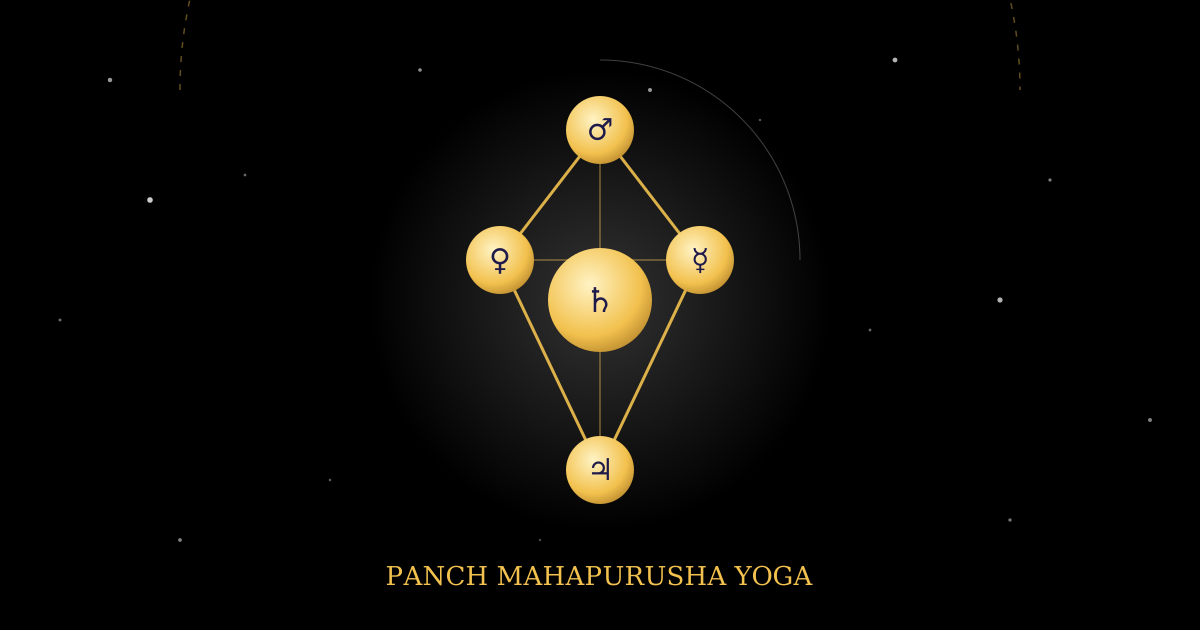
Every chart-reading tradition has its hall of fame — the combinations that make an astrologer's eyebrows rise and a client's hopes lift. In Vedic astrology, or Jyotish, that hall of fame has a name: Panch Mahapurusha Yoga. Panch means five, mahapurusha means great person, and yoga means combination. Five combinations, each said to mark a person others naturally follow.
The idea is older than most of the world's surviving literature. Texts like Brihat Parashara Hora Shastra describe these five yogas in loving, almost cinematic detail: the faces of their natives, the way they walk, the careers they master, the honors they collect. Modern readers should take the poetry as poetry — this is folk symbolism for reflection and entertainment, not a personnel file written in the sky. But as a piece of astrological architecture, the system is elegant, and understanding it teaches you how Vedic astrology thinks about strength itself.
What Makes a Mahapurusha Yoga: Strong Planet, Angular House
Most yogas in Jyotish are relationships — two planets cooperating, as in Raja Yoga, where a kendra lord joins a trikona lord. Panch Mahapurusha Yoga is different. It is a yoga of one planet, standing tall. The recipe has exactly two ingredients, and both must be present.
First, the planet must be strong by dignity: sitting in its own sign (swakshetra) or in its sign of exaltation (uchcha). A planet in its own sign is at home, ruling its own territory; a planet exalted is an honored guest at the height of its power. The five planets that can form these yogas, with their own signs and exaltations, are: Mars (own signs Aries and Scorpio, exalted in Capricorn), Mercury (own signs Gemini and Virgo, exalted in Virgo), Jupiter (own signs Sagittarius and Pisces, exalted in Cancer), Venus (own signs Taurus and Libra, exalted in Pisces), and Saturn (own signs Capricorn and Aquarius, exalted in Libra).
Second, the planet must sit in a kendra house: the 1st, 4th, 7th, or 10th house from the Ascendant. The kendras are the angles of the chart, the pillars that hold the whole structure up — self, home, partnership, and career. A strong planet tucked away in a quiet house is a talent nobody sees; a strong planet in a kendra is a talent on stage. That is the whole logic of the yoga: strength, placed where the world can watch it work.
Notice who is missing. The Sun and Moon, the two luminaries, have no Mahapurusha Yoga of their own. Each rules only a single sign — Leo for the Sun, Cancer for the Moon — and the classical system gives them their own separate combinations and roles instead. The five yogas belong to the five planets that rule two signs each and can therefore stand strong in an angle across a wide range of charts.
The Five Great Yogas, One by One
Each Mahapurusha Yoga has its own name, its own planet, and its own traditional portrait. Here they are in the order the classical texts list them:
- Ruchaka Yoga (Mars): formed when Mars sits in its own sign or exaltation in a kendra. The tradition paints the Ruchaka native as the commander — bold-featured, physically strong, fearless in confrontation, and magnetic in a crisis. The careers the texts associate with it are the uniformed and the competitive: the military, policing, surgery, engineering, sport, and any field where courage under pressure is the currency. Read honestly, Ruchaka is the yoga of drive made visible: energy that does not wait for permission.
- Bhadra Yoga (Mercury): formed when Mercury sits in its own sign or exaltation in a kendra — note that Virgo counts twice, as both Mercury's own sign and its exaltation, which makes Bhadra one of the more commonly found of the five. The Bhadra native, in the classical portrait, is the scholar-statesman: sharp-witted, articulate, graceful in bearing, and skilled with language, numbers, and negotiation. The associated careers are writing, teaching, law, commerce, diplomacy, and analysis. Where Ruchaka charges, Bhadra persuades.
- Hamsa Yoga (Jupiter): formed when Jupiter sits in its own sign or exaltation in a kendra. Hamsa means swan, the bird of discrimination in Indian symbolism, said to separate milk from water — truth from noise. The Hamsa native is the sage-teacher: wise, generous, respected for counsel, and often drawn to philosophy, religion, education, or the law. The texts promise lasting reputation rather than passing fame, and they describe Hamsa natives as people others consult before deciding. If Ruchaka commands and Bhadra persuades, Hamsa advises.
- Malavya Yoga (Venus): formed when Venus sits in its own sign or exaltation in a kendra. The Malavya native is the artist of grace: beautiful in bearing, refined in taste, skilled in music, art, or design, and blessed — in the tradition's telling — with comfort, luxury, and a life surrounded by beautiful things. The associated careers are the arts, fashion, hospitality, perfumery, and any craft where beauty is the product. The folk warning attached to Malavya is the same as its gift: a life of ease must still be earned, or comfort curdles into indulgence.
- Sasa Yoga (Saturn): formed when Saturn sits in its own sign or exaltation in a kendra. The Sasa native is the stern ruler: disciplined, patient, and willing to do the slow work others avoid. The texts describe a rise that comes late and lasts — authority earned through endurance rather than charm, in careers like administration, law, governance, mining, agriculture, or any large organization where persistence is power. Where the other four yogas shine early, Sasa is the long game: the tortoise among the hares, arriving last and staying longest.
Read together, the five form a complete cabinet of human greatness as the old world imagined it: the general, the minister, the priest, the artist, and the administrator. It is a telling list. The tradition did not imagine one kind of great person; it imagined five, and it gave each a planet, a house, and a job description.
How to Check Your Chart for a Mahapurusha Yoga
You will need a Vedic (sidereal) birth chart, not a Western tropical one — the two systems place every planet roughly 24 degrees apart, which can move a planet between signs and houses and change the answer entirely. Free Vedic chart calculators are easy to find online; you need your birth date, exact birth time, and birthplace. Then work through these four checks:
- Step 1 — Find your Ascendant. Your rising sign sets the house map. Without it, there are no kendras to check.
- Step 2 — Locate the five planets. Find Mars, Mercury, Jupiter, Venus, and Saturn in your chart, and note the sign and house of each.
- Step 3 — Test each planet against the recipe. Is the planet in a kendra (1st, 4th, 7th, or 10th house)? And is it in its own sign or exaltation? Mars in Aries, Scorpio, or Capricorn in an angle is Ruchaka; Mercury in Gemini or Virgo in an angle is Bhadra; Jupiter in Sagittarius, Pisces, or Cancer in an angle is Hamsa; Venus in Taurus, Libra, or Pisces in an angle is Malavya; Saturn in Capricorn, Aquarius, or Libra in an angle is Sasa. Each hit is a Mahapurusha Yoga.
- Step 4 — Grade the yoga. The tradition does not stop at presence; it grades. A yoga planet that is also strong in the Navamsa (D9) chart, unafflicted by malefics, aspected by benefics, and not combust (too close to the Sun) is rated far above one that is weak in D9 or heavily afflicted. Then check the dasha timeline: the tradition says a yoga speaks loudest during its own planet's mahadasha or antardasha.
That last step explains the most common real-life puzzle: the chart carrying a textbook Mahapurusha Yoga whose owner lives an ordinary life. A magnificent yoga whose planet never rules a dasha in the person's lifetime is said to stay mostly latent, and a yoga weakened by affliction is said to promise in a whisper rather than a shout. In the classical view, the yoga is the seed and the dasha is the season.
When a Mahapurusha Yoga Is Strong, Weak, or Cancelled
The texts are refreshingly honest about failure modes. A Mahapurusha Yoga is traditionally considered weakened when its planet is combust, defeated in planetary war, retrograde in a way the tradition reads as unsteady for that planet, or hemmed in by malefics without benefic aspect. It is strengthened when the planet is also strong in the Navamsa, sits in a kendra that is also its own or exalted sign in D9, is aspected by Jupiter or Venus, and is supported by a strong Ascendant lord — the chart's captain, without whom even the grandest yoga struggles.
There is also the question of how many yogas a chart can carry. Most charts that carry one carry only one, but two or more are possible, and the tradition rates such charts very highly — the commander who is also a sage, the artist who is also an administrator. The honest caveat, repeated by careful astrologers, is that strength matters more than count. One strong, well-supported, dasha-activated yoga outweighs several weak ones, and a chart with no Mahapurusha Yoga at all is not a chart without promise: most of the yogas in the classical system, including the great Raja Yogas, are formed by planetary relationships rather than single-planet strength, and a chart can be rich in those while carrying none of these five.
Scale deserves the same honesty as strength. Mahapurusha in classical India meant the chief of a world — the head of a guild, the leading scholar of a town, the most trusted voice in a community — not necessarily a literal king. Read in that spirit, the five yogas promise prominence in your own sphere, and spheres come in all sizes. The head teacher, the lead surgeon, the founder of a small firm, and the artist everyone in town knows are all, in the old sense, great persons.
Panch Mahapurusha Yoga and Raja Yoga: How They Relate
Beginners often ask whether these five yogas are a kind of Raja Yoga, and the answer is yes with a nuance. Panch Mahapurusha Yoga is counted among the Raja Yogas — the royal combinations — because a strong planet in an angle traditionally indicates status and authority. But it is a distinct branch of the family: Raja Yoga in its classic definition is a relationship between a kendra lord and a trikona lord, while Mahapurusha Yoga is a single planet standing strong in an angle. The two can overlap beautifully. A Jupiter that forms Hamsa Yoga may also be a trikona lord connected to a kendra lord, stacking a relationship yoga on top of a strength yoga, and the tradition says such stacked charts are the ones to watch.
The practical lesson is the same one that runs through all of Jyotish: no single combination tells the story. The chart is a network, and the yogas are its landmarks. Panch Mahapurusha Yoga is simply the most famous landmark of all — five great persons, standing in the angles of the sky, waiting for their season.
Myths About Panch Mahapurusha Yoga, Debunked
"A Mahapurusha Yoga guarantees fame and fortune." The tradition's own fine print contradicts this. Classical authors grade yogas by strength, require dasha activation, and insist on the native's effort. The yoga opens a door; nobody in the texts walks through it for you.
"Only one yoga matters, so check for yours and stop." The chart is a network. A Mahapurusha Yoga is one landmark among many, and the yogas interact — a Hamsa Yoga supported by a strong Raja Yoga reads differently from one standing alone in a weak chart.
"No Mahapurusha Yoga means an ordinary life." Most charts carry none of the five, and the tradition never treats that as a verdict. Relationship yogas, dasha timing, and a strong Ascendant lord all shape a life, and many celebrated charts are rich in those while carrying no Mahapurusha Yoga at all.
"You can buy or ritual your way into a Mahapurusha Yoga." Nothing in the classical framework creates a yoga that is not in the chart. Remedies — gemstones, mantras, charity — are described as steadying a planet's expression or supporting the native, never as rewriting the birth chart. Anyone selling you a purchased yoga is selling a crown that fits no head.
The five great persons endure in the imagination because the hunger they name is real, whatever you believe about the stars. Everybody has felt the difference between talent hidden and talent placed — between the gift that never found its stage and the gift that stood in the angle of the chart, in the light, where the world could see it work. Panch Mahapurusha Yoga, in the tradition's telling, is simply that feeling given a geometry: strength, standing tall, in the house where life happens. Read it as a lens for reflection and entertainment, check it honestly against dignity, Navamsa, and dasha, and let it be what the old texts always said it was — not a verdict on your life, but a reminder to put your strongest self where it can be seen.
Frequently asked questions
What is Panch Mahapurusha Yoga in Vedic astrology?
Panch Mahapurusha Yoga is a group of five celebrated combinations in Vedic astrology, formed when Mars, Mercury, Jupiter, Venus, or Saturn sits strong — in its own sign or exaltation — in a kendra house (1st, 4th, 7th, or 10th). Each planet forms its own yoga: Ruchaka (Mars), Bhadra (Mercury), Hamsa (Jupiter), Malavya (Venus), and Sasa (Saturn). The tradition describes their natives as great persons — people others naturally follow — with each yoga carrying its own flavor of leadership, wisdom, artistry, or discipline.
How do I know if I have a Panch Mahapurusha Yoga?
You need a Vedic (sidereal) birth chart. Check whether Mars, Mercury, Jupiter, Venus, or Saturn sits in a kendra house (1st, 4th, 7th, or 10th) in its own sign or in its sign of exaltation. If it does, the matching Mahapurusha Yoga is present. The tradition then grades it by the planet's strength in the Navamsa chart, freedom from affliction, and whether the planet's dasha period ever runs.
Can you have more than one Panch Mahapurusha Yoga?
Yes, though it is rare. A chart can carry two or even more Mahapurusha Yogas at once, and the tradition rates such charts very highly — the person is said to combine, for example, the commander's drive with the sage's wisdom. Most charts that carry one carry only one, and the tradition warns that a yoga's strength matters more than the count: one strong, well-supported yoga outweighs several weak ones.
Does Panch Mahapurusha Yoga guarantee success?
No. Classical texts treat these yogas as promises of potential, not guarantees of outcome. Their results are said to depend on the planet's dignity and strength, its placement in the Navamsa chart, afflictions from malefics, the dasha periods running in the person's life, and the person's own effort. Read them as folk symbolism for reflection and entertainment, not as a prediction of fame or fortune.
Why are the Sun and Moon not part of Panch Mahapurusha Yoga?
The Sun and Moon are the luminaries and are treated differently in the classical system: the Sun is said to own only one sign (Leo) and the Moon only one (Cancer), and both have their own separate yogas and roles. Panch Mahapurusha Yoga is defined specifically for the five non-luminary planets — Mars, Mercury, Jupiter, Venus, and Saturn — each of which rules two signs and can therefore sit in its own sign or exaltation in a kendra in a wider range of charts.
Keep exploring
Raja Yoga in Vedic Astrology: Meaning, Types & How to Find It in Your Chart
What is Raja Yoga? The royal combinations of Jyotish explained — kendra and trikona lord connections, the major types, how to check your chart, and what the tradition really promises.
Read the meaning →
Gajakesari Yoga: Meaning, How to Find It in Your Chart & What It Really Promises
What is Gajakesari Yoga? Jupiter in a kendra from the Moon forms the famous elephant-and-lion combination — learn how to check your chart, when it is strong or weak, and what the tradition really promises.
Read the meaning →
Atmakaraka Planet: Meaning, How to Find Your Soul Planet & What It Reveals
What is Atmakaraka? The soul planet of Jaimini astrology explained — how to find the highest-degree planet in your chart, what each Atmakaraka reveals, and how it shapes your life path.
Read the meaning →
Navamsa Chart (D9): Meaning & How to Read Your Fruit Chart
The birth chart is the tree, the Navamsa is the fruit. Learn how each sign divides into nine padas, what D9 reveals about planetary strength and partnership, and the 5 checks to read your own chart.
Read the meaning →