
The 12th House in Astrology: Spirituality, Hidden Patterns & the Unconscious
Eleven of the twelve houses deal with visible life: money in the 2nd, love in the 7th, career in the 10th. Then there is the 12th — the final house, the one astrologers reach for when the subject is dreams, spiritual experience, solitude, and the quiet machinery of the unconscious mind. It has been called the house of the unseen, the house of endings, and (in older texts with a flair for drama) the house of self-undoing. Modern astrologers tend to be kinder: they call it the ocean at the bottom of the chart.
This guide walks the shoreline of that ocean. You'll learn what the 12th house rules, how to read its cusp sign and ruling planet, what each planet means when placed there, which transits wake it up, and — because this house gets a bad reputation it doesn't deserve — how to work with it as a source of rest, creativity, and quiet strength. As with all astrology, treat this as a reflective lens for self-understanding, not a prediction of what will happen to you.
What the 12th House Rules
The 12th house gathers everything in life that happens out of sight — literally and psychologically. Its traditional domains include:
- Spirituality and mysticism: prayer, meditation, contemplation, mystical experience — the sense of belonging to something larger than yourself.
- Dreams and the unconscious: the dream world, the imagination, and the patterns that run beneath your conscious intentions.
- Solitude and retreat: time alone, sabbaticals, retreats, and the need to withdraw periodically to recharge.
- Hidden patterns and habits: the behaviors you repeat without noticing — self-sabotage included, which is why older texts used harsher language for this house.
- Endings and closure: the 12th is the last house before the Ascendant, so it carries themes of completion, release, and letting go.
- Compassion and quiet service: helping behind the scenes — charity, caregiving, and work done for its own sake rather than for recognition.
- Seclusion and institutions: hospitals, retreat centers, monasteries, and any place set apart from ordinary life.
- The collective: the shared, archetypal layer of experience — what Carl Jung's followers would call the collective unconscious, and what many modern astrologers simply call "the ocean we're all swimming in."
Notice what binds the list together: every item involves the boundary between self and not-self getting softer. The 1st house is "me"; the 12th is where "me" dissolves — into sleep, into spirit, into service, into the sea.
Where the 12th Sits in Your Chart's Story
Each house tells a chapter in the wheel's larger narrative, and the 12th is the final chapter. The 10th house builds your public role, the 11th connects you to communities and causes, and the 12th asks what remains when the roles and groups fall away. It is a cadent house (one of the houses that falls away from the angles), which traditional astrology associated with mental and spiritual activity rather than outer action — preparation more than performance.
The 12th is the natural house of Pisces, the zodiac's most boundary-dissolving sign, which is why the two share so much symbolism: dreams, compassion, imagination, and transcendence. Its traditional ruler is Jupiter (the planet of faith and expansion) and its modern ruler is Neptune (the planet of dreams and the infinite). That double rulership is a nice summary of the house itself: part faith, part fog.
And about that old "self-undoing" label: it came from observing that 12th-house themes — hidden habits, escapism, keeping secrets from yourself — can quietly steer a life off course. Modern astrologers keep the warning but drop the doom. The 12th isn't a house of punishment; it's the house that asks you to look at what you normally look away from.
The Sign on Your 12th House Cusp
To find your 12th house, locate the Ascendant — the leftmost point of your chart, where the eastern horizon met the zodiac at your birth. The wedge of sky just above it, tucked between the Ascendant and the very top of the wheel, is your 12th house. The sign on that house's cusp sets the flavor of your inner world.
As a reflection prompt rather than a verdict, here is the traditional flavor of each sign on the 12th cusp:
- Aries 12th: Hidden reserves of courage; private ambition that surprises people when it surfaces.
- Taurus 12th: A secret love of comfort and beauty; restoration through nature, food, and the senses.
- Gemini 12th: A rich, constant inner monologue; the need to write or talk things out in private.
- Cancer 12th: Deep, private emotional tides; family history felt as an undertow.
- Leo 12th: Creativity kept backstage; generosity given quietly, without an audience.
- Virgo 12th: A hidden perfectionist streak; peace found in private rituals and order.
- Libra 12th: Relationship patterns that run on autopilot; harmony sought in solitude first.
- Scorpio 12th: Profound psychological depth; transformation happens in the dark, then emerges.
- Sagittarius 12th: A private philosophical streak; wanderlust of the mind during quiet hours.
- Capricorn 12th: Hidden discipline and endurance; rest that has to be scheduled to happen.
- Aquarius 12th: Unconventional inner life; solidarity with the collective felt privately.
- Pisces 12th: The ocean at home: vivid dreams, porous boundaries, and a natural pull toward the spiritual.
Once you know the cusp sign, find its ruling planet — where is it placed, and what aspects does it make? That planet is the 12th house's working manager. A 12th house with a Virgo cusp is managed by Mercury; if your Mercury sits in the 7th, your hidden patterns most often surface inside relationships. Follow the ruler and the house starts talking.
Planets in the 12th House: What Each Placement Suggests
Planets in the 12th are traditionally read as energies that work privately, intuitively, or behind the scenes rather than in public view. None of these are verdicts — they are starting points for self-reflection:
- Sun in the 12th: Identity needs solitude the way lungs need air. You may recharge alone and express your core self more freely away from the spotlight — many 12th-house Suns are publicly modest and privately vivid.
- Moon in the 12th: A rich, private emotional life. Feelings are processed internally before they're shared, and dreams may carry unusual weight. Solitude isn't loneliness for this placement; it's emotional hygiene.
- Mercury in the 12th: A constant inner dialogue — the mind talks to itself, and writing, journaling, or voice notes become the bridge between inner and outer worlds.
- Venus in the 12th: Love expressed quietly: devotion shown in actions rather than announcements, a secret artistic life, or affection for the overlooked and underdog.
- Mars in the 12th: Drive that needs a private warm-up. Anger may go underground rather than outward, so physical outlets and honest alone-time matter; channeled well, this is the placement of the tireless behind-the-scenes worker.
- Jupiter in the 12th: Traditionally called a "guardian angel" signature — a sense of quiet protection, faith that renews in solitude, and generosity that asks for no credit.
- Saturn in the 12th: The discipline of rest has to be learned; there can be a fear of being unseen or forgotten. The growth edge is trusting that you don't have to be visible to be valuable.
- Uranus in the 12th: Unconventionality that runs underground — sudden insights in dreams or solitude, and a private streak of rebellion against your own routines.
- Neptune in the 12th: The planet of the infinite at home in the house of the infinite: thin boundaries, strong intuition, and an imagination that needs a regular creative outlet.
- Pluto in the 12th: Deep psychological currents — the placement of people who do their transforming in private and emerge, periodically, as someone new.
A note on emphasis: a stellium (three or more planets) in the 12th concentrates a lot of chart energy in the unseen realm. Astrologers often read this as a life with a strong contemplative, creative, or service-oriented undertow — and a genuine need for regular withdrawal to stay balanced.
The 12th House in Relationships
In synastry (chart comparison), one person's planets falling in your 12th house creates a peculiar intimacy: you may feel strangely known by them — or strangely unable to see them clearly. The 12th overlay can feel like instant soul-recognition, and equally like a fog where projections thrive. Astrologers suggest enjoying the tenderness while keeping one foot in clear-eyed reality: ask whether you're seeing the person or your own unconscious reflected back.
In composite charts (the chart of the relationship itself), 12th-house emphasis suggests a bond with a strong private world — a couple that needs its cave, its rituals, its shared inner life away from everyone else. That privacy is a feature, not a bug, as long as the relationship doesn't use it to hide from honest conversation.
Transits Through the 12th House: Seasons of the Unseen
When planets move through your 12th house by transit, astrologers read it as a season when inner life takes the foreground. Treat these as reflective prompts, not forecasts:
- Jupiter through the 12th (about a year): traditionally a quiet, protected chapter — good for retreat, spiritual study, and finishing old business. Many astrologers call it the year to tie up loose ends before Jupiter enters your 1st house and a new twelve-year cycle begins.
- Saturn through the 12th (about two and a half years): the classic "confront the patterns" transit. Old habits, unfinished grief, and avoided conversations tend to surface for review. Astrologers frame it as a renovation of the inner house — uncomfortable, clarifying, and usually worth it.
- Uranus, Neptune, or Pluto through the 12th (years to decades): long, slow chapters of unconscious change. People often look back on these periods and realize the ground of their inner life quietly rearranged itself.
- Eclipses in the 12th: read as moments when something hidden comes to light — a realization, a revelation, or simply the moment you finally name what you've been avoiding.
The through-line: 12th-house transits reward the practices the house itself rules — journaling, rest, honest conversation with yourself — and they punish the house's shadow: avoidance, numbing, and pretending everything is fine.
Working With Your 12th House: Gentle Practices
Whatever your placements, the 12th house responds to attention. These are reflective practices astrologers and contemplative traditions alike associate with this house — general wellness habits, not medical advice:
- Keep a dream journal: Note dreams on waking, even fragments. You're not decoding prophecies; you're building a relationship with your own unconscious, which is exactly what the 12th house is.
- Schedule solitude: Treat alone time as an appointment, not a leftover. Even twenty unplugged minutes a day gives 12th-house energy somewhere to go.
- Create privately: Art, music, or writing made with no audience in mind. The 12th house is famously where creativity lives before it's ready to be seen.
- Practice quiet service: Do something kind that nobody will know about. It sounds like a moral exercise; astrologically, it's 12th-house hygiene — compassion without performance.
- End things cleanly: The 12th rules closure. Unsent letters written and burned, old accounts closed, apologies made — endings are this house's native language.
- Watch the escapes: The shadow of the 12th is avoidance dressed as rest — endless scrolling, numbing routines, "one more episode." Noticing the difference between genuine retreat and quiet escape is the house's master class.
Three Myths About the 12th House
This house collects superstitions like lint. Let's clear the big three:
- "The 12th is the bad-luck house." The old texts called it unfortunate because it sits far from the chart's power points — not because it curses anyone. Modern practice reads it as neutral-to-gifted: the house of spiritual depth, creativity, and compassion.
- "Planets in the 12th are wasted." A planet you can't see working publicly is still working. 12th-house planets often express through art, caregiving, spiritual life, or dream work — channels that don't require an audience to be real.
- "An empty 12th means you have no inner life." Emptiness in a house never means the life area is missing — it means no planet is stationed there. The cusp sign and its ruler always carry the story, and everyone has a 12th house.
Your Turn: A 10-Minute 12th-House Reading
Pull up your birth chart and try this:
- Step 1: Find your Ascendant, then look at the wedge just above it — that's your 12th house. Note the sign on its cusp.
- Step 2: Note any planets inside that wedge. Read each one through the "private, intuitive, behind-the-scenes" filter above.
- Step 3: Find the ruler of your 12th cusp sign. Where is it? That planet's house and aspects show where your hidden patterns most often surface in daily life.
- Step 4: Check current transits: is any slow planet moving through your 12th house right now? If so, journal for a week on what feels "under review" in your inner life.
- Step 5: Ask honestly: where in my life do I already honor this house — and where do I avoid it? The 12th house rewards the honest answer more than any technique.
The 12th house is astrology's reminder that the most important things in a life are often the least visible: the dreams you remember, the solitude that restores you, the kindness no one sees, and the quiet work of becoming yourself when nobody is watching.
Frequently asked questions
What does the 12th house represent in astrology?
The 12th house represents everything that works beneath the surface: spirituality, dreams, the unconscious mind, solitude, hidden patterns and habits, endings and closure, compassion and quiet service, and the parts of yourself you don't show the world. It is the final house of the chart cycle, where the personal dissolves into the universal.
Is it bad to have planets in the 12th house?
No. Planets in the 12th house are traditionally read as energies that work privately, intuitively, or behind the scenes rather than publicly. A 12th-house Venus may love deeply but quietly; a 12th-house Mars may need solitude to recharge. The placement asks for conscious integration of your inner life, not fear.
What does an empty 12th house mean?
An empty 12th house simply means no planets are placed there — read the sign on the 12th house cusp and the position of its ruling planet instead. Most people have several empty houses, and emptiness never means a missing life area; the cusp sign and ruler always tell the story.
Which planet rules the 12th house?
The 12th is the natural house of Pisces, so its traditional ruler is Jupiter and its modern ruler is Neptune. But in your own chart, the planet that rules the sign on your 12th house cusp is the house's working ruler — follow that planet's sign, house, and aspects to see how your 12th house expresses itself.
How do I find my 12th house sign?
On your birth chart, find the Ascendant (the leftmost point, marking the 1st house cusp). The 12th house is the wedge just above it, tucked between the Ascendant and the top of the chart. The zodiac sign on that house's cusp is your 12th house sign.
Keep exploring
Empty Houses in Astrology: What They Really Mean & How to Read Them
Spot an empty house in your birth chart? Learn what empty houses really mean — how to read the cusp sign and ruling planet, and the transits that light them up.
Read the meaning →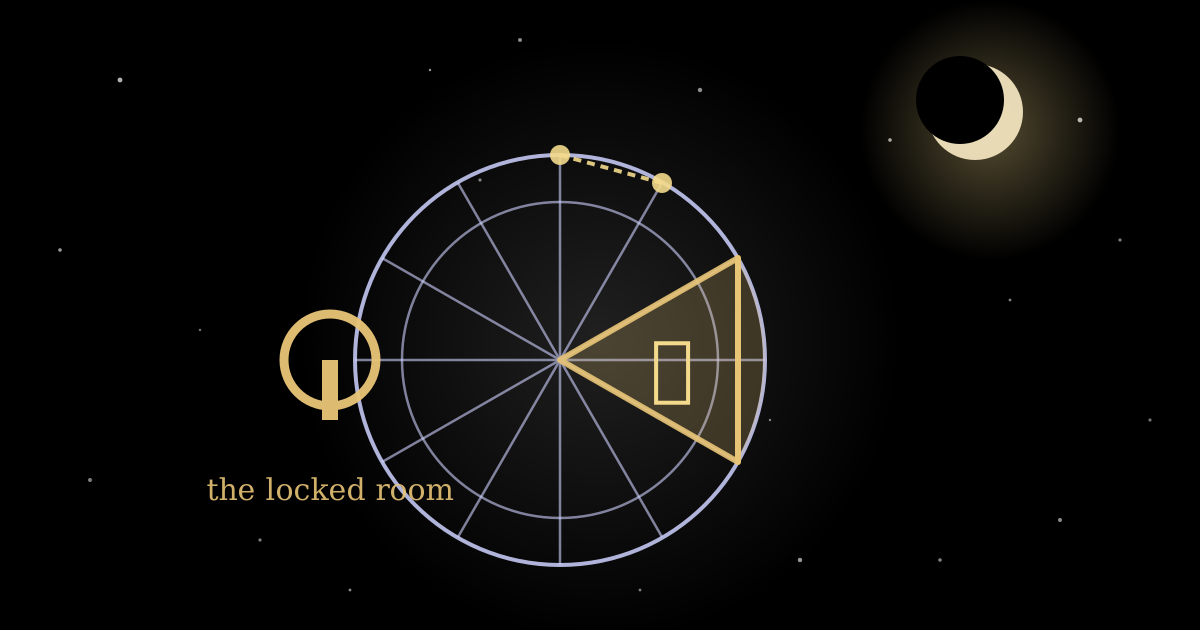
Intercepted Houses in Astrology: What an Intercepted Sign Really Means
Spot a zodiac sign tucked entirely inside one house, touching no cusp? Learn what intercepted houses mean, why they happen, and how to unlock the hidden energy.
Read the meaning →
The 12 Astrology Houses: Complete Meaning Guide
The 12 astrology houses explained: meanings for each house, how to read planets in houses, house systems, and what empty houses mean.
Read the meaning →
Planets in the Houses: How Placements Shape Each Life Area
Planets in the houses: what every planet means in each house. Learn the planet + sign + house blend with examples, stelliums, and a worked reading.
Read the meaning →