
Whole Sign vs. Placidus House Systems: Which One Should You Use?
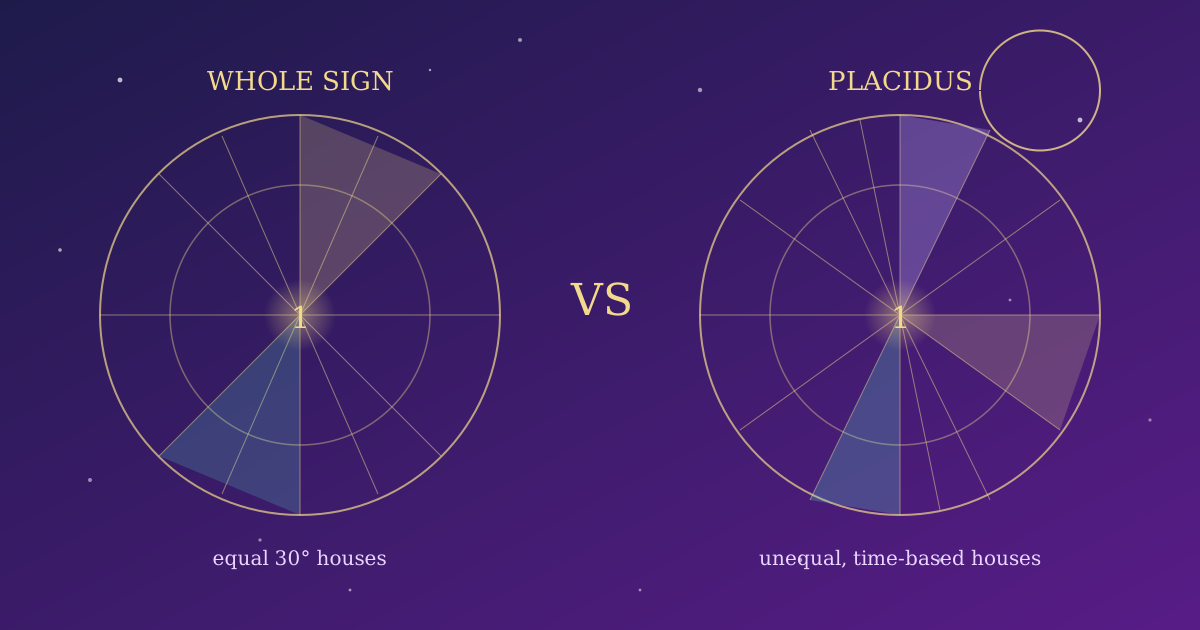
Open the same birth chart in two different apps and you may get a small shock: a planet that sat in your 7th house yesterday is suddenly in your 8th. Nothing about your birth data changed. What changed is the house system — the method the software used to slice the sky into twelve houses. Whole Sign and Placidus are the two systems beginners meet first, and the confusion between them is one of the most common stumbling blocks in learning astrology.
This guide explains both systems in plain language: how each one divides the wheel, where they agree and where they differ, why intercepted signs and a wandering Midheaven appear in one system and not the other, and a practical way to choose the system that works for your own reading. As with all astrology here, treat house systems as reflective frameworks for self-understanding, not as predictions about your life.
Why House Systems Matter at All
The twelve houses are the where of a birth chart. Signs describe style, planets describe energy, and houses describe the life area where that energy plays out — the 1st house of self, the 7th of partnership, the 10th of career, and so on. But the sky is a continuous circle, and dividing a circle into twelve meaningful pieces requires a rule. Different eras and schools chose different rules, and each rule produces a slightly different map of the same sky.
That is why house systems matter: they decide which life area a planet belongs to, and that decision shapes the whole reading. A Venus in the 5th house reads as romance and creative pleasure; the same Venus in the 6th reads as devotion expressed through daily care and service. Both readings draw on the same planet and the same sign — only the house changed. When two systems disagree, they are not disagreeing about the planet. They are disagreeing about where to draw the boundary line.
It helps to know that this disagreement is old and normal. Whole Sign is the oldest known house system, used by Hellenistic astrologers two thousand years ago. Placidus, named for the seventeenth-century astrologer Placidus de Titis, became the default in modern Western astrology and remains the preset in most chart software today. Vedic astrology uses Whole Sign as its standard, while most Western textbooks teach Placidus first. A reader who knows both systems can follow almost any book, app, or teacher without getting lost when the houses shift.
The Whole Sign System: One Sign, One House
Whole Sign is beautifully simple. Find the sign rising on the eastern horizon at birth — the Ascendant sign — and that entire sign becomes the 1st house, all thirty degrees of it. The next sign becomes the entire 2nd house, the next the 3rd, and so on around the wheel until the twelfth sign becomes the 12th house. Every house is exactly thirty degrees wide, every house contains exactly one sign, and every sign belongs to exactly one house.
Suppose your Ascendant is 24 degrees Leo. In Whole Sign, the whole of Leo — from 0 to 30 degrees — is your 1st house, even though your Ascendant degree sits near the end of the sign. Virgo becomes your entire 2nd house, Libra your entire 3rd, and so on. A planet at 5 degrees Leo and a planet at 28 degrees Leo are both in your 1st house, because both are in Leo. There are no partial houses, no split signs, and no house smaller than any other.
This simplicity is also the system's strength for learning. Beginners can read a Whole Sign chart without calculating a single cusp, and the sign-house correspondence stays clean: the sign on a house cusp is the sign of the whole house, so the house ruler is obvious. Traditional astrologers also valued a related idea called the whole-sign dignity: a planet in its own sign is at home in that house in a way that quadrant systems sometimes blur, because the sign and the house are the same stretch of sky.
Whole Sign does have a quirk that surprises newcomers. The Midheaven — the point at the top of the chart associated with career and public life — is not forced to sit at the start of the 10th house. Depending on birth latitude, the Midheaven can fall in the 9th, 10th, or 11th Whole Sign house. Whole Sign readers do not treat this as a problem: the Midheaven remains an important point wherever it lands, and it is read alongside the 10th house rather than as its boundary. The Ascendant, by contrast, always opens the 1st house, since the 1st house is defined by the rising sign itself.
The Placidus System: Time-Based, Unequal Houses
Placidus divides the sky by time rather than by sign. Its calculations start from the Ascendant and the Midheaven and divide the time a point takes to rise and culminate into equal thirds, producing house cusps that move with latitude and time of day. The practical result is that Placidus houses are usually unequal: one house might span twenty degrees while its neighbor spans forty, and the difference grows more dramatic the farther north or south of the equator the birthplace lies.
Using the same example — Ascendant at 24 degrees Leo — Placidus keeps the 1st house cusp at 24 degrees Leo, not at 0 degrees. The 1st house then runs from 24 Leo until the calculated 2nd house cusp, which might fall in late Virgo or early Libra. A planet at 5 degrees Leo would sit in the 12th house in Placidus, not the 1st, because it falls before the Ascendant degree. A planet at 28 degrees Leo would sit in the 1st. The same sign is now split across two houses, and the boundary between them is a degree, not a sign edge.
Placidus also produces two features Whole Sign never does: intercepted signs and duplicate signs. An intercepted sign is a sign fully contained inside one Placidus house, with no house cusp inside it — it has no house of its own and is sometimes described as locked away or expressed indirectly. A duplicate sign is the mirror image: a sign that contains two house cusps, so it rules two houses at once. Both features appear most often at higher latitudes, where unequal houses are most extreme, and some astrologers read them as meaningful extra layers — a theme that is hidden, or a theme that doubles up.
Why did Placidus become the modern default? Partly because its mathematics felt more astronomically precise to early modern astrologers, who liked that its cusps tracked the actual motion of points across the sky through the day. Partly because its unequal houses give more texture to a reading: the exact degree of a cusp, the size of a house, and the presence of intercepted signs all become interpretive details. And partly through momentum — once the major software and textbook publishers adopted it, students learned it first and kept it.
Side by Side: What Actually Changes
For most charts, switching systems changes less than people fear. Planets in the middle of a house usually stay in the same house under both systems, because only the boundaries move. The placements that shift are the ones near a Placidus cusp: a planet within a few degrees of a boundary can cross into the neighboring house in Whole Sign, and a planet in a small Placidus house can gain or lose a neighbor. If your Ascendant falls early in its sign, the two systems will look very similar. If it falls late in its sign — say 27 degrees — the shift can be larger, because Whole Sign pulls the whole rising sign into the 1st house while Placidus starts the 1st house at 27 degrees and leaves the earlier degrees of that sign in the 12th.
Consider a concrete example. A person born with an Ascendant of 26 degrees Scorpio and Mars at 10 degrees Scorpio would have Mars in the 12th house under Placidus, since Mars sits before the Ascendant degree. Under Whole Sign, Scorpio is the entire 1st house, so Mars moves to the 1st. The reading changes tone: 12th-house Mars is often described as drive expressed privately or held back, while 1st-house Mars is described as drive expressed directly and visibly. Neither description is wrong in some absolute sense — they are two framings of the same Mars in Scorpio — but a reader will recognize one more readily than the other, and that recognition is useful data.
House rulers can shift too. In Whole Sign, the ruler of a house is simply the ruler of its sign, so the ruler of the 7th house is the ruler of the sign opposite the rising sign. In Placidus, a house whose cusp falls in one sign but whose bulk lies in another can leave readers debating whether to use the cusp ruler, the sign ruler of the intercepted sign, or both. Whole Sign keeps rulership clean; Placidus makes it richer and more contested. If you follow house-ruler techniques like derived houses or annual profections, this difference matters more than it does for a simple planet-in-house reading.
Transits and timing also behave differently. Placidus readers often time events to exact cusp crossings — a planet crossing the 10th house cusp is treated as a career moment. Whole Sign readers time events to sign ingresses instead, since a house begins when a planet enters its sign. Both approaches give usable timing language, but they will not always agree on the date a transit becomes active, which is worth knowing before comparing predictions from two sources.
Intercepted Signs, Duplicate Signs, and the Midheaven Question
Intercepted signs deserve a closer look, because they are the feature most often used to argue for or against Placidus. In Placidus, an intercepted sign has no house cusp and therefore no house to rule in the usual way. Some astrologers read this as a theme that is present but hard to access — a talent that stays private, a family pattern that goes unspoken, a need that expresses itself sideways. Others treat interception as a mathematical artifact with no special meaning, and simply read the planet in the house that contains it. There is no consensus, which itself is useful to know: if an intercepted sign appears in your chart, you are free to test both readings against your experience rather than accepting one authority.
Duplicate signs raise a similar question. When one sign holds two cusps, it rules two houses, and some readers describe its themes as doubled or blended across those life areas. A sign ruling both the 2nd and 3rd houses, for example, might link money and communication in a person's life — earning through words, or valuing learning as a resource. Whole Sign readers never face this question, because each sign rules exactly one house, and the link between money and communication would have to come from somewhere else in the chart, such as a planet aspecting both houses.
The Midheaven question is the mirror image. Placidus guarantees the Midheaven is the 10th house cusp, which keeps career and public life neatly tied to one house. Whole Sign lets the Midheaven float into the 9th, 10th, or 11th house, which some readers find untidy and others find honest: a person's public role may genuinely be shaped by philosophy and travel (9th), by career itself (10th), or by community and networks (11th), and the Midheaven's house tells you which. If you were born at a high latitude, check where your Midheaven falls in Whole Sign — that house often adds a nuance to career readings that Placidus folds into the 10th by definition.
One more practical note: at extreme latitudes, near the Arctic or Antarctic circles, Placidus calculations can break down entirely, producing houses that span enormous arcs or cusps that cannot be computed. Whole Sign has no such problem, since it needs only the rising sign. This is one reason Whole Sign remains popular among astrologers who work with charts from far northern or southern birthplaces, and why some software falls back to Whole Sign automatically when Placidus fails.
How to Choose a System for Your Own Chart
The honest answer is to try both and keep the one that reads more true — but try them properly, not by glancing at one shifted planet and declaring a winner. Generate your chart in both systems, list the placements that actually change, and read each changed placement as a short paragraph. Which version describes the life area more recognizably? Which one explains a pattern you already know about yourself? A single placement rarely decides the question; a pattern across two or three changed placements usually does.
If you are just starting out, begin with Whole Sign. Its clarity removes a whole layer of calculation anxiety: every house is a sign, every sign is a house, and you can focus on learning what the houses mean before worrying about cusps and interceptions. Once the twelve houses feel familiar, generate the Placidus version and compare. The comparison itself is a lesson — it teaches you which of your placements are stable across systems and which sit near boundaries, and boundary placements are worth understanding in either system.
If you are following a particular teacher, book, or tradition, match its system while you study it. A Hellenistic or Vedic text will assume Whole Sign; a modern psychological astrology text will usually assume Placidus. Mixing systems mid-study is the main source of confusion, not either system on its own. Once you have finished a course of study, you can experiment freely, and many experienced astrologers do: some read Whole Sign for natal charts and Placidus for transits, some use Placidus for clients and Whole Sign for their own study, and some keep one system for consistency and check the other only when a reading feels stuck.
Consistency matters more than the choice itself. A chart read in two systems at once, with placements cherry-picked from each, quickly becomes unfalsifiable — every trait can be explained by one system or the other. Pick a primary system, learn it well, and let the other be a second opinion you consult deliberately, not a menu you browse for the most flattering reading. That discipline is what turns house systems from a source of confusion into a genuine tool.
Three Myths About House Systems
- “Placidus is the correct system because it is the default.” Placidus is the default in most modern software, but defaults reflect history and publishing momentum, not proof. Whole Sign predates it by well over a thousand years and remains the standard in major living traditions. A default is a starting point, not a verdict.
- “Whole Sign is too simple to be serious.” Simplicity in division is not simplicity in interpretation. Whole Sign readers work with the same planets, signs, aspects, and rulerships as everyone else, and its clean sign-house correspondence supports sophisticated techniques like whole-sign profections that quadrant systems handle less neatly.
- “You must pick one system forever.” Many astrologers change systems over a career, use different systems for different techniques, or read a chart in both before settling on an interpretation. What matters is knowing which system produced the chart in front of you and being honest about it, not swearing loyalty to one method for life.
The houses are rooms, and house systems are the floor plans. Whole Sign draws twelve equal rooms, each painted a single sign color. Placidus draws twelve rooms sized by the time of day, with some colors spilling across two rooms and some rooms holding two colors at once. Walk through both floor plans of your own chart, notice which rooms feel like home, and read from the plan that helps you understand the life lived inside it.
Frequently asked questions
What is the difference between Whole Sign and Placidus houses?
In the Whole Sign system, each house is exactly one whole zodiac sign: the sign on the Ascendant becomes the entire 1st house, the next sign becomes the 2nd house, and so on. In the Placidus system, houses are divided by time-based calculations tied to the Ascendant and Midheaven, so houses are usually unequal in size and a house can contain parts of two signs or share a sign with a neighboring house.
Which house system is more accurate, Whole Sign or Placidus?
Neither system is objectively more accurate; they are two different lenses for dividing the same chart. Placidus is the most widely used system in modern Western astrology, while Whole Sign is the oldest system and is standard in Hellenistic and Vedic-influenced practice. Many astrologers read both and keep the one whose house placements describe their life most recognizably, used here as a reflective tool rather than a prediction.
Can a planet change houses between Whole Sign and Placidus?
Yes, and that is the most common surprise when switching systems. A planet near a house boundary in Placidus may sit in a different house in Whole Sign, especially when the Ascendant falls late in a sign. Planets well inside a house usually stay put, so most of a chart looks the same in both systems and only a few placements shift.
Does Whole Sign ignore the Midheaven?
No. Whole Sign still uses the Midheaven as a chart point for career and public life, but the Midheaven is not forced to be the cusp of the 10th house. In Whole Sign the Midheaven can fall in the 9th, 10th, or 11th house depending on latitude, and it is read as an important point wherever it lands rather than as a house boundary.
How do I choose a house system for my own chart?
Generate your chart in both systems, compare the placements that change, and notice which version reads more recognizably to you. If you are learning, start with Whole Sign for its clarity, then try Placidus to see what the unequal houses add. Many readers settle on one system for consistency while still checking the other when a placement feels unclear.
Keep exploring
The 12 Astrology Houses: Complete Meaning Guide
The 12 astrology houses explained: meanings for each house, how to read planets in houses, house systems, and what empty houses mean.
Read the meaning →
Planets in the Houses: How Placements Shape Each Life Area
Planets in the houses: what every planet means in each house. Learn the planet + sign + house blend with examples, stelliums, and a worked reading.
Read the meaning →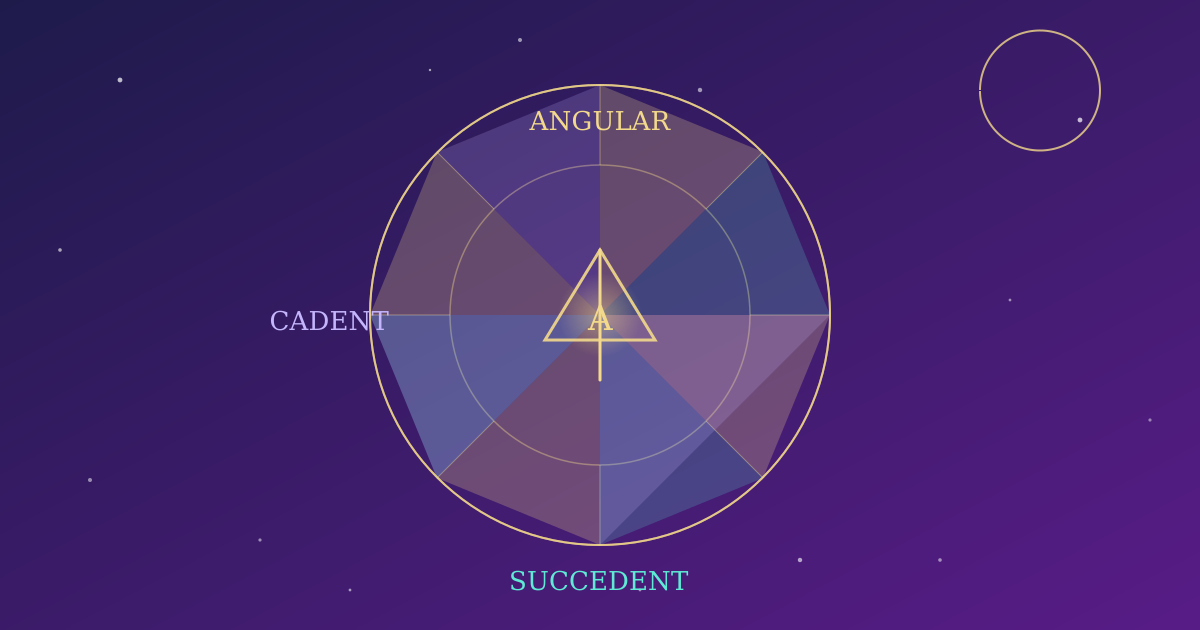
Angular, Succedent & Cadent Houses in Astrology: Meaning & How to Read Them
Angular, succedent, and cadent houses explained: which houses are angular, succedent, or cadent, what each quality means, and how to read planets in each type of house.
Read the meaning →
Stellium in Astrology: Meaning, Houses & How to Read One
What is a stellium? Three or more planets in one sign or house explained — how to spot one, stellium meanings by house, and how to work with concentrated chart energy.
Read the meaning →