
Magenta Aura Meaning: Passion, Creativity & Unconventional Spirit
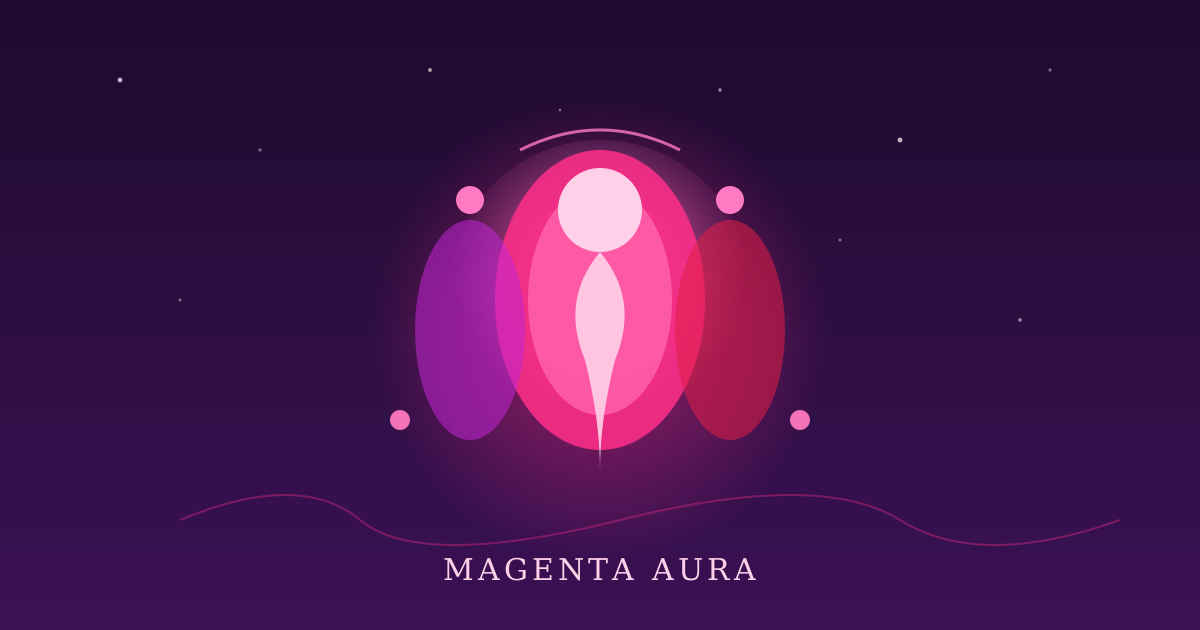
Magenta sits in a fascinating place on the spectrum. It is not quite red, not quite purple, and not quite pink — it borrows fire from all three and becomes something entirely its own. In aura tradition, that in-between quality is the point. A magenta aura is read as the energy of someone who does not fit neatly into a single category, and who stopped trying to a long time ago. Where a red aura charges forward and a purple aura dreams upward, a magenta aura does both at once: it imagines a different kind of life, and then it actually builds it.
Aura colors are understood as reflections of your emotional and energetic state rather than fixed labels — they shift with mood, season, and life chapter. Read everything here as spiritual exploration and entertainment. A magenta aura appearing as your dominant field suggests that originality, emotional intensity, and creative courage are central themes for you right now. Let us explore what that means, shade by shade.
The Magenta Aura Personality
Magenta-aura individuals are traditionally described as the people who color outside the lines on purpose. They are the friend with the unexpected career path, the wardrobe nobody else would dare to wear, and the opinions they arrived at by thinking, not by inheriting. Friends often describe them as vivid: not necessarily loud, but impossible to mistake for anyone else. There is a quality of aliveness to magenta energy, a sense that this person is fully, unapologetically themselves.
That originality is paired with emotional honesty. Magenta-aura people tend to say what they actually feel, even when a softer version would be easier. They are not cruel about it — in fact, their bluntness is usually rooted in respect, a belief that the people around them deserve the truth rather than a performance. This makes them magnetic to people who are tired of small talk and surface-level connection. If you want a real conversation, find the magenta in the room.
There is also a deep creative current running through magenta energy. Magenta-aura people are often makers in the broadest sense: artists, yes, but also inventors, founders, stylists, writers, performers, and anyone who rearranges the pieces of life into a shape nobody had seen before. Their creativity is not a hobby tucked into weekends. It is how they process feelings, solve problems, and make sense of the world. Take away their creative outlet and a magenta person does not just get bored — they dim, the way a room dims when you switch off its brightest lamp.
Magenta Aura Shades and What They Mean
Like every aura color, magenta is read in shades, and the shade changes the story. Bright, hot magenta — almost neon, buzzing with pink and red — is traditionally read as a season of bold action: new love, a creative launch, a reinvention, a truth finally spoken out loud. It is high-voltage energy, thrilling and a little exhausting, and it usually arrives when someone is stepping into a bigger version of themselves.
Deep magenta, leaning toward plum and burgundy, suggests a quieter, more seasoned intensity. This is magenta with depth: a person who has lived through enough to know what matters, and who channels passion into something lasting — a long-term project, a committed partnership, a cause. Deep magenta is often associated with emotional wisdom earned the hard way, and with a creative practice that has survived its early, chaotic phase.
Soft, rose-tinted magenta sits closer to pink and is read as magenta's gentler face: affection, tenderness, and romantic idealism, but with more spark than pure pink. Someone showing soft magenta may be falling in love, healing a relationship, or opening their heart after a guarded chapter. And cloudy or muddy magenta — the color dulled, as if seen through smoke — is traditionally read as passion tangled with frustration: a creative block, a feeling that cannot find its outlet, or a truth being held back. The suggested response is not alarm but movement: make something, say the thing, change one small circumstance, and watch the color clear.
Is a Magenta Aura Rare?
Magenta is considered one of the less common dominant aura colors, and the tradition gives a simple reason: most people lean on steadier energies most of the time, the way most wardrobes lean on neutrals. Magenta is a statement color. Holding it as a dominant field takes a willingness to be seen, to stand out, and to accept that not everyone will understand you — and that is a rarer stance than it sounds.
That said, flashes of magenta are common. Many people show magenta in passing — during a passionate new chapter, a creative breakthrough, a bold decision, or a season of reinvention when an old identity is being shed. Aura readers distinguish these passing flashes from a stable magenta field: the first is a beautiful spark, the second is a fire that keeps burning. Both are welcome. If your magenta comes and goes, the tradition reads it as proof of your creative range, not as a failure to hold it permanently. Auras shift, and that shifting is the point.
Strengths of the Magenta Aura
Magenta strengths are the ones that move a room. Originality: magenta-aura people see the option nobody else considered, whether that is a business idea, a way to solve a family problem, or a fresh take on an old tradition. They do not innovate for applause; they innovate because the standard answer genuinely does not fit. Emotional courage: they will name the feeling in the room, have the hard conversation, and admit when they were wrong — all things most people avoid for years.
Creative stamina is another magenta gift, at least when the project matters to them. A magenta person can pour themselves into a novel, a startup, a garden, or a community project with an intensity that surprises even them, working late because the work itself is the reward. And loyalty with teeth: magenta love is not passive. Magenta-aura people show up for their people loudly and practically — the friend who drives across town at midnight, the partner who remembers the dream you mentioned once and helps you chase it. In work, magenta strengths shine in design, branding, performance, entrepreneurship, advocacy, and any role that rewards a distinctive voice: the person whose work you recognize before you see their name.
Challenges and Growth Edges
A color this vivid has a shadow side too, and magenta tradition names it honestly. Restlessness: when everything is interesting, finishing one thing can feel like a cage, and magenta-aura people can start five projects and finish one, or chase the next bright idea before the last one has landed. All-or-nothing feelings: magenta emotions run hot, so a small disappointment can feel enormous for an afternoon, and a small victory can feel like destiny. The intensity is real, but it is not always proportional, and learning to let feelings crest and pass is a lifelong magenta lesson.
Pushing back against structure is another classic magenta trap. Rules, routines, and other people's timelines can feel like an insult to a magenta spirit, even when they would genuinely help — the budget, the deadline, the boring admin that keeps the brilliant project alive. And burnout follows naturally: magenta people burn bright, and bright things need fuel. A magenta person who never rests does not stay vivid; they flicker, then go dark for a while, then feel guilty about the darkness. The growth edge, in magenta tradition, is pairing fire with form: one routine, one finished thing, one honest boundary at a time. A flame in a lantern burns longer than a flame in the wind.
Magenta Auras in Relationships and Work
As partners, magenta auras are passionate, surprising, and deeply loyal — the ones who plan the unforgettable date, defend you fiercely, and tell you the truth even when it stings. They love with their whole spectrum: desire, play, tenderness, and imagination all get a turn. Their growth edge in love is steadiness through the ordinary days — staying present for the grocery run and the quiet evening, not only for the grand gesture, and letting a partner love them back without turning every moment into a performance.
At work, magenta-aura people thrive where originality is a feature, not a problem: creative studios, startups, fashion, media, advocacy, and any field where a distinctive voice is the product. They make excellent founders and lead creatives because they can see the thing that does not exist yet and describe it so vividly that other people want to build it too. The trap is the same as in life — too many open tabs, and a dislike of the unglamorous follow-through. Magenta professionals do best with one flagship project at a time, a trusted collaborator who loves the details they skip, and a creative outlet that is just for play, so the work itself never has to carry all of their fire.
Magenta vs. Pink, Purple, and Red Auras
Magenta is often confused with its neighbors, so it helps to draw the lines clearly. Pink is traditionally read as softer love energy: tenderness, affection, sweetness, and care. Magenta is pink with red's fire added, so it reads as bolder and more driven — love with an edge, affection that acts. Purple is the dreamer's color: intuition, spirituality, and imagination. Magenta borrows purple's imagination but grounds it in red's action, so where purple dreams, magenta builds.
Red is pure drive: physical energy, passion, courage, and competition. Magenta keeps red's passion but adds violet's depth, so its drive has a creative, unconventional flavor that pure red does not. Think of it this way: red runs the race, purple imagines a new kind of race, pink cheers everyone on, and magenta invents a race nobody has run before — and then runs it in an outfit nobody expected. If you have ever been told you are too much, too intense, or too different, and you took it as a compliment, magenta may be your color.
How to Tell If You Have a Magenta Aura
No test can prove an aura color, and any reader or photograph that claims certainty should be treated with healthy skepticism. What people actually do is gather clues. Do you feel drawn to magenta again and again — in clothing, in art, in the objects you choose for your home? Do friends describe you as intense, creative, or unconventional, even when you think you are being restrained? Do you get restless when life gets too routine, and come alive when a bold new idea appears? Do you process feelings by making something — writing, painting, cooking, rearranging a room — rather than by talking them in circles?
Another clue is how you handle being misunderstood. Magenta-aura people are used to it, and they have usually made peace with it: they would rather be fully themselves and occasionally misread than be easily understood and half alive. If that sentence feels like it was written about you, take it as a meaningful resonance, not a diagnosis. Aura colors are best used as a mirror for self-reflection, a colorful language for noticing what is already true about you, rather than a label to wear or defend.
Nurturing and Balancing a Magenta Aura
If magenta is your color — or the energy you want to cultivate — a few practices resonate especially well. One creative outlet, protected daily: even twenty minutes of making something, with no audience and no goal, keeps magenta energy from pooling into restlessness. One anchor routine: a morning walk, a regular bedtime, a weekly planning hour — a single steady habit that lets the rest of your vivid life play freely without falling apart. Movement: magenta is a physical color, and dance, running, or even a long walk can discharge intensity that would otherwise turn into irritability.
And protect the gift: practice finishing one thing before starting the next, and treat rest as part of the fire, not an interruption of it. A magenta that never rests becomes glare, then ash. The brightest magenta appears in people who have learned to pace themselves — not by dimming, but by choosing where the light goes. Keep one project as your flagship, let the others be sketches, and remember that originality is not a race. The most unconventional thing a magenta person can do is sometimes the simplest: stay, finish, and let the work speak.
Magenta Auras, Chakras, and Shifting Colors
In chakra language, magenta is often linked to the space between the heart and the crown — love made imaginative, and imagination made loving. Some traditions place magenta at the higher heart or the soul star above the crown, the point where personal feeling opens into something larger. That is why magenta-aura people often describe themselves as feeling both deeply personal and oddly universal at the same time: their own story matters intensely, and yet they sense it connects to everyone else's.
Expect your magenta to shift. Some seasons it will burn hot and bright, some seasons it will deepen into plum, and some years it will fade into pink or violet as your life asks for softness or dreaming instead. This is normal, and it is not a loss of magenta — it is magenta responding to your life. If your color ever feels dimmed or muddy, the tradition's advice is gentle and practical: make something small, move your body, say one honest thing, and finish one small task. Then look again. Vivid colors have a way of returning when they are given room to breathe, and they usually return brighter for having passed through a quiet season.
Frequently asked questions
What does a magenta aura mean?
A magenta aura is traditionally read as a blend of red passion and violet imagination: a bold, creative, emotionally honest energy. It is associated with originality, unconventional thinking, strong feelings, and a refusal to live by other people's scripts.
Is a magenta aura rare?
Magenta is considered one of the less common dominant aura colors. It appears more often as a flashing or secondary color — during creative bursts, passionate chapters, or periods of reinvention — than as a stable lifelong dominant field.
How is magenta different from a pink aura?
Pink is traditionally read as softer, gentler love energy: tenderness, affection, and care. Magenta is pink with red's fire and violet's imagination added, so it reads as bolder, more driven, and more unconventional — love with an edge, creativity with a cause.
What are the challenges of a magenta aura?
The classic magenta challenges are intensity without a release valve: restlessness, all-or-nothing feelings, pushing back against structure even when it would help, and burning brightly for a project and then dropping it. The traditional remedy is grounding routine paired with a creative outlet.
How do I know if I have a magenta aura?
No test can prove an aura color. People explore this through self-reflection: noticing whether they feel drawn to magenta, feedback from aura readers or aura photography, and whether the magenta personality description resonates. Treat the result as entertainment and a prompt for self-reflection.
Keep exploring

Pink Aura Meaning: Love, Tenderness & Gentle Strength
What does a pink aura mean? Explore the pink aura personality — love, tenderness, and gentle strength — plus shades, strengths, challenges, and relationships.
Read the meaning →
Purple Aura Meaning: Intuition, Spirituality & Imagination
What does a purple aura mean? Explore the purple aura personality — intuition, spirituality, and imagination — plus shades, strengths, challenges, and relationships.
Read the meaning →
Rainbow Aura Meaning: What a Multicolored Aura Says About You
What does a rainbow aura mean? Explore the rainbow aura personality — a rare, multicolored energy blending every color's gifts — plus what each color means, strengths, challenges, and relationships.
Read the meaning →
What Is My Aura Color? How to Discover Your Dominant Aura
What is my aura color? Discover your dominant aura through guided self-reflection questions, a quick 7-question check-in and full color meanings explained.
Read the meaning →