
Black Obsidian Meaning: The Volcanic Glass Stone of Protection & Truth
A Stone Born of Fire, Cooled in an Instant
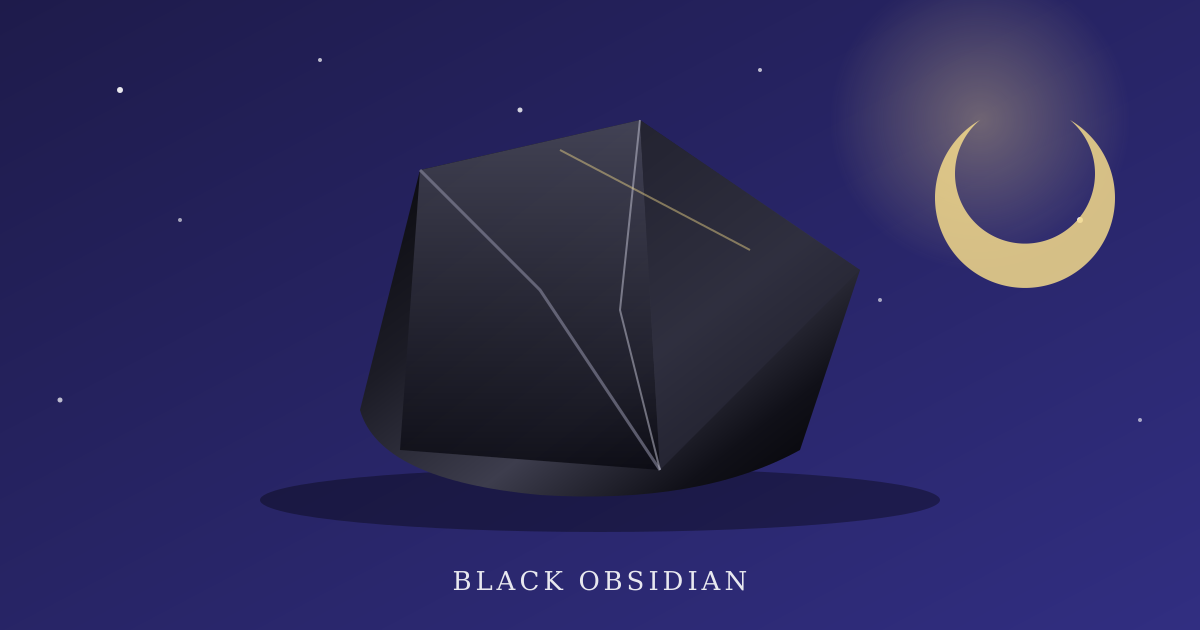
Hold a piece of black obsidian up to the light and it does something no ordinary black stone does: it glows at the edges. Thin sections turn smoky and translucent, revealing the glass within. That is the first clue to what obsidian really is. Despite sitting in crystal shops alongside quartz and amethyst, obsidian is not a crystal at all in the mineral sense. It is natural volcanic glass, formed when silica-rich lava erupts and cools so quickly that atoms have no time to arrange themselves into a crystal structure. The result is a solid that behaves like glass because, geologically speaking, it is glass.
That origin explains everything about the stone, from its shine to its sharpness. When obsidian breaks, it fractures in smooth, curved shells called conchoidal fractures, leaving edges thinner and sharper than a steel scalpel. Early humans noticed this immediately. Long before metal tools existed, obsidian was the cutting edge of the Stone Age: arrowheads, knives, scrapers, and spear points knapped from obsidian have been found on every continent where volcanoes erupted, and traded over astonishing distances. Archaeologists have traced obsidian tools hundreds of miles from their volcanic source, proof that this black glass was among the first precious materials humans ever traded.
The same glassy surface that made obsidian a blade also made it a mirror. Polished obsidian discs reflect a dim, smoky image, and that dim reflection shaped the stone's spiritual reputation for thousands of years. A mirror that shows you darker and quieter than you expect invites a different kind of looking: not at your face, but at what sits behind it. Obsidian became the mirror stone, the truth stone, the stone you consult when you are ready for an honest answer rather than a comforting one.
Our framing throughout stays grounded: crystals and stones are companions for reflection and intention, not treatments, guarantees, or substitutes for professional advice. Obsidian will not change your life on its own. But as a symbol of protection and honesty — dark, sharp, and unflinching — it has a way of focusing a question: what are you avoiding, and what would change if you faced it?
What Black Obsidian Represents
In crystal tradition, black obsidian represents three intertwined ideas, all born from its volcanic nature:
- Protection: the signature theme. Obsidian is said to act as a shield, absorbing or deflecting negativity in the way its dark surface absorbs light. It is the traditional stone for the front door, the difficult workplace, and the conversation you need to walk into guarded rather than open.
- Truth and shadow work: the mirror theme. Obsidian is associated with bringing hidden patterns, habits, and feelings into view — the parts of ourselves we usually edit out. Practitioners call it the shadow-work stone because it is said to show you the whole picture, including the parts you would rather not see.
- Grounding and release: the volcanic theme. Formed from the earth itself, obsidian is linked to the root chakra and to letting go: cutting cords, releasing old stories, and clearing away what no longer serves you. The blade metaphor runs through all of it — obsidian cuts, and cutting is sometimes exactly what a situation needs.
It is worth saying plainly that obsidian's appeal is the opposite of gentle comfort. Where rose quartz soothes and amethyst calms, obsidian confronts. People who love it often describe the same experience: the stone does not make a hard week easier, it makes it clearer. That clarity is the whole point, and it is also why experienced practitioners advise beginners to work with obsidian in small doses rather than all day, every day.
From Aztec Mirrors to Apache Tears
Obsidian's human history is longer and richer than almost any other stone in the shop. In Mesoamerica, the Aztec and Maya built entire economies around it. Aztec warriors carried obsidian-edged macuahuitl clubs, surgeons used obsidian blades, and priests polished obsidian into mirrors for divination rituals. The Aztec god Tezcatlipoca, whose name means Smoking Mirror, was associated with a polished obsidian mirror through which he was said to see all human deeds. That is not a small detail: in one of the great civilizations of the ancient world, the god of fate and sorcery literally looked through black glass.
Across the ancient world, obsidian mirrors appear again and again. In the Roman world, the naturalist Pliny the Elder wrote of obsidian, and polished obsidian mirrors were luxury objects. In the ancient Near East, obsidian was carved into vessels, beads, and inlays thousands of years before glassmaking was invented. Wherever volcanoes supplied it, people treated this black glass as something between a tool and a treasure.
One of the best-known obsidian stories in North America is the legend of the Apache tears. According to the tale, a group of Apache warriors, cornered on a cliff by US cavalry, chose to leap rather than surrender. The women who mourned them wept, and their tears fell to the earth and turned to small, rounded stones of black obsidian. Apache tears are real stones — small, pebble-like nodules of obsidian found in the American Southwest — and the legend is told as folklore, not history. In crystal tradition, Apache tears are associated with grief, comfort, and gentle release, and are often recommended as a softer introduction to obsidian for people who find the larger stone too intense. Whether you take the legend literally or as a story about grief turning into something you can hold, it captures obsidian's double nature: a stone of sorrow and a stone of survival, in the same black glass.
Black Obsidian and Shadow Work
Shadow work is the modern name for an old practice: sitting honestly with the parts of yourself you usually avoid — the habit you keep repeating, the conversation you keep postponing, the pattern in relationships you keep blaming on other people. In crystal tradition, black obsidian is the classic shadow-work companion, precisely because its mirror symbolism fits the job. The practice is not mystical; it is journaling with a focal point.
A simple version looks like this. Sit with a piece of obsidian, or a polished obsidian mirror, for ten quiet minutes. Ask one honest question and write whatever comes, without editing: What am I avoiding right now? What pattern keeps repeating in my life? What would I do differently if I were not afraid of the answer? The tradition says the stone helps surface truths. The honest reading is that a dark, silent object gives your mind permission to be quiet long enough for an uncomfortable answer to arrive — and writing it down makes it real enough to act on. Either way, the reflection is the work, and the stone is the prompt.
One practical caution belongs here. Because shadow work surfaces uncomfortable material, it can stir up strong feelings, and it is not a substitute for therapy or support when you are dealing with grief, trauma, or a mental health difficulty. If a journaling session leaves you distressed, step away from the practice and talk to someone you trust or a professional. Obsidian's tradition is about honesty, and honesty includes knowing when a stone is not the right tool for the job. Used gently, in short sessions, with a grounding practice afterward — a walk, a glass of water, a conversation with a friend — it is a reflective exercise, not an ordeal.
How to Work With Black Obsidian
The standard practices are daily carry, mirror work, home placement, and desk work — each adapted to the stone's protective reputation:
Daily carry: carry a small tumbled stone or Apache tear in your pocket, or wear it as a bracelet or pendant. Practitioners treat obsidian as a boundary stone: before entering a draining environment, hold it for a few seconds and set a simple intention, such as staying calm or leaving on time. The ritual is a reminder to yourself, and the stone makes the reminder physical.
Mirror and scrying work: polished obsidian mirrors and spheres are the traditional tools for scrying, the old practice of gazing into a dark reflective surface to quiet the mind and invite images or impressions. The honest version of this practice is meditation with a focal point: sit in dim light, gaze softly at the mirror without straining, and notice what thoughts drift up. Treat anything that comes as material for reflection, not as a prediction — obsidian mirrors do not show the future, they show you your own mind settling.
Home placement: tradition places black obsidian near the front door or in the entryway as a protective threshold stone, and a larger piece in a room where difficult conversations happen. Some people keep a piece by the desk for focus. One honest note: a few people find obsidian too stimulating to keep beside the bed, reporting vivid dreams or restless sleep. If that happens to you, move it to the entryway or out of the bedroom — the tradition says the stone belongs to your waking hours, and the practical advice is the same.
Desk and creative work: because obsidian is associated with cutting through confusion, it is the traditional stone for decisions and editing. Writers and editors in the tradition keep a piece on the desk while cutting a draft, as a symbol of the willingness to remove what does not belong. The ritual is practical: before revising, hold the stone and name the one thing the work would be better without.
Pairing Black Obsidian With Other Stones
Obsidian's intensity makes pairing important — it is almost always softened or steadied by a companion stone:
- Black obsidian + rose quartz: the classic balance. Rose quartz's gentleness is said to soften obsidian's bluntness, so hard truths arrive with compassion. This is the standard pairing for shadow work and difficult conversations.
- Black obsidian + clear quartz: clarity with amplification — quartz is believed to sharpen whatever it pairs with, so this combination is the traditional choice when you want a direct answer rather than a gentle one.
- Black obsidian + hematite: the double-grounding pair. Both stones are associated with steadiness and protection, and together they are the traditional choice for overwhelming environments or days when you feel scattered and exposed at once.
- Black obsidian + selenite: clearing with calm — selenite is the tradition's cleansing stone, and practitioners keep it near obsidian to clear the heavy energy obsidian is said to absorb, like wiping a mirror clean after use.
- Black obsidian + black tourmaline: the full shield. Both stones are associated with protection, and together they are the traditional pairing for the front door, the office, or any space you want to feel guarded rather than open.
The principle is simple: obsidian shows you the truth, and its companions decide how gently that truth lands. Choose the pairing that matches the day you are having.
Caring for Black Obsidian
Obsidian is glass, and glass has one great weakness: it breaks. It ranks around 5 to 5.5 on the Mohs hardness scale, harder than a fingernail but far more brittle than quartz, and a dropped sphere can chip or shatter. Treat it like a beautiful glass object, because that is what it is:
- Handle with care: do not drop obsidian, knock it against hard surfaces, or carry it loose with harder stones that can chip it. Store spheres and mirrors on a soft cloth or stand, and carry tumbled pieces in their own pouch.
- Cleaning: a soft, dry cloth is usually enough, and it restores the shine better than any liquid. A brief rinse in plain water with mild soap is fine for tumbled pieces, but dry promptly and skip salt water, hot water, and long soaks.
- Cleansing: practitioners cleanse obsidian with moonlight, incense smoke, sound, or a selenite plate. Because obsidian is said to absorb heavy energy, regular cleansing is part of its tradition — and wiping a mirror clean is a satisfying ritual in its own right.
- Sunlight and heat: avoid prolonged direct sunlight on polished spheres, which can focus light like a lens, and keep obsidian away from sudden temperature changes that can stress glass.
- Sharp edges: raw obsidian is genuinely sharp. Keep raw pieces out of reach of children, handle broken pieces with care, and never use a raw edge as a cutting tool unless you know what you are doing — ancient surgeons did, but they trained for it.
One reassurance: genuine obsidian is abundant and affordable, so a real piece costs far less than the rare stones in your collection. That is part of its charm — the mirror stone is also the democratic one.
Spotting Real Black Obsidian (and Manufactured Glass)
Obsidian has a fake problem of a different kind from most stones: because it is glass, ordinary manufactured glass can look very convincing. Here is how to tell the difference honestly:
- Flow lines and inclusions: under bright light, real obsidian often shows subtle flow banding, tiny mineral inclusions, or a faint smoky translucency at thin edges. Perfectly uniform, flawless black glass with no variation at all is suspect.
- Bubbles: manufactured glass often contains small, perfectly round air bubbles visible under magnification. Natural obsidian can contain tiny inclusions too, but neat rows of round bubbles point to a factory, not a volcano.
- Temperature and feel: real obsidian feels cool and glassy to the touch, like a windowpane, and warms slowly in the hand. A piece that feels warm immediately or plasticky is suspect.
- Fracture: broken obsidian shows the smooth, curved conchoidal fracture of glass. A broken piece that crumbles, shows grain, or looks like molded plastic is not obsidian.
- Source and price: genuine obsidian is affordable, so an inflated price is not a sign of authenticity — but a suspiciously perfect black sphere sold cheaply in bulk, with no source named, deserves a second look. Buy from a mineral dealer who can name the volcanic source, and be wary of any seller who calls ordinary black glass obsidian without qualification.
None of this means manufactured glass is worthless as an object — many people enjoy it as decoration. The problem is only the label. If you want the natural stone, buy from a dealer rather than a fashion seller, ask whether the piece is natural volcanic glass, and expect the honest answer.
Closing: The Mirror That Does Not Flatter
Black obsidian asks something unusual of you — and that is its gift. It does not promise comfort, abundance, or easy answers. It promises honesty: a dark surface that reflects you without flattery, a sharp edge that cuts what no longer belongs, a heavy piece of cooled fire that reminds you, a dozen times a day, that you can face what you have been avoiding.
But here is the quietest truth about the mirror stone: the courage people credit to obsidian is almost always a courage they were already capable of. The stone does not create honesty. You do — the moment you pause, look into the dark glass, ask the question you have been dodging, and choose to act on the answer instead of looking away. Obsidian is a mirror for the mind. Use it in small doses, keep it close, pair it with something gentle, and let it remind you of what you already knew: the truth is rarely as frightening as the avoidance, and you are stronger than the story you have been telling yourself.
Frequently asked questions
What is black obsidian good for in crystal tradition?
In crystal tradition, black obsidian is the stone of protection and truth: it is associated with grounding, honest self-reflection, and clearing away what no longer serves you. People reach for it when they want to set a boundary, face an uncomfortable truth, or feel steadier in a difficult environment.
Is black obsidian dangerous or bad luck?
No tradition treats black obsidian itself as bad luck, though its reputation for bringing uncomfortable truths to the surface can make it feel intense. In folklore it is a mirror stone: it is said to show you what you already know but have been avoiding. That honesty is the point, not a curse.
Can black obsidian go in water?
A brief rinse in plain water is generally fine for polished black obsidian, but long soaks, salt water, and hot water are best avoided. Dry it promptly with a soft cloth, and never put a polished obsidian mirror or sphere in a dishwasher or ultrasonic cleaner.
Where should you place black obsidian in your home?
Tradition places black obsidian near the front door or in the entryway as a protective threshold stone, and on a desk or workspace for focus. Some people keep a piece in the bedroom entryway rather than beside the bed, since its intense reputation can feel too stimulating for sleep.
How can I tell if my black obsidian is real?
Real obsidian is natural volcanic glass: it feels cool and glassy, shows subtle flow lines or tiny inclusions under bright light, and has a sharp conchoidal fracture on broken edges. Perfectly uniform, bubble-filled, or suspiciously cheap pieces sold in bulk are often ordinary manufactured glass.
Keep exploring
Black Tourmaline Meaning: The Stone of Protection & Grounding
Black tourmaline meaning & uses: the stone of protection and grounding. Shielding practices, EMF lore, placement rituals, cleansing & care.
Read the meaning →
Clear Quartz Meaning: The Master Healer of the Crystal World
Clear quartz meaning & uses: the master healer stone of clarity, focus & amplification. Programming intentions, crystal pairings, cleansing & care — an honest guide.
Read the meaning →
How to Cleanse and Charge Crystals: Complete Guide
How to cleanse and charge crystals: water, smoke, moonlight, sound & selenite methods. Which stones to keep dry, plus a simple monthly ritual.
Read the meaning →
Tiger's Eye Meaning: The Stone of Courage & Clear Vision
Tiger's eye meaning & uses: the golden-brown stone of courage, focus & good luck. Chatoyancy, red & blue varieties, the all-seeing-eye lore, care & spotting fakes.
Read the meaning →