
Quantum Jumping for Manifestation: Meet Your Parallel Self
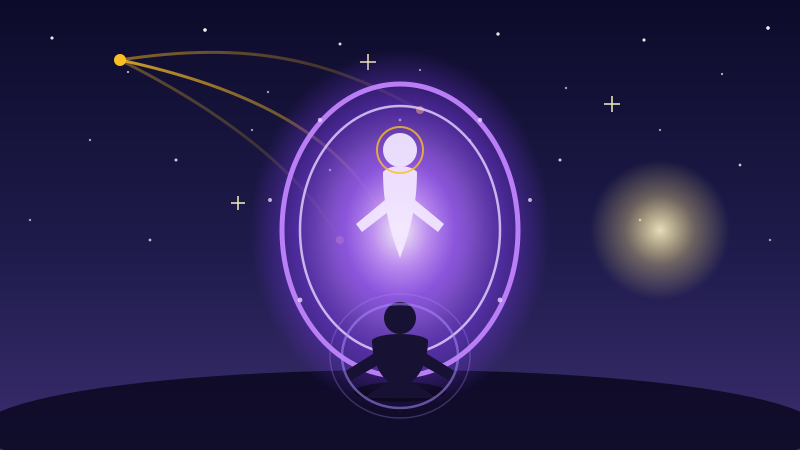
Somewhere, the story goes, there is a version of you who already has it. The new job. The easy mornings. The relationship that feels like home. Quantum jumping treats that version not as a fantasy but as a parallel self — and gives you a guided meditation to go meet them. You visualize traveling to their timeline, looking through their eyes, feeling how they feel — and then you merge with them and bring their confidence back into this life.
Is it real? In the physics sense, no — and this site will be straight with you about that. But dismissing it for that reason would miss the point of why it has quietly become one of the most beloved practices in the manifestation community. The parallel-self story is an extraordinarily effective stage on which to rehearse becoming someone new. What follows is the honest version: the idea, the ritual, what it plausibly does to your mind — and what it cannot do.
What Quantum Jumping Actually Is
At its simplest, quantum jumping is a guided visualization with a cosmic costume. You enter a relaxed state, imagine stepping into a "portal" or light, and picture a parallel version of yourself who is already living your desired outcome. You spend time with them — noticing how they carry themselves, how they make decisions, what their ordinary day feels like — and then the two of you merge. You return with their felt sense installed, like new software for your nervous system.
The practice was popularized in the mid-2000s by Burt Goldman, who packaged it as a way to borrow skills and confidence from "alternate selves," and it has since been absorbed into law-of-attraction culture, where creators on TikTok and YouTube now teach their own jump meditations. The word "quantum" does most of the marketing work; the experience itself is closer to lucid daydreaming with a purpose.
It sits in the same family as scripting and the 55x5 method — all are rehearsal techniques, ways of making a future feel familiar before it arrives. Quantum jumping's distinction is the encounter: instead of writing about a future, you meet the person living it. For many people, a face is easier to borrow confidence from than a paragraph.
The Physics It Borrows (and Returns Unpaid)
The name comes from the many-worlds interpretation of quantum mechanics — the genuinely serious, genuinely debated idea that every branching outcome of the universe continues to exist somewhere. On a cosmic scale, the theory's defenders argue, everything that can happen does happen, in a vast tree of branching realities.
Here is the part to hold clearly: no physicist claims a meditation lets you switch branches. The many-worlds interpretation says nothing about consciousness commuting between universes, and the manifestation community's use of the word "quantum" is borrowing prestige, not premises. Enjoy the costume; do not mistake it for a lab coat.
Why does the story work so well anyway? Because "a version of you who already has it" is a psychologically potent fiction. It externalizes the change — you are not trying to become someone new from scratch, you are meeting them and letting them show you how. That small shift, from effort to encounter, dissolves the resistance that usually meets self-improvement. The physics is entertainment. The encounter is the engine.
The Guided Jump, Step by Step
Set aside 20–30 undisturbed minutes. Sit or lie down, and use a quiet guided audio if you prefer being led — the steps below work solo too:
Step 1: Choose one clear desire. A quantum jump needs a destination, and vague ones produce vague journeys. "I want to be successful" gives your parallel self nothing to do; "I want to be running my own design studio with three clients I respect" gives them a life. Pick the outcome that is loudest in you right now.
Step 2: Relax into the threshold state. Breathe slowly for several minutes until the day's noise recedes. The practice works best in the half-awake state between alertness and sleep — the same door visualization practices use. You are aiming for relaxed, not asleep.
Step 3: Enter the portal. Picture a doorway of light, a staircase descending, a corridor of doors — whatever image reads as "between worlds" to you. Walk through it slowly. The journey imagery matters: it signals to your mind that the ordinary rules of this life have been left behind, and something new is possible on the other side.
Step 4: Meet your parallel self. On the other side, there they are — you, living the desired outcome. Take your time. Look at them properly: what are they wearing, how do they move, what does their home look like, what does a Tuesday feel like for them? Then ask them the three questions practitioners swear by: What do you know that I don't? What did you stop doing? What should I start? Listen for whatever answers surface.
Step 5: Merge. This is the signature move. Step forward and let the two of you overlap — feel their posture become your posture, their calm become your calm, their way of moving through a day settle into your body. Spend a minute or two fully inside their felt sense. The tradition says you are downloading their timeline; the grounded reading says you are installing a new bodily memory of confidence.
Step 6: Return and anchor. Walk back through the portal and let the scene fade. Before you open your eyes, choose one concrete thing your parallel self would do this week — one email, one conversation, one application — and commit to it. A jump without an anchor is just a pleasant dream; the anchor is what makes it a practice.
The Two-Cup Method: Quantum Jumping's Physical Ritual
For people who want something they can touch, the community developed the two-cup method — a small ceremony that makes the jump literal:
Take two glasses of water. Label the first with your current situation ("stuck in a job I dislike") and the second with your desired one ("running my own studio"). Pour water from the first glass into the second while focusing on the transition, then drink the second glass — symbolically absorbing the new reality into yourself.
Practitioners often frame it as "changing the water's information," a nod to the disputed idea that intention alters water's structure. The honest framing is simpler: the ceremony gives the desire a body. Pouring is a physical commitment in a way that thinking is not, and drinking makes the abstract intimate. Like the guided jump, it works — to the extent it works — as a commitment device dressed in ritual, not as physics.
The Honest Psychology Behind It
Strip the portal away and quantum jumping is a well-constructed identity exercise. Here is what the twenty minutes are plausibly doing:
Future-self continuity. Psychologists have found that people who feel vividly connected to their future selves make better long-term decisions — they save more, procrastinate less, act more ethically. The parallel self is future-you with a costume change. Meeting them face to face shortens the distance between who you are and who you are trying to become, which is exactly what the research says moves behavior.
Embodied rehearsal. Athletes have used visualization for decades because the brain's motor and emotional systems partially treat vivid imagining as practice. Walking through a day as the confident studio owner — feeling the posture, hearing the conversations — is a rehearsal of that identity. Rehearsed identities produce real choices, the way vision-board practitioners and 369 writers have always found.
Attention retuning. After a deep jump session, practitioners often report noticing openings they had been missing — the same salience-filter effect behind the "synchronicities" of other methods. Spend half an hour inhabiting the life of someone who acts on opportunity, and your own filter starts flagging opportunities instead of threats.
Permission. This is the quietest and maybe the most important one. Many desires stall not for lack of strategy but for lack of permission — a sense that wanting it is indulgent, or that becoming that person would betray something. Meeting a parallel self who already lives it, and is happy there, is the mind giving itself permission in the most vivid way available. The portal is a door past your own resistance.
5 Mistakes That Deflate the Jump
- Jumping nightly to "make sure." One deep jump, then live from it — that is the tradition. Nightly re-jumps for the same desire turn a ritual into auditing, and auditing breeds exactly the doubt the practice is meant to dissolve. If the desire still feels far away, do the aligned action, not another jump.
- Keeping the parallel self abstract. A jump to "my best self" produces nothing to merge with. The practice needs sensory specifics: their morning routine, their workspace, the sound of their voice on a call. Vividness is not decoration here — it is the mechanism.
- Skipping the three questions. Most people rush to the merge and skip the conversation. But the questions — what they know, what they stopped, what you should start — are where the session earns its keep. The answers that surface are your own deeper intelligence speaking in costume; do not leave without them.
- No anchor, no change. A jump that ends with "that was nice" and no committed action is entertainment. The one concrete thing your parallel self would do this week is the whole point of the trip. Write it down before you leave the session.
- Confusing the metaphor with a mechanism. The people who get burned by quantum jumping are the ones who take the physics costume literally — waiting for the universe to relocate them instead of acting. The jump rehearses the person; the person still has to do the work. Belief in parallel selves is optional. Behavior is not.
After the Jump: Living From the New Timeline
The tradition's final instruction is the least mystical and the most important: act like the person you met. Not in a costume-drama way — in the small, concrete choices of a week. Your parallel self sends the email, makes the call, raises the rate, ends the draining arrangement. You do the same.
Give it a week before any evaluation, and evaluate the right things: not whether reality has rearranged itself, but whether you have. Are you deciding faster? Noticing more? Acting on things you would have postponed? Those are the real signs a jump landed — and, entertainment framing aside, they are also the things that actually move a life from one timeline to another.
And the disclaimer that runs through everything on this site: nothing here can schedule the future. Quantum jumping cannot override probability, other people's free will, or the need for real-world effort. What it can do — reliably, and without any physics required — is change the person holding the intention. Meet your parallel self, borrow their way of being, and bring it back into this life. The rest, as always, is up to you.
Frequently asked questions
Is quantum jumping real physics or just a metaphor?
It is a metaphor wearing physics' wardrobe. The many-worlds interpretation is a genuine (if debated) reading of quantum mechanics, but no physicist claims a guided meditation lets you switch universes. Treat quantum jumping as what it honestly is: a richly staged visualization practice that uses the parallel-selves story to rehearse a new identity. It can change how you think, feel, and act — which is already a lot — but it cannot override probability, other people's choices, or the logistics of the real world.
How often should you do a quantum jump meditation?
One deep session is the tradition's standard: you meet the parallel self, merge, and then live from the shift. Repeating the jump nightly for weeks usually turns a ritual into rumination — checking whether it worked is the opposite of the confident embodiment the practice aims to produce. If the desire still feels distant after a week or two, the wiser move is not another jump but an honest look at the aligned action you may be avoiding.
Can quantum jumping help with something specific, like a job or a move?
Practitioners apply it to specific goals all the time — visualizing the version of themselves who already has the role, the apartment, the relationship. The practice is most satisfying when the target is concrete enough to picture in sensory detail: the office you walk into, the keys in your hand, the routine of that life. Abstract goals like "happiness" make weak jumps because the parallel self has nothing specific to be doing.
What if nothing changes after a quantum jump?
First, give it time without auditing — many practitioners report shifts in their own confidence and decisions rather than dramatic external events. Second, audit honestly: did the jump change your behavior, or did you just enjoy the meditation and return to the old routine? Quantum jumping is identity rehearsal, not a substitute for applications, conversations, and real-world moves. If nothing external changed, the question worth asking is what your parallel self would have actually done differently this week — then do that.
Keep exploring
Scripting for Manifestation: Write Your Future Into Being
Scripting for manifestation: how to write your future in the present tense. The step-by-step method, a full example script, variations, and the psychology.
Read the meaning →
The Whisper Method: TikTok's Viral Manifestation Technique
The Whisper Method explained: TikTok's viral manifestation technique step by step — what to whisper, the exact wording, the honest psychology, mistakes, and the consent conversation.
Read the meaning →
Signs Your Manifestation Is Coming: 11 Signs It's Almost Here
Signs your manifestation is coming: repeating numbers, synchronicities, vivid dreams, a sudden calm, doors closing — the 11 classic signs, the honest psychology behind each, and how to respond.
Read the meaning →