
Birthday Number Meaning: What Your Day of Birth Reveals in Numerology
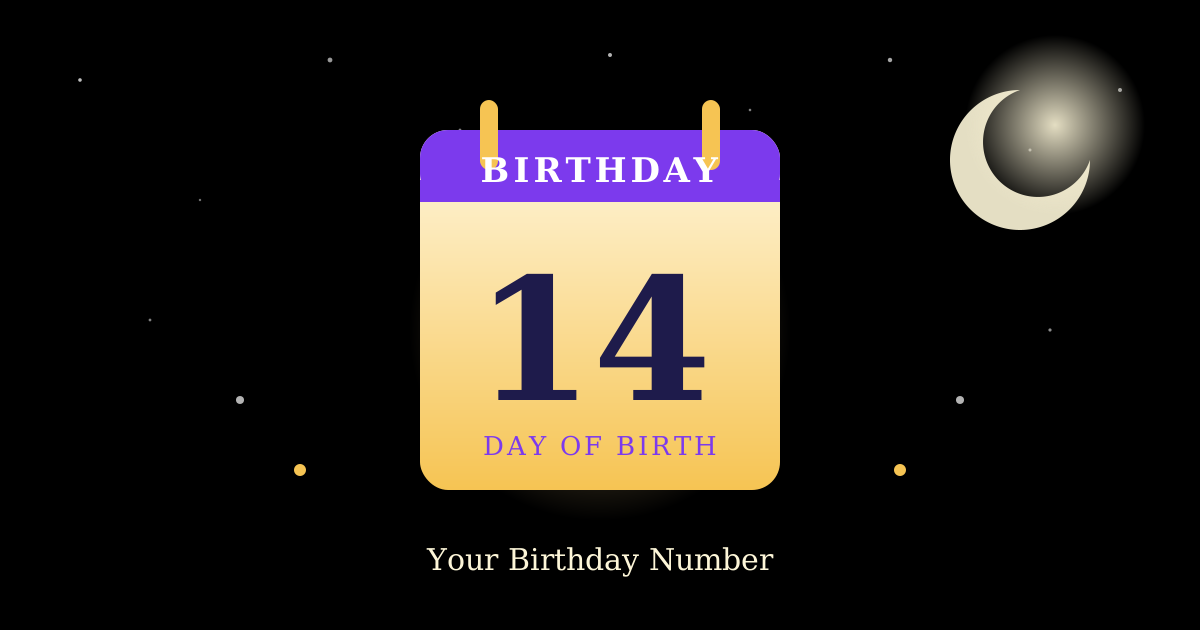
What Is the Birthday Number?
Most numerology charts are built from two big calculations: the Life Path number, drawn from your full birth date, and the Destiny number, drawn from the letters of your full birth name. The Birthday Number is smaller, simpler, and in many ways more intimate. It uses just one piece of information — the day of the month you were born — and the tradition says it describes a talent, a tendency, or a way of moving through the world that is distinctively yours.
Numerologists often describe the Birthday Number as a gift or a tool. Where the Life Path is the road you travel for a lifetime, the Birthday Number is something like the shoes you walk it in: the style, the pace, the habits that feel natural to you even when the road itself is difficult. A person whose Life Path demands patience, for example, might have a Birthday Number 5 that makes sitting still feel like a punishment — and that tension, the tradition says, is exactly where the interesting self-knowledge lives.
It is also the number most people meet first. Long before anyone learns to calculate a Destiny number from a name chart, they can look at their birth day and find their Birthday Number in seconds. That accessibility is part of its charm, and part of its reputation: because it is so easy to find, people test it against their own experience right away, and many report that it fits with surprising precision. Others find it only half-right, which the tradition itself expects — the Birthday Number is one layer of a chart, not the whole chart.
As with everything in numerology, a little honesty belongs here. Numerology is a symbolic system for reflection, not a science, and no number can predict your future or define who you are. The Birthday Number works best as a mirror: a vocabulary for talents you may already know you have, and a nudge toward ones you have not used in a while. If the description rings true, it has done its job. If it does not, the rest of your chart — and your own lived experience — gets the final word.
How to Calculate Your Birthday Number
The calculation is the simplest in numerology, and it takes about five seconds.
Step 1: Take the day of your birth. Ignore the month and the year entirely. Only the day matters: the 3rd, the 14th, the 27th, whatever it is.
Step 2: If the day is a single digit, you are done. Born on the 7th? Your Birthday Number is 7. Born on the 9th? Your Birthday Number is 9.
Step 3: If the day has two digits, add them together. Born on the 14th? 1 + 4 = 5. Born on the 27th? 2 + 7 = 9. Born on the 30th? 3 + 0 = 3. Born on the 19th? 1 + 9 = 10, then 1 + 0 = 1 — reduce until you reach a single digit.
The Master Number question. If your day reduces to 11 or 22, traditions split. Born on the 22nd, you may read your Birthday Number as 22, the Master Builder, or reduce it to 4, the Builder. Born on the 29th, you get 11 (2 + 9 = 11), and the same choice applies: 11, the intuitive Master Number, or its reduced form, 2. There is no single authority, so the tradition's practical advice is to read both descriptions and notice which one matches your experience. Many people find that one fits their inner life and the other fits how the world sees them — and that both readings are useful.
A quick reference. Days 1 through 9 keep their own number. Days 10, 19, and 28 reduce to 1. Days 11 and 29 reduce to 11 or 2. Days 12, 21, and 30 reduce to 3. Days 13 and 31 reduce to 4. Days 14 and 23 reduce to 5. Days 15 and 24 reduce to 6. Days 16 and 25 reduce to 7. Days 17 and 26 reduce to 8. Days 18 and 27 reduce to 9. Days 20 reduces to 2, and day 22 reduces to 22 or 4.
What Each Birthday Number Means
Birthday 1: The Initiator. People with this Birthday Number tend to start things: projects, conversations, movements, businesses. The tradition describes a natural independence and a comfort with being first, even when first means alone. The gift is initiative; the shadow is impatience with anyone who moves more slowly, and a reluctance to ask for help when the solo act gets heavy.
Birthday 2: The Diplomat. The talent here is sensitivity to other people — reading a room, smoothing a conflict, noticing what someone needs before they say it. Birthday 2 people often become the glue in families and teams. The shadow is over-accommodation: saying yes to keep the peace, then quietly resenting the yes. The tradition's advice is to treat your own needs as one of the parties worth negotiating for.
Birthday 3: The Expressive. Words, images, humor, performance — the Birthday 3 talent is making inner life outer. These are often the storytellers, the funny friend, the person who can turn an ordinary evening into a memory. The shadow is scattering: ten half-finished creative projects and a wit that sometimes lands as deflection. One finished thing, the lore says, is worth ten brilliant starts.
Birthday 4: The Builder. Order, reliability, and follow-through are the Birthday 4 gifts. These are the people who keep the systems running, remember the details, and finish what they start. The shadow is rigidity — the plan becoming more important than the people it was meant to serve — and a tendency to mistake rest for laziness. The tradition's homework for the 4 is deliberate flexibility: one unplanned hour a week.
Birthday 5: The Free Spirit. Adaptability is the Birthday 5 superpower: new cities, new jobs, new ideas, all absorbed with unusual ease. These people often reinvent themselves several times and surprise everyone, including themselves, with how well the reinvention works. The shadow is restlessness that mistakes motion for progress. The lore's counsel is to keep one anchor — one person, one practice, one place — while everything else moves.
Birthday 6: The Nurturer. Care is the Birthday 6 talent: the home that welcomes people, the advice that actually helps, the responsibility taken without being asked. These are often the family anchor and the friend everyone calls in a crisis. The shadow is the classic 6 trap — care that curdles into control, or giving until empty and then keeping quiet score. The tradition's corrective is the same in every 6 reading: include yourself in the circle of care.
Birthday 7: The Seeker. Depth, analysis, and the examined life mark the Birthday 7. These are the researchers, the readers, the people who need to understand before they act — and whose counsel is prized precisely because it is unhurried. The shadow is withdrawal: the study, the solitude, or the skepticism that becomes a hiding place. The lore advises one foot in the library and one foot in the world.
Birthday 8: The Achiever. The Birthday 8 talent is for the material world: organizing, building, leading, and handling resources with a steady hand. These people often rise to positions of responsibility early and handle them well. The shadow is measuring self-worth by the ledger alone — by salary, status, or output. The tradition says the 8's real harvest is what its competence shelters: the people, projects, and causes its strength makes possible.
Birthday 9: The Humanitarian. Breadth of heart is the Birthday 9 gift: compassion that extends beyond the immediate circle, to strangers, causes, and the world at large. These are the givers, the teachers, the ones who let go gracefully. The shadow is the martyr's bargain — giving from emptiness and quietly resenting it — or holding on to the past out of loyalty to what is already over. The lore's remedy is to give from overflow and to practice the 9's hardest skill: release.
Birthday 11: The Intuitive. For those who keep the Master Number, 11 is the heightened 2: the diplomat's sensitivity turned up to inspiration. Birthday 11 people are often described as unusually perceptive, with hunches that prove right and a presence that moves rooms. The shadow is nervous intensity — the same sensitivity that inspires can also overwhelm — so the tradition prescribes grounding practices: sleep, routine, and time away from other people's noise.
Birthday 22: The Master Builder. For those who keep 22, it is the heightened 4: the builder's order turned toward large-scale vision. Birthday 22 people are said to combine practicality with imagination, turning big ideas into working realities. The shadow is pressure — the feeling that anything less than monumental is failure. The lore's advice is to build in stages: the cathedral is still a cathedral if it takes a lifetime.
Birthday Number vs. Life Path Number
The distinction matters, because the two numbers answer different questions. The Life Path, calculated from your month, day, and year together, describes the broad arc: the recurring lessons, the long road, the theme of a lifetime. The Birthday Number, calculated from the day alone, describes the instrument you play that theme on: a talent, a habit, a style that shows up in everyday life.
A useful way to see it: the Life Path is what life keeps teaching you, and the Birthday Number is how you tend to respond to the lesson. A Life Path 8 person learning stewardship might respond with a Birthday 3's humor, turning pressure into lightness for everyone around them. A Life Path 2 person learning partnership might respond with a Birthday 1's independence, needing solo time inside the togetherness. Neither number cancels the other; together they describe a person more fully than either could alone.
That is also why two people born on the same day of the month can feel so different. A Birthday 5 born in a Life Path 4 year and a Birthday 5 born in a Life Path 7 year share the free-spirit flavor, but one pours it into building systems and the other into seeking depth. The Birthday Number is the spice, not the whole dish — and knowing which is which keeps the reading honest.
How Your Birthday Number Shows Up in Daily Life
In work, the Birthday Number often points to the role you fall into without trying. The Birthday 1 volunteers to lead the project. The Birthday 2 becomes the unofficial mediator. The Birthday 4 ends up owning the spreadsheet. The Birthday 7 gets asked to check the research. None of this is assigned; it is simply what the group starts expecting, because it is what you do well and, usually, what you enjoy.
In relationships, the Birthday Number colors how you love and how you argue. The Birthday 6 shows love by taking care of things. The Birthday 3 shows it by making you laugh. The Birthday 5 shows it by planning the adventure. The Birthday 9 shows it by forgiving first. And in conflict, the same numbers show their shadows: the 6 over-functions, the 3 deflects with humor, the 5 leaves the room, the 9 goes quiet. Recognizing the pattern, the tradition says, is the first step to choosing a different move.
In decision-making, the Birthday Number hints at your default speed. Birthday 1 and 5 decide fast and adjust later. Birthday 4 and 7 decide slowly and thoroughly. Birthday 2 and 6 decide by checking how everyone else feels first. None of these speeds is right in every situation, and the tradition's practical wisdom is simply to know your default — so you can speed up when the moment needs boldness and slow down when it needs care.
5 Practices for Using Your Birthday Number
1. Name the talent out loud. Write one sentence: "My Birthday Number is X, and its gift is Y." Saying it plainly turns a vague feeling ("I am just like that") into something you can use on purpose, including at work and in relationships.
2. Schedule the gift. Talents wither without use. A Birthday 3 who never creates, a Birthday 6 who never nurtures outside the family, a Birthday 7 who never studies — the tradition says an unused gift turns into its shadow. Give yours one protected hour a week.
3. Watch for the shadow in stress. Under pressure, every Birthday Number overdoes its gift: the 1 bulldozes, the 2 disappears, the 4 clamps down, the 5 bolts, the 8 counts, the 9 martyrs. Naming the stress version of your number in advance makes it easier to catch in the moment.
4. Pair it with your Life Path. Read your Birthday Number and your Life Path number side by side and ask where they agree and where they argue. The agreement is your easy strength; the argument is your growth edge — and, the tradition says, usually the most interesting part of the chart.
5. Revisit it yearly. Your Birthday Number never changes, but you do. Read its description on each birthday and notice what has shifted: the gift you use more, the shadow you catch faster, the talent you finally took seriously. The number is fixed; the relationship with it is not.
Try This: The Birthday Reflection
On your next birthday, give yourself twenty minutes and three questions:
- Part one — the gift: write down your Birthday Number and its talent. Then write one recent moment when you used that talent well, in plain language, without mysticism.
- Part two — the shadow: write down your number's shadow side. Then write one recent moment when the shadow showed up — the over-functioning, the bolting, the deflecting — and what it cost.
- Part three — the year ahead: pick one small way to use the gift more deliberately in the coming year: the hour, the conversation, the project, the boundary. Put a date on it. This month, not someday.
Keep the page and read it next birthday. The Birthday Number's whole teaching fits inside that ritual: the day you were born gave you a tool, and each year asks what you did with it.
Frequently asked questions
How do I calculate my Birthday Number?
Take the day of the month you were born and reduce it to a single digit by adding its digits together. Born on the 14th? 1 + 4 = 5, so your Birthday Number is 5. Born on the 7th? Your Birthday Number is 7, no math needed. Some numerologists keep 11 and 22 as Master Numbers instead of reducing them, so a person born on the 22nd may read both 22 and its reduced form, 4.
How is the Birthday Number different from the Life Path number?
The Life Path number uses your full birth date — month, day, and year — and describes the broad road of your life. The Birthday Number uses only the day, and describes a narrower, more personal layer: a talent, a habit, or a style that colors how you walk that road. Think of the Life Path as the journey and the Birthday Number as the way you personally travel it.
What if I was born on the 11th, 22nd, or 29th?
The 11th and 22nd are the classic question marks. Many numerologists keep 11 and 22 as Master Numbers with their own heightened meanings, while others reduce them to 2 and 4. The 29th reduces to 11 (2 + 9 = 11), so it carries the same choice. The practical advice in the tradition is to read both the Master Number and the reduced number and notice which description fits your lived experience better.
Does my Birthday Number change over time?
No. Your Birthday Number is fixed by the day you were born, and unlike the Personal Year number, which cycles every year, it does not change. What changes is how you express it: the tradition says the same number can look like impulsiveness at 20 and confident initiative at 50, because the talent matures even though the number stays the same.
Can two people with the same Birthday Number be very different?
Absolutely. The Birthday Number is only one layer of a full numerology chart, alongside the Life Path, Destiny, Soul Urge, and other numbers. Two people born on the 5th share a Birthday Number, but different Life Paths, names, and life experiences will shape how that 5 shows up. Numerology is a symbolic system for reflection, not a fixed prediction, so the number describes a tendency, never a destiny.
Keep exploring
Life Path 1 Meaning: The Independent Leader
Life Path 1 meaning in numerology: the initiator number of independence and leadership — the 1's gifts, shadow side, 1 in love and career, and how to lead without going it alone.
Read the meaning →
Maturity Number Meaning: Your Later-Life Purpose in Numerology
Maturity Number meaning in numerology: how to calculate your Maturity Number from your Life Path and Destiny numbers, what each Maturity Number 1-9 reveals about your later-life purpose, and when it activates.
Read the meaning →
Destiny Number Meaning: Your Name, Your Purpose
Destiny Number meaning in numerology: how to calculate your Expression number from your full birth name, what each Destiny number 1-9 reveals, and how it works with your Life Path.
Read the meaning →
Personal Year Number Meaning: Your Year in Numerology
Personal Year Number meaning: how to calculate your Personal Year, what each year 1-9 brings, and how to plan your year around its cycle.
Read the meaning →