
Karmic Debt Numbers 13, 14, 16, 19: Meaning & How to Work With Them
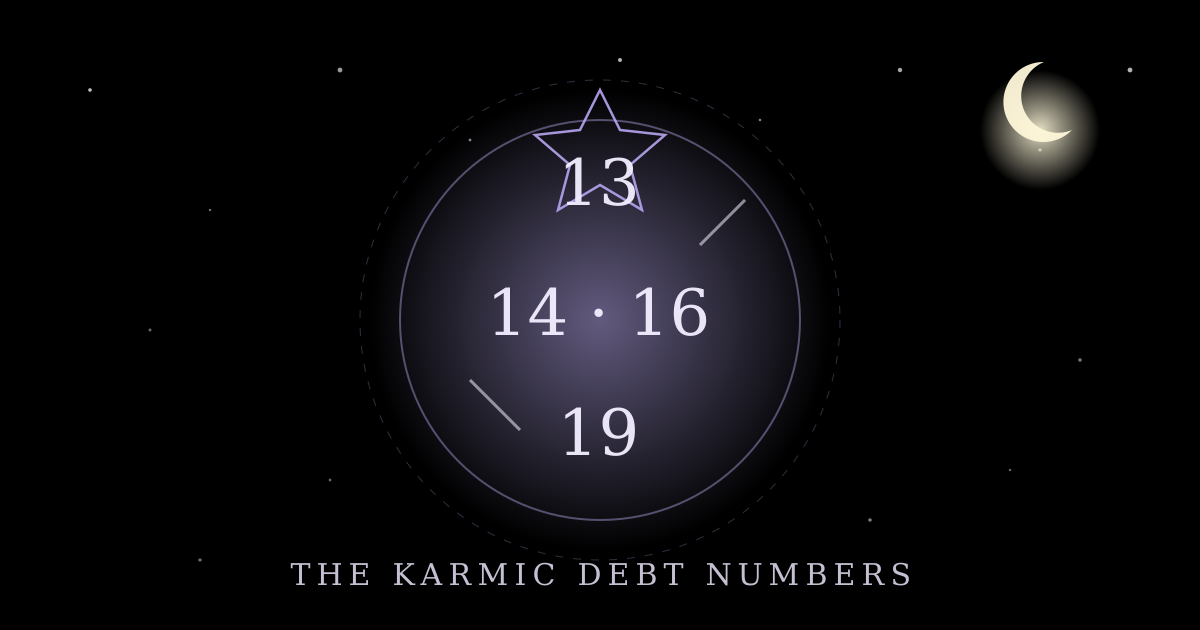
What Are Karmic Debt Numbers?
When you calculate a numerology number, you usually reduce it to a single digit: 29 becomes 11 becomes 2. But sometimes, on the way down, you pass through a number that traditional numerologists refuse to skip. If your Life Path calculation totals 13 before reducing to 4, that 13 stays in your chart as a Karmic Debt Number — written as 13/4. The same goes for 14/5, 16/7, and 19/1. These four are the only Karmic Debts in classical numerology.
The idea comes from the karmic tradition in numerology, most associated with the school of Kevin Quinn Avery and modern writers like Linda Goodman: the notion that a soul arrives with unfinished business. A debt doesn't mean you did something wrong in a past life in any provable sense — numerology is a symbolic system, not a historical record. What the debt describes is practical and observable: a recurring pattern in this life, a groove you've been falling into for years. The 14/5 person isn't cursed; they just keep meeting the same moderation lesson. The 13/4 person isn't being punished; they keep being offered the same invitation to do the work.
That's the reframe that matters. People find out they have a Karmic Debt and hear a sentence of doom. But every working numerologist treats these numbers as neutral curriculum — the lessons your chart flags as the ones you're most likely to skip, and therefore the ones most worth doing. Nobody with a debt is behind. They're just enrolled in a course that keeps showing up.
How to Tell If You Have One
Check every core number in your chart — not the final single digits, but the totals before reduction:
- Life Path: did the birth-date sum pass through 13, 14, 16, or 19?
- Birthday Number: were you born on the 13th, 14th, 16th, or 19th? (These carry the debt directly.)
- Destiny/Expression: did the name-total reduce from one of these four?
- Soul Urge and Maturity: same check — any of the four before reduction.
- Timing cycles: a Personal Year or Personal Month of 13/4, 14/5, 16/7, or 19/1 means the lesson is active during that period, not necessarily lifelong.
Worked example: someone born October 24, 1994: 1 + 0 + 2 + 4 + 1 + 9 + 9 + 4 = 30 → 3. No debt in the Life Path. But if they were born October 22, 1994: 1 + 0 + 2 + 2 + 1 + 9 + 9 + 4 = 28 → 10 → 1. Also no debt. Now October 25, 1994: 1 + 0 + 2 + 5 + 1 + 9 + 9 + 4 = 31 → 4. No debt. But October 13, 1994: 1 + 0 + 1 + 3 + 1 + 9 + 9 + 4 = 27 → 9 — the birthday itself (13) still marks a 13/4 debt, even though the Life Path is 9. The birthday-number debt counts even when the final Life Path reduces cleanly.
If none of your core numbers pass through 13, 14, 16, or 19, you don't have one — and nothing here applies. That's a perfectly normal outcome; most charts don't carry them.
13/4 — The Debt of Work
The trap: cutting corners, avoiding effort, resenting the unglamorous work. The 13/4 chart tends to show a history of brilliant starts that fizzle — the person is often genuinely talented but allergic to the grind phase. Opportunities that require sustained effort keep evaporating: the degree nearly finished, the business almost launched, the body almost trained. The pattern isn't lack of ability. It's that work itself feels like an insult, and so it's perpetually postponed.
What it asks: diligence, order, and follow-through — doing the unexciting parts without resentment. The traditional "payment" is famously simple: keep your word about effort. Finish things. Build systems. Show up on the boring days. People with 13/4 who commit to honest, sustained work often report that their luck visibly turns — not through any magic, but because the world rewards people who reliably finish.
The gift underneath: once the pattern breaks, 13/4 people become some of the most capable builders in numerology — people who combine vision with the discipline to actually deliver. The debt was never about suffering; it was about learning that effort is how talent becomes real.
14/5 — The Debt of Freedom
The trap: excess and the abuse of freedom — overindulgence in pleasure, substances, spending, drama, or constant novelty. The 14/5 person craves intensity and variety, and the debt pattern is that freedom keeps curdling into chaos: the fun that turns expensive, the adventure that turns reckless, the craving for change that destroys good things. The traditional language is blunt: this is the debt of misused liberty.
What it asks: moderation and adaptability without self-destruction. The payment is learning that freedom and discipline aren't opposites — discipline is what keeps freedom from eating itself. The 14/5 lesson is balance: say yes to experience, but keep your hand on the wheel. Build commitments you can honor and still breathe. Notice the difference between freedom and escape.
The gift underneath: healed 14/5 people are magnetic — adaptable, charismatic, genuinely free in a way that doesn't cost them their stability. They become the ones who know how to live fully without falling apart, and that balance is something others instinctively want to learn.
16/7 — The Debt of the Ego
The trap: pride, control, and building life on image. The 16/7 debt — sometimes called the "tower" debt after the tarot card — is the one numerologists describe as the most dramatic, because its lessons tend to arrive as reversals: the plan that collapses, the identity that cracks, the sure thing that turns out not to be. The pattern is ego-driven construction — a life designed to look right rather than be right — and life keeps sending storms to test which parts were real.
What it asks: humility and inner truth. The payment is the hardest of the four to fake: letting the false structures fall and rebuilding on honesty. Not performative humility — actual surrender of control where control was the point. People in a 16/7 lesson often describe a before and after: the collapse hurt, but what got rebuilt was more genuine than anything that came before.
The gift underneath: those who pass through the 16/7 lesson tend to develop rare spiritual depth and authenticity. Having lost what was false, they're less interested in appearances and more attuned to what matters. The debt converts into wisdom — the kind that can't be learned any other way.
19/1 — The Debt of Independence
The trap: self-centeredness — using others, or depending on others, in ways that serve only the self. The 19/1 pattern shows up as a chronic inability to stand alone combined with a reluctance to truly serve: the person who needs constant support but offers little, or who uses people as stepping stones. Relationships in this pattern tend to be transactional, and isolation tends to be the recurring lesson — left alone until self-reliance is learned.
What it asks: true independence in service of others. The payment is twofold: first, learning to stand on your own feet without leaning on everyone around you; second, turning that strength outward — using your capability for others, not just yourself. The 19/1 arc is from "me first" to "me, strong enough to lift others."
The gift underneath: resolved 19/1 people become genuine leaders — self-sufficient, original, and generous with their strength. The 1 energy, freed from its selfish groove, is the pioneer who clears a path everyone else can follow.
Karmic Debts in Love & Relationships
Debts don't just operate in career and character — they surface in relationships, because relationships are where patterns repeat fastest.
13/4 in love can mean wanting the romance without the maintenance: the grand gestures, the exciting beginning, then withdrawal when the daily work of partnership starts. The lesson is showing up for the unglamorous parts — listening, apologizing, doing the dishes of the relationship.
14/5 in love is the classic freedom-versus-commitment pattern: craving closeness, then feeling trapped by it, then sabotaging it. The work is learning that commitment and aliveness can coexist — and that the urge to flee is a signal to communicate, not to run.
16/7 in love can look like pride in partnership: needing to be right, controlling the narrative, keeping score. The lesson is vulnerability — letting a partner see the parts that aren't polished, and letting the relationship reshape you.
19/1 in love tends toward one-sided dynamics: taking more than giving, or needing a partner to function. The work is building genuine self-reliance so the relationship can be a choice rather than a crutch — and then choosing generosity inside it.
The key question for any debt in a relationship isn't "is this doomed?" — it's "which version of this pattern am I playing right now?" Debts don't ruin relationships; unexamined patterns do. An examined debt can actually make a partnership stronger, because both people know what they're working on.
How to Work With Your Debt (Without Fear)
The tradition is clear on one thing: there is no ritual, crystal, or shortcut that removes a Karmic Debt. The "payment" is behavioral — you pay it by living differently. Here's what that looks like in practice:
- Name the pattern honestly. Read your debt's description and notice where you flinch — the flinch marks the live wire. Write down three specific moments when the pattern ran you.
- Pick the opposite action. 13/4: finish one thing you've been avoiding. 14/5: keep one commitment that limits you. 16/7: admit one thing you're wrong about. 19/1: do one thing for someone with no benefit to you. Small and real beats grand and symbolic.
- Track the repeats. The debt dissolves when the pattern stops repeating — and you can't stop what you don't notice. A simple weekly note ("where did the pattern show up?") turns an invisible groove into a visible choice.
- Expect the test. Numerologists say the lesson keeps being offered until it's learned — which means the situation will recur. That's not the universe punishing you; it's the curriculum repeating the question. Each recurrence is another chance to answer differently.
- Stay out of the fear market. Anyone who tells you your debt means doom, bad luck, or that you need their paid ritual to clear it is selling something. The tradition treats debts as lessons, not curses — and lessons are free.
A note on framing: none of this is medical or psychological advice, and numerology doesn't diagnose anything. If the patterns described here overlap with real struggles — addiction, depression, destructive relationships — a qualified professional is the right guide, not a number. Use the debt as a lens for reflection, and get real help for real problems.
Mistakes People Make With Karmic Debt Numbers
Treating the debt as a doom sentence. A Karmic Debt is a lesson flag, not a fate. People with debts build excellent lives all the time — often excellent precisely because they did the work the debt asked for.
Counting debts that aren't there. The debt only exists if 13, 14, 16, or 19 appeared BEFORE reduction in a core number. A Life Path that reduces from 22 to 4 is not a 13/4. A total of 26 → 8 has no debt. Only the four numbers count.
Ignoring the birthday debt. People born on the 13th, 14th, 16th, or 19th carry the debt even when their Life Path reduces cleanly. The birthday number is its own placement — check it separately.
Paying someone to "clear" it. No ritual, spell, or service removes a Karmic Debt in the traditional system. The debt is behavioral, and only changed behavior addresses it. Paid clearing is a scam wearing mystical clothes.
Using the debt as an excuse. "I can't help it, I have a 14/5" is the pattern talking. The whole point of knowing the debt is to stop letting it drive. Information is supposed to increase your agency, not shrink it.
Try This: A Debt-Pattern Audit
This week, give your debt thirty honest minutes:
- Minutes 0–10: write your debt number at the top of the page. Under it, list every time in the last year the pattern ran: the project abandoned (13/4), the excess (14/5), the pride standoff (16/7), the selfish shortcut (19/1). Be specific. Vague confessions change nothing.
- Minutes 10–20: for each instance, write what the opposite action would have been — the thing you didn't do. Not the perfect action; just the honest one.
- Minutes 20–30: pick ONE opposite action and schedule it this week. One. Debts are paid in installments, not lump sums. Write the date and time you'll do it.
Do this monthly and something shifts: the pattern stops being a mysterious force and becomes a set of specific moments you can choose differently. That's the entire mechanism of "paying" a Karmic Debt — not punishment, not ritual, just the slow work of becoming someone the pattern can't run anymore.
Frequently asked questions
Are Karmic Debt Numbers bad?
No. Despite the dramatic name, Karmic Debt Numbers are not a curse or a punishment. In numerology they describe a recurring life lesson — a pattern where you tend to meet the same challenge until you learn to meet it differently. Most numerologists describe them as neutral information: a debt you 'pay off' through growth, not suffering.
How do I know if I have a Karmic Debt Number?
Look at the un-reduced numbers in your chart. If any of your core numbers — Life Path, Birthday, Destiny/Expression, Soul Urge, or Maturity — was 13, 14, 16, or 19 BEFORE being reduced to a single digit (13/4, 14/5, 16/7, 19/1), that number is a Karmic Debt in your chart. If every number reduces without passing through 13, 14, 16, or 19, you have none in the core chart.
Which Karmic Debt Number is the hardest?
Numerologists generally consider 16/7 the most intense, because its lessons tend to arrive as sudden reversals — plans collapsing, identities being reshaped. But 'hardest' is personal: someone prone to overwork may find 14/5's lesson about moderation far tougher. The difficulty of a debt depends on how strongly the pattern lives in you.
Can a Karmic Debt Number be cleared or removed?
The number itself stays in your chart — you can't edit your birth data. But the debt is 'paid' in the traditional sense when you stop repeating the pattern: doing the work (13/4), honoring limits (14/5), releasing ego (16/7), or serving something larger than yourself (19/1). Numerology frames this as growth dissolving the debt, not a ritual removing it.
Can Karmic Debt Numbers appear in compatibility or timing cycles?
Yes. They can appear in Personal Year, Personal Month, or Essence cycles — meaning the lesson is active during that period rather than being a lifelong theme. A Personal Year 13/4, for example, is traditionally read as a year when effort and discipline pay off and shortcuts backfire. The same meaning applies, just on a timer.
Keep exploring

How to Calculate Your Life Path Number: Step-by-Step
How to calculate your Life Path number in numerology: the step-by-step method with worked examples, Master Numbers 11/22/33, and mistakes to avoid. now.
Read the meaning →
Master Number 11 Meaning: The Illuminator Explained
Master Number 11 meaning in numerology: the Illuminator's gifts, challenges, love, career, 11:11 synchronicity, and grounding practices for sensitivity.
Read the meaning →
Soul Urge Number Meaning: How to Calculate Your Heart's Desire
Soul Urge Number meaning: calculate your Heart's Desire number from the vowels in your birth name, what each Soul Urge 1-9 (and 11, 22) reveals, and how to honor it.
Read the meaning →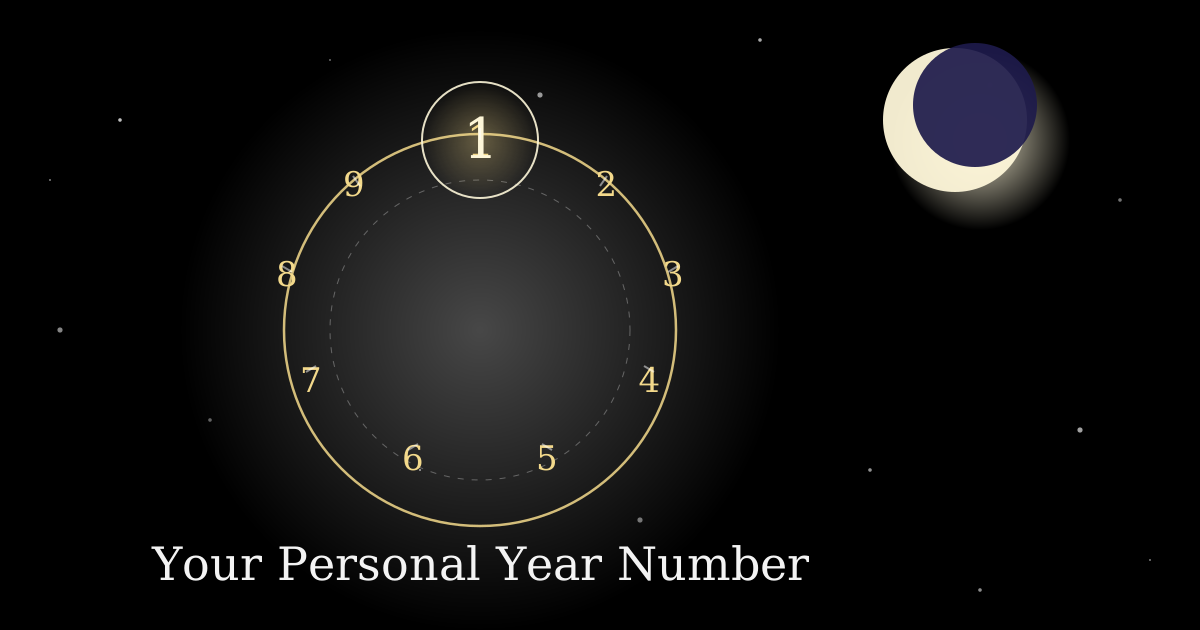
Personal Year Number Meaning: How to Calculate & Use Yours
Personal Year Number meaning in numerology: how to calculate your current year number, the meaning of each year 1-9, and how to use the 9-year cycle for timing.
Read the meaning →