
Mount of Saturn in Palmistry: Discipline, Responsibility & What Its Shape Really Means
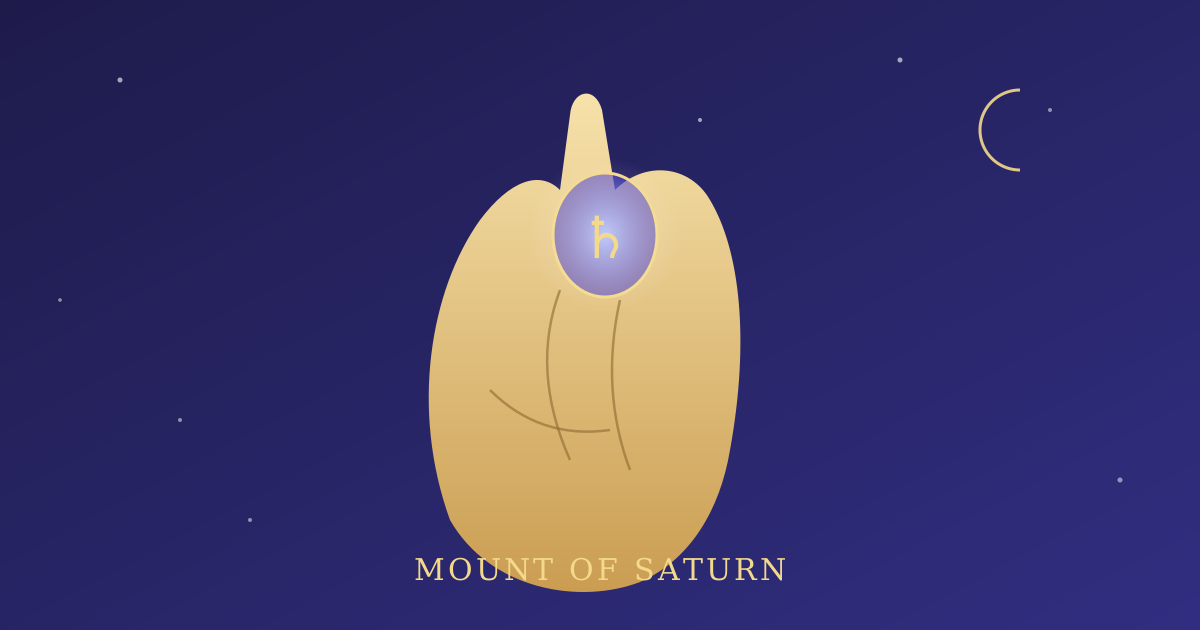
If the mounts of the palm were a council, Jupiter would be the ambitious leader, Venus the warm heart, and Saturn the quiet one at the end of the table who actually reads the fine print. Named for the Roman god of time, harvest, and limits, Saturn governs everything unglamorous and essential: showing up on time, keeping promises, finishing what you started, and being comfortable alone with your thoughts. Its mount sits beneath the middle finger, right at the center of the upper palm, and traditional readers treat that central position as meaningful. Saturn is the balance point of the hand, the place where ambition on one side and creativity on the other meet something steadier.
That reputation for heaviness gives Saturn an unfair image. People hear "serious" and picture gloom, but the old books are more generous. Saturn's gift is depth. Where other mounts sparkle, Saturn endures. It is the mount of the person who quietly keeps a family business running for thirty years, who revises a manuscript for the fourth time, who saves a little every month without announcing it. In a culture that celebrates speed and spectacle, Saturn is the counterweight, and learning to read it is learning to recognize a kind of strength that rarely makes a scene.
Where Is the Mount of Saturn?
Hold your hand open and find your middle finger, the longest finger on most hands. Slide straight down from its base into the palm and you are standing on the Mount of Saturn. It is flanked by the Mount of Jupiter beneath the index finger on one side and the Mount of Apollo beneath the ring finger on the other. Unlike Venus, which announces itself as a big pad at the thumb, Saturn is often modest. On many hands it is a gentle rise rather than a dramatic mound, and beginners sometimes miss it entirely, especially if the neighboring mounts are prominent and crowd it.
Its most important neighbor is not another mount but a line: the fate line, also called the Saturn line, which often runs upward through the center of the palm toward this mount. When the fate line reaches Saturn cleanly, traditional readers see a person whose work and sense of purpose feel aligned. When it stops short, bends, or breaks before arriving, they read a career path that changed direction, sometimes more than once. The mount and the line are separate features, but they tell one story together, which is why no careful reader judges Saturn's pad without glancing at the line approaching it.
A Prominent, Well-Formed Mount of Saturn
A Mount of Saturn that rises clearly and evenly from the palm, firm to the touch and in proportion with its neighbors, is the classic picture of the responsible temperament in the old books. Traditionally, it marks a person who is serious without being severe: patient, methodical, honest about limits, and willing to do unglamorous work for a long-term result. These are the friends who remember the details everyone else forgets, who keep the budget balanced, who stay calm when a plan falls apart and start rebuilding without drama. Their reliability is not performative. It is simply how they are built.
The tradition also links a strong Saturn to a love of solitude and study. A prominent Saturn often belongs to people who recharge alone, who prefer one deep friendship to a dozen shallow ones, and who are drawn to subjects that reward patience: history, science, craft, philosophy, or anything with a long apprenticeship. This is not loneliness in the sad sense. It is the contentment of a person who enjoys their own company and does their best thinking in quiet. Saturn's wisdom, the old texts insist, is earned slowly, and the mount's prominence suggests someone willing to pay that price.
An Overdeveloped Mount of Saturn
As with every mount, Saturn has a shadow side when it dominates the hand. A very large, hard, or bulging Saturn, especially one that towers over Jupiter and Apollo, is traditionally read as seriousness tipping into heaviness: worry, rigidity, pessimism, or a tendency to expect the worst and plan only for it. The old books describe such hands as belonging to people who carry burdens that are not always theirs, who distrust good news, and who can become so attached to rules and routines that spontaneity feels like a threat. It is a recognizable portrait, and most of us know someone who fits parts of it during a hard season.
The honest reading, though, is gentler than the old warnings. An overdeveloped Saturn often appears during periods of genuine pressure: caregiving, debt, grief, or a demanding job. The hand reflects the season, and seasons change. The tradition's practical advice for a heavy Saturn is delightfully concrete rather than mystical: make room for play on purpose, let a plan bend without breaking, and spend time with people who laugh easily. Saturn does not need to be defeated. It needs balance, and Apollo's creativity and Jupiter's confidence, sitting on either side of it, are exactly the neighbors meant to provide it.
A Flat or Underdeveloped Mount of Saturn
Now look for the opposite pattern. A flat Mount of Saturn, one that barely rises from the palm, traditionally suggests a lighter relationship with duty and structure. These readers are not irresponsible people, and the better palmistry books are careful to say so. They are simply more spontaneous, more flexible, and less comforted by routine than the strong-Saturn type. They may dislike strict schedules, prefer variety to repetition, and make decisions by feel rather than by five-year plan, and that flexibility is a genuine strength in fast-moving work, creative fields, and crisis situations where the plan has already failed.
A flat Saturn can also mean that a person's sense of purpose is still forming, which is normal at many ages and stages. The tradition notes that Saturn tends to develop later in life than the other mounts, as responsibilities accumulate and a person discovers what they are willing to be serious about. A young hand with a quiet Saturn may belong to someone whose Saturn chapter simply has not arrived yet. Readers who revisit the same hand over years often find Saturn rising as a person settles into a vocation, a family, or a craft, which is a good reminder to read the hand as a story in progress rather than a final grade.
Firmness, Color, and Texture
Size is only the first chapter. Press the mount gently and notice how it responds. A firm, resilient Saturn that springs back is traditionally read as balanced seriousness: discipline that supports life rather than strangling it. A very hard, tense Saturn suggests willpower held too tightly, a person bracing against life, while a very soft, yielding Saturn suggests a seriousness that is easily discouraged, or a thoughtful nature that struggles to turn thought into action. None of these is a diagnosis of any kind. They are traditional metaphors for temperament, best treated as prompts for honest self-reflection rather than facts about the body.
The old books also mention color, though it should be read with even more caution, since skin tone and circulation vary widely. A healthy, even tone on Saturn is traditionally linked to steady energy, while unusual paleness or mottling is simply noted as a sign to rest and take care of yourself. If anything about your hands ever worries you physically, a doctor, not a palm reader, is the right person to ask. Saturn's real value is symbolic: it gives you a vocabulary for noticing how disciplined, burdened, or patient you feel, and that noticing is useful in itself.
Lines and Marks on the Mount of Saturn
Saturn's markings are read with special care because the fate line ends here, and the mount often carries small signs of its own. A single clear vertical line rising into Saturn is traditionally read as a strong sense of purpose, a life direction that feels chosen rather than imposed. A cross on Saturn has a mixed reputation in the old books, sometimes linked to a period of hardship or a spiritual turning point, and modern readers tend to treat it gently, as a sign of a chapter that tested a person and changed them. A star on Saturn is one of the more debated marks in palmistry: some old texts read it as a warning about loss or sudden change, while others read it as a mark of exceptional achievement through perseverance, and the disagreement itself is a useful lesson in how little weight a single mark should carry.
A grille, a crisscross lattice of fine lines, is traditionally read as worry or mental restlessness concentrated in Saturn's territory: a mind turning the same problem over without rest. A square is read as protection, a kind of shelter around one's responsibilities, while an island in a line approaching Saturn is read as a period of uncertainty or divided effort. As with every mark in palmistry, one sign is a whisper. A star on an otherwise calm, well-formed Saturn means far less than a star combined with a broken fate line and a chained head line. Patterns across the hand are the conversation; single marks are only words.
Saturn, the Fate Line, and the Middle Finger Together
The most useful Saturn reading comes from combining three features. First, the mount itself: its size and firmness sketch the temperament, the raw material of patience and responsibility. Second, the fate line: its clarity, breaks, and branches describe the path that temperament has walked, including the detours. Third, the middle finger: a long, straight middle finger beside a strong Saturn is the traditional picture of seriousness expressed openly, while a short or bent middle finger suggests a Saturn nature that expresses itself more privately, through loyalty and care rather than through public achievement.
Read together, these features sketch a working style rather than a destiny. Two people can share a prominent Mount of Saturn and work entirely differently, one as a meticulous researcher and one as a devoted parent, depending on what the rest of the hand says. That is why experienced palmists resist judging a hand from one feature. Saturn tells you how much patience and gravity are in the tank. The fate line tells you where they have been spent. The middle finger tells you how visibly they show.
Saturn in Work and Daily Life
For career questions, Saturn is the first place traditional readers look after the fate line itself, but the honest reading is broader than any job title. A strong Saturn suggests a person who thrives where patience is rewarded: long projects, skilled trades, research, teaching, administration, or any work where quality matters more than speed. A flat Saturn suggests someone who thrives where adaptability is rewarded: startups, creative work, travel, or roles that change every few months. Neither is a verdict on worth. The world needs both the person who keeps the lighthouse and the person who sails the ship.
One caution belongs in every Saturn chapter. No mount, line, or mark can predict whether a career will succeed, and no hand can tell you to stay in a job or leave it. Palmistry tradition itself, at its most thoughtful, treats the hand as a portrait of tendencies, and tendencies can be worked with. If your Saturn reading resonates, use it as a conversation starter with yourself: where am I carrying more than I need to, where could I be more patient, and what long-term project deserves my steady attention right now? That question is worth more than any prediction.
How to Read Your Mount of Saturn in 60 Seconds
Try it now. Hold your dominant hand open, palm up, fingers relaxed. Find the pad beneath your middle finger and notice its size relative to Jupiter and Apollo on either side: prominent, moderate, or flat? Press it gently: firm and springy, hard, or soft? Glance for a clear line rising into it, a cross, or a grille. Then trace your fate line upward and see whether it reaches Saturn cleanly, and compare both hands, dominant and passive, for differences.
Finally, do the exercise that makes palmistry worth learning: check your reading against someone you know well. Does the steady friend with the strong Saturn actually carry responsibility the way the tradition describes, or does she surprise you? Does the spontaneous colleague with the flat Saturn get things done in ways you had missed? The hand is at its best when it teaches you to notice people more carefully, and the Mount of Saturn, sitting quietly at the center of the palm, is the steadiest place to start.
Frequently asked questions
Where is the Mount of Saturn on the palm?
The Mount of Saturn is the fleshy pad directly beneath the middle finger, between the mounts of Jupiter and Apollo. It sits at the center of the upper palm, which is why traditional readers treat it as the hand's balance point.
What does a prominent Mount of Saturn mean?
A prominent, well-formed Mount of Saturn traditionally suggests seriousness, patience, and a strong sense of responsibility. It is linked to people who take commitments seriously and prefer depth over speed.
What does a flat Mount of Saturn mean?
A flat Mount of Saturn traditionally suggests a lighter, more spontaneous approach to duty and routine. It is often read as flexibility and a dislike of rigid structure rather than a lack of character.
What is the difference between the Mount of Saturn and the fate line?
The Mount of Saturn is a pad of flesh beneath the middle finger, while the fate line is a crease that often runs upward toward it. The line is traditionally read as the path of career and life direction, and the mount as the temperament that walks it.
Can the Mount of Saturn change over time?
Yes, like all mounts, Saturn's pad changes with age, hand use, weight, and general condition. Traditional readers expect mounts to shift across a lifetime and read the hand as a living record, not a fixed verdict.
Keep exploring

Mounts of the Palm: A Complete Guide to the 7 Mounts
The 7 mounts of the palm, Venus, Jupiter, Saturn, Apollo, Mercury, Moon and Mars, reveal your drives and talents. Learn to read every mount, step by step.
Read the meaning →
Mount of Jupiter Meaning in Palmistry: Leadership, Ambition & Confidence
The Mount of Jupiter sits beneath your index finger and governs ambition, leadership, and confidence. Learn to read its size, firmness, and marks — and what a prominent, flat, or overdeveloped mount traditionally reveals.
Read the meaning →
Fate Line Meaning: What Your Fate Line Says About Career & Life Path
Your fate line rises toward the Mount of Saturn and traditionally maps career, direction, and life path. Learn to read its length, breaks, branches, and what a missing fate line means.
Read the meaning →
Life Line Meaning: What Your Life Line Really Reveals
Your life line reveals vitality, energy and major life chapters, not lifespan. Learn to read its length, depth, breaks, branches and markings with our guide.
Read the meaning →