
The Hierophant Tarot Card Meaning: Tradition, Guidance & Reversed
Meet the Hierophant: The Teacher on the Throne
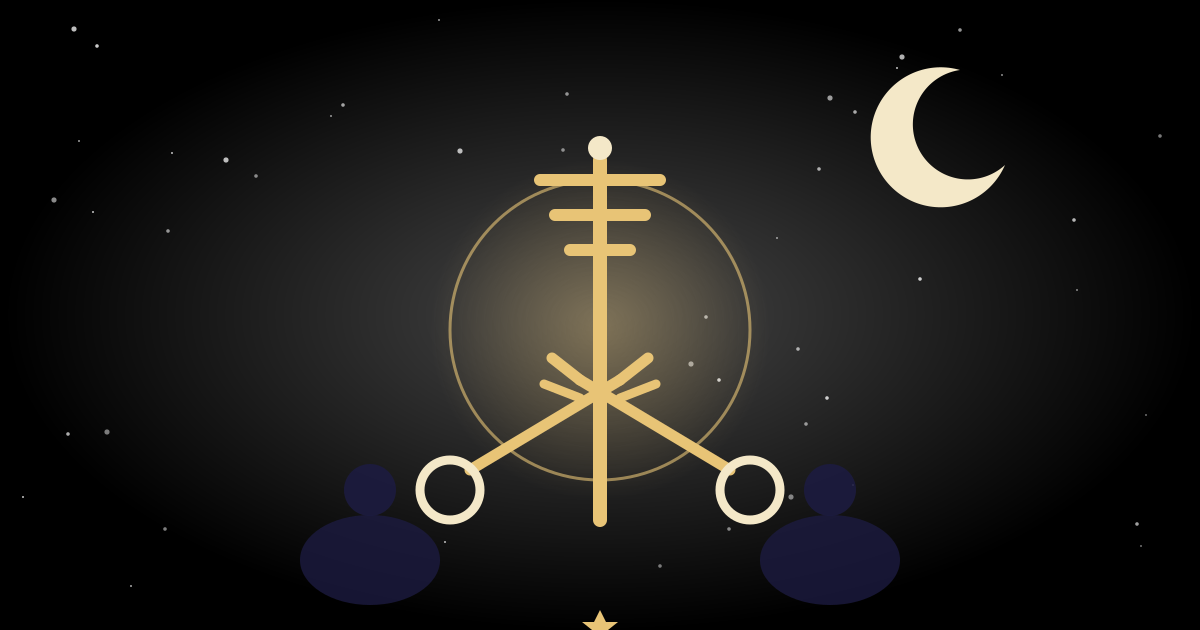
Card five of the Major Arcana sits between two grey pillars, two kneeling acolytes before him, one hand raised in blessing and the other gripping the papal triple cross. In older decks he is simply called the Pope — and the name tells you exactly what he represents: the spiritual authority, the one who holds the keys to the sacred, the living bridge between the human and the divine. The High Priestess guards hidden knowledge; the Hierophant teaches it. She whispers the mystery; he builds the school around it.
His number is five, and fives are about the human being as the link between worlds — the figure with head, arms, and legs outstretched, a star of flesh connecting earth and sky. His sign is Taurus, which surprises people until they think about it: Taurus is the sign that holds. Soil holds roots, vaults hold treasure, and the Hierophant holds traditions — patiently, stubbornly, across centuries. Ruled by Venus, his wisdom is not cold doctrine but embodied ritual: the bread you can taste, the choir you can hear, the candle you can smell. The Hierophant's teaching enters through the senses.
The two acolytes matter more than beginners realize. This is not a solitary sage on a mountaintop; this is a teacher with students, a card of lineage. The Hierophant insists that some knowledge cannot be invented — it must be handed down. The ceremony at his feet, the robes, the gesture passed from master to pupil for a thousand years: all of it says that you do not have to figure this out alone. Someone has walked this path before you, left markers, and — if you will accept the teaching — will shorten your road considerably.
The Hierophant Upright: Honor the Lineage
When the Hierophant appears upright, the message is one of the warmest in the deck: you are not the first person to face this. There is a lineage, a method, a community, a teacher — and your wisest move is to connect with it rather than reinvent it. This card shows up when the tried-and-true path is genuinely the right one: the degree program, the established practice, the elder's counsel, the ritual that has comforted people for generations. Originality is a virtue, but so is not being too proud to learn from those who came first.
Practically, the upright Hierophant asks for a teacher. Not an influencer with a course, but a genuine mentor — someone whose life demonstrates what they teach, who has stood where you stand and walked further. It may be a professor, a master craftsperson, a therapist, a spiritual guide, a grandmother whose recipes are actually life philosophy in disguise. The card's counsel is to approach such people with humility: the acolyte kneels not from weakness but from readiness. What can you learn only by being taught? What discipline have you been avoiding because self-teaching felt safer than admitting you need help?
He also governs belonging. The Hierophant upright frequently appears when you need a community that shares your values — the congregation, the guild, the study group, the twelve-step circle, the group of friends who understand the thing you love without explanation. His promise is that wisdom is not only found in solitude; some truths can only be learned shoulder to shoulder with others. If you have been carrying a question alone, this card suggests bringing it to the circle. And sometimes he is literal: the upright Hierophant is the deck's strongest card for formal commitment — the marriage, the vows, the signed covenant. What was private is ready to become witnessed.
The Hierophant Reversed: Question the Ritual
Reversed, the Hierophant turns his teaching into a question — and it is the bravest question in the deck.
The first reading is the empty ritual: going through the motions. The Sunday attendance with the heart elsewhere. The family tradition nobody enjoys and nobody dares cancel. The corporate values poster that contradicts everything the company does. Reversed in this flavor, the card is not attacking tradition itself; it is attacking the shell that tradition becomes when meaning drains out. The reversed Hierophant asks what the acolytes never ask: does this ritual still do what it was built to do? If the answer is no, he gives you permission to stop performing devotion you don't feel — for reflection, not for rebellion's sake, but because hollow practice eventually poisons the very thing it claims to honor.
The second reading is the false mentor: the teacher who should not be trusted. The guru with the red flags, the expert selling certainty, the institution protecting its power instead of its people. The upright Hierophant says find a teacher; the reversed one says examine the teachers you already have. Does their counsel serve your growth or their control? Does the teaching make you freer or more dependent? This is one of the card's most protective messages: reverence is not the same as obedience, and no title — priest, professor, coach, parent — exempts anyone from honest scrutiny.
The third reading is the most liberating: the unconventional path. Sometimes the reversed Hierophant is simply telling you that the traditional route is not your route — and that is not failure, it is information. The marriage timeline that doesn't fit. The career ladder you keep sliding off. The spiritual practice that must be personal rather than institutional. Every tradition was once someone's unconventional experiment. The reversed Hierophant blesses the seeker who must forge a new way — with one condition: know what you're leaving. Reject the teaching from knowledge, not from ignorance, and you carry its best parts with you.
The Hierophant in Love: Vows and Questions
In love readings the upright Hierophant is the card of commitment made real. For singles, he suggests you are ready for something serious — not the spark, the structure. He counsels dating with intention: knowing you want a partner, a household, a shared future, and choosing people who want the same. He also gently warns against dismissing traditional courtship entirely; there is wisdom in the old slow ways, in meeting families, in being seen together, in the relationship becoming part of a larger community rather than a private secret.
For couples, the upright Hierophant speaks of the relationship entering its formal phase: engagement, marriage, vows renewed, the partnership recognized and witnessed. His advice for keeping it there is about shared ritual — the traditions that make two people feel like one household: the anniversary kept sacred, the weekly date, the way you reconcile, the values you raise children by. For entertainment and reflection: he is also the card of the partner your family approves of, the safe choice, the one who shows up for the holidays and means it.
Reversed in love, the questions arrive. Perhaps the relationship is challenging convention — an unconventional arrangement, a refusal of the traditional timeline, a partnership that works precisely because it ignores the rules. Perhaps there is outside pressure: family demanding a wedding, culture demanding conformity, a counselor whose advice serves the institution rather than the couple. Or perhaps the most honest reading: the couple has the certificate but lost the connection — married in form, strangers in fact. Either way, the reversed Hierophant asks whether your love life serves the ritual or the ritual serves your love. The answer, held honestly, is the whole reading.
The Hierophant in Career and Money: The Guild Path
Career-wise, the upright Hierophant favors the established route: formal education, certifications, apprenticeships, joining a respected institution. If you asked about a career change, he says: learn it properly. Get the credential. Study under a master. The Hierophant is the patron of every profession with a lineage — medicine, law, the crafts, the clergy, academia — and his money wisdom is similarly traditional: the savings account, the pension, the diversified portfolio, the will written and witnessed. Boring? Perhaps. But the Hierophant's finances, like his rituals, have survived every crisis because they were built for centuries, not quarters.
He is also the card of the mentor appearing. In career readings the upright Hierophant often predicts a teacher entering your professional life — the boss who develops you, the senior colleague who explains the unwritten rules, the industry veteran who opens the door. His counsel is to be teachable: the fastest way up is often down on one knee, metaphorically speaking, absorbing what someone twenty years ahead can tell you in an afternoon. Mentorship is the original career hack, and the Hierophant has been offering it since long before the phrase existed.
Reversed in career, the card splits along its familiar seams. The dogma flavor: a workplace where the way we've always done it has become a prison — the bureaucracy, the credential worship, the innovation that dies in committee. Your move is to build the new thing, quietly if necessary, loudly when it works. The rebel flavor: your own unorthodox path — the portfolio career, the unconventional business, the refusal of the ladder. The reversed Hierophant does not condemn it; he only asks that you know the tradition you're departing from, because the rebel who understands the system outmaneuvers the one who merely resents it.
Symbols to Notice: Reading the Picture
The Hierophant's card is a study in spiritual authority — every detail carries teaching. Here is what to look for:
- The triple cross: the papal staff with its three horizontal bars — traditionally read as the three worlds (heaven, earth, underworld) or the three offices (teacher, priest, ruler). The bridge between realms, held in one hand.
- The crossed keys: at his feet, the keys of heaven — the authority to unlock mysteries, the teaching that opens locked doors. What is locked in your life, and who holds the key?
- The raised hand: two fingers pointing up, two folded down — the ancient gesture of blessing, the as above, so below of the hands. A bridge drawn in the air.
- The tiara: the triple crown — the Hierophant's authority is layered: what he knows, what he has been taught, and what has been taught through him.
- The two acolytes: kneeling students, one in roses, one in lilies — desire and purity, the two natures every teaching must address. The lineage made visible.
- The grey pillars: like the High Priestess's pillars but stone-grey — the established order, less mysterious than hers, more institutional. The temple as an organization, not just an idea.
When this card appears in your reading, notice which detail your eye lands on first. Drawn to the keys? The question is about access — what door needs opening, and who can open it. To the acolytes? About your own posture as a student. To the raised hand? About the blessing you are being offered — and whether you will accept it.
Try This: The Mentor Interview
The Hierophant is a card of handed-down wisdom, so here is a practice in his spirit — simple, humbling, and surprisingly powerful:
- Name the lineage (five minutes): write down three people — living or dead, known or unknown — who have taught you something that changed you. A teacher, a grandparent, an author, a boss. One sentence each on what they gave you.
- Find the living thread (five minutes): who in your life right now knows something you need to learn? The colleague with the skill, the elder with the story, the friend with the peace you envy. Write the name and the one question you would ask them.
- Ask the question (this week): actually ask it — over coffee, by message, in a letter. The acolyte's posture is the whole practice: approach as a student, listen more than you speak, and receive what is offered without arguing.
- Become the bridge (ongoing): teach one thing you were taught to someone behind you on the path. The Hierophant's lineage only lives if it flows through you. You are someone's acolyte and someone's teacher at the same time.
Repeat whenever you feel stuck. The interview won't hand you answers — the Hierophant is honest that wisdom is earned, not delivered — but it will reconnect you to the chain of teaching you belong to, and that is where his strength has always lived.
Combinations: The Hierophant Meets Other Cards
The Hierophant brings tradition and teaching to whatever he touches — he asks every card beside him what it was taught:
- Hierophant + Emperor: the establishment in full regalia — outer law and inner doctrine aligned. Institutions, official processes, the conventional path favored twice over.
- Hierophant + High Priestess: the two teachers together — outer teaching and inner knowing. Study the tradition, but let intuition be your private tutor.
- Hierophant + Empress: the nurturing tradition — family values, the mother-line, wisdom passed hand to hand through generations. The home as a school.
- Hierophant + Magician: the student becomes the practitioner — what was taught is now being used. The apprentice's graduation; knowledge turning into craft.
- Hierophant + Tower (reversed nearby): the tradition is cracking. What was taught as eternal is being tested by reality — examine the doctrine before the lightning does it for you.
- Hierophant + Two of Cups: the blessed union — commitment witnessed and honored. Engagement, marriage, or a partnership the community celebrates.
As always, these are starting points. Your own readings will teach you pairings no book lists — the Hierophant rewards the student who does the daily work, after all.
Closing: Take the Keys
Here is the Hierophant's whole sermon in one line: you do not have to walk alone, and you do not have to walk where others walked. The keys at his feet unlock in two directions — the door of the tradition, and the door out of it.
So when this card appears for you, receive it as a student would. Find the teacher. Join the circle. Honor what was handed to you — the recipe, the ritual, the hard-won advice. And when the time comes, as it always does, ask the reversed question with a clear conscience: is this tradition serving me? If yes, kneel and learn. If no, take the best of what you were taught and walk your own road. The lineage does not end when you leave the temple; it continues in everyone you go on to teach. Take the keys. Use them well.
Frequently asked questions
Is the Hierophant a yes or no card in tarot?
The Hierophant leans yes — but his yes comes through the traditional route. He favors the official path: the marriage over the elopement, the degree over the shortcut, the contract over the handshake. In entertainment-style readings, he answers yes to questions about commitment, education, mentorship, and anything that involves joining an institution or following an established process. He leans toward no — or not this way — for rebellious shortcuts and unconventional schemes.
What does the Hierophant reversed mean in love?
Reversed in love, the Hierophant often describes a relationship questioning convention — choosing an unconventional arrangement, resisting pressure to marry or follow a traditional timeline, or discovering that a supposedly wise relationship counselor has been steering you wrong. It can also flag that a couple is going through the motions: together on paper, hollow in practice. The card asks whether your relationship serves the ritual or the ritual serves the relationship. For entertainment and reflection only.
What zodiac sign is associated with the Hierophant?
The Hierophant is ruled by Taurus, the earth sign governed by Venus. This gives him his steadfastness — Taurus energy holds traditions the way soil holds roots — and explains the card's surprising sensuality: the Hierophant's wisdom is embodied, ritual, tasted and touched, not abstract. His number is five, the number of the human figure with arms outstretched: the seeker between earth and heaven.
How is the Hierophant different from the Emperor?
The Emperor and the Hierophant are the deck's two authorities — but they govern different kingdoms. The Emperor rules the outer world: laws, structures, budgets, the visible order of society. The Hierophant rules the inner world: beliefs, rituals, initiation, the shared meaning that holds a community together. The Emperor tells you what to do; the Hierophant tells you what it means. One commands obedience, the other offers belonging.
Does the Hierophant mean marriage in tarot?
The Hierophant is the tarot's strongest marriage card in the upright position — not the falling-in-love part, but the formal, witnessed, committed part. Vows, ceremonies, recognized partnership, the relationship becoming an institution. It can also point to other formal commitments: joining a community, signing a lasting agreement, taking vows of any kind. Reversed, it suggests the marriage question is complicated — pressure to marry, or a deliberate choice of an unconventional path.
Keep exploring

The Emperor Tarot Card Meaning: Authority, Structure & Reversed
The Emperor tarot card meaning fully explained — upright & reversed symbolism, love, career, authority, card combinations, and a grounding leadership practice.
Read the meaning →
The Empress Tarot Card Meaning: Abundance, Love & Reversed
The Empress tarot card meaning fully explained — upright & reversed symbolism, love, career, abundance, card combinations, and a grounding abundance practice.
Read the meaning →
The High Priestess Tarot Card Meaning: Intuition & Reversed
The High Priestess tarot card meaning fully explained — upright & reversed symbolism, love, career, intuition, card combinations, and a quiet listening practice.
Read the meaning →
The Magician Tarot Card Meaning: Manifestation & Reversed
The Magician tarot card meaning fully explained — upright & reversed symbolism, love, career, intuition, card combinations, and a quiet listening practice.
Read the meaning →