
The Moon Tarot Card Meaning: Dreams, Illusions & Reversed
Meet the Moon: The Card of the Night Mind
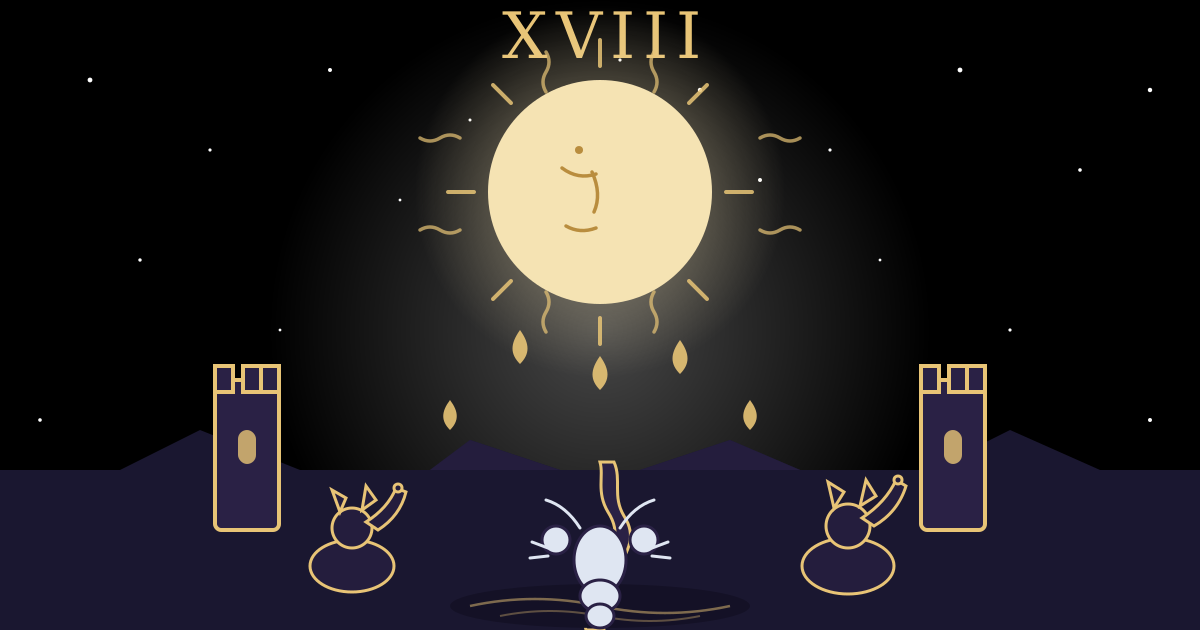
A moon with a human face hangs huge and low in the night sky, shedding drops of dew like tears onto the landscape below. Beneath it stand two stone towers, and between them a winding path disappears toward distant mountains. A dog and a wolf sit side by side, both baying at the moon. And at the edge of a dark pool of water, a lobster — or crayfish — crawls toward the shore. This is the Moon, card eighteen of the Major Arcana: the most nocturnal, dreamlike, and misunderstood card in the deck.
If the High Priestess is intuition at its clearest, the Moon is intuition's shadow side — the same deep waters, but at night, when the shapes get strange. The Sun card is clarity; the Moon card is the honest admission that sometimes clarity is not available yet. Readers have warned about this card for centuries, and the warning is worth hearing precisely: it is not the card of disaster. It is the card of not-knowing. The Moon does not lie to you. It asks whether you are sure about what you think you are seeing.
The card is ruled by Pisces, the last sign of the zodiac — the sign of the boundless ocean, the dissolve of boundaries, dreams, and the place where the self thins out into something bigger. Pisces is the sign of both mystics and mirage-chasers, and the Moon card holds both at once. Its number is eighteen, sitting in the Major Arcana between the Star's quiet hope and the Sun's full daylight — the Moon is the last stretch of the night before the dawn.
The Moon Upright: Walking by Moonlight
When the Moon appears upright, it describes a situation with low visibility — emotionally, informationally, or both. Something is unclear: the real motives, the full facts, the shape of the thing ahead. This is not the card of danger; it is the card of fog. And the card's first counsel is the oldest travel advice there is: when you cannot see the road, slow down. The Moon upright warns specifically against the irreversible decision — the contract signed in a hurry, the conclusion leapt to, the breakup decided at 2 a.m. — made while perception is distorted.
The distortion the Moon describes comes in several flavors. Illusion is the first: things are not what they seem — the too-good opportunity, the friend whose warmth does not match their actions, the story you have told yourself so many times you now believe it. Anxiety is the second: the Moon amplifies fear the way moonlight amplifies shadows, and much of what keeps you up at night is projection, not information. The third flavor is the card's genuine gift, and it is real: heightened intuition. Dreams get vivid and specific. Gut feelings arrive with unusual force. The Moon heightens the night mind — the problem is that it heightens the nightmares along with the dreams. Trust the feelings; verify the facts.
The card's most concrete signal is the dream life. When the Moon appears, pay attention to your dreams for the next week — tradition says the card is often the subconscious itself surfacing, the lobster climbing out of the pool. Recurring figures, repeated settings, the emotion that greets you on waking: this is the Moon's mail. Keep a notebook by the bed. But the card's warning applies to dreams too — dreams are not instructions, they are weather. Read the forecast; do not sail by it.
Practically, the upright Moon is a visibility report, not a verdict. Postpone what can be postponed. Read the fine print twice. Ask the clarifying question you have been avoiding. Give it a full moon cycle if you can — what looks one way in moonlight often looks different in sunlight. For entertainment and reflection: the Moon never tells you what to do. It tells you the light is bad.
The Moon Reversed: The Fog Lifts — or Thickens
Reversed, the Moon splits into two opposite readings, and part of reading this card reversed is figuring out which one you are in.
The first is the fog lifting: secrets surfacing, confusion clearing, anxiety easing as the facts arrive. The situation that was opaque becomes legible; the person you could not read finally shows their hand. If the upright Moon was the nightmare, the reversed Moon is the waking — and the relief is the reading's signature emotion. The truth that emerges is often the one you already suspected: the fog was hiding something you half-knew.
The second reversed reading is the fog thickening: not confusion arriving from outside, but self-deception from within. The lies you tell yourself when you already know the truth. The red flags you have photographed, catalogued, and framed. The anxiety that has become a lifestyle — checking, re-checking, running disaster movies in the night mind and calling it preparation. Reversed in this reading, the Moon asks the uncomfortable question: are you confused because the facts are hidden, or because you are hiding from the facts?
How to tell which reading is yours: the lifting fog feels like relief arriving with information — a message that clears things up, a pattern finally visible, a fear that dissolves when named. The thickening fog feels like the same loop with more detail — the anxiety is not new information, it is the same worry wearing a new costume. For entertainment and reflection: the reversed Moon is a flashlight. Turn it on — either the shadow was a coat rack, or it was not, and both answers are better than standing in the dark.
The Moon in Love: Projections, Jealousy & the Unsaid
In love readings, the upright Moon is the card of projection — seeing the person across from you through the movie in your head.
For singles, the classic Moon illusion is idealization: the new romance bathed in moonlight, where you fill every gap in what you know with your hopes. The card's question for singles is the uncomfortable one: are you in love with them, or with the story about them? The Moon also covers the opposite illusion — the suspicion with no evidence, reading texts like crime scenes, assuming betrayal before it happens. Both are the same distortion wearing different costumes.
For couples, upright the card describes the unspoken — the conversation both people are avoiding, the jealousy rooted in imagination rather than fact, the distance that is emotional before it is ever physical. The Moon's advice for couples is direct: say the unsaid thing. Moonlight fear dies in daylight conversation. The card also names the nights themselves: the 3 a.m. spirals, the mind rehearsing fights that have not happened. Those are weather, not prophecy — treat them accordingly.
Reversed in love, the truth surfaces — sometimes gently, the misunderstanding cleared up, the motive finally understood; sometimes violently, the secret found, the illusion broken by force. If a relationship survives a reversed Moon, it usually comes out more honest than it went in. The card's counsel stays the same either way: bring it into the light. For entertainment and reflection: the Moon never says leave. It says look.
The Moon in Career and Money: Uncertainty at Work
Career-wise, the upright Moon is the card of low visibility at work: the unclear role, the reorganization whose real shape nobody will name, the offer letter with the interesting blank spots, the boss whose praise does not match the promotion pattern. The counsel is contractual, not mystical: get it in writing, ask the follow-up question, read the fine print twice. Do not resign in a Moon month if you can avoid it — decide in daylight.
The card also names office fog — the rumor mill, the hidden agendas, the colleague whose helpfulness has a weather pattern. Watch, take notes, assume nothing. But the Moon has a career gift, and it is significant: this is the great card of the night workers, the dreamers, the makers. Artists, writers, therapists, filmmakers, game designers — the professions that mine the subconscious. If your work runs on imagination, the Moon is your season. Create in the dark; publish in the light.
Money-wise, the Moon describes the unclear financial picture — the account you have not reconciled, the debt you have a feeling about but not a number, the investment pitched in moonlight language: guarantees, urgency, fog. The card's money advice is bookkeeping: turn the light on. Reversed in career and money, the reading is the exposure — the hidden term surfacing, the real numbers finally visible, or the self-deception named at last: the budget you keep meaning to make, the spending you keep meaning to face. For entertainment and reflection: sunlight is a budgeting tool.
Symbols to Notice: Reading the Picture
The Moon rewards a slow look. Here is what the details are saying:
- The moon with a face: the night mind made visible. The face means this is not random darkness — it is the psyche's own night, personal and watchful. The moon is looking at you; the question is whether you are looking back.
- The sixteen rays — eight straight, eight wavy: conscious and unconscious light. The card's reminder that the moon gives two kinds of light: the clear and the distorting. Some of what you see by moonlight is true; some of it is the wavering kind.
- The dew drops: the tears of the moon — spiritual essence condensing, the night mind fertilizing the earth. Or grief doing its quiet work. Either way, the night is not barren; it is watering something.
- The two towers: the gatekeepers of the unknown — the same architecture as the High Priestess's pillars, but darker and more distant. You are on the outside of the mystery now. The towers mark the threshold you cannot yet cross.
- The dog and the wolf: the tamed and the wild parts of your fear — one domesticated anxiety, one feral. Both are baying at the same moon. Notice which one sounds like you.
- The lobster: the primitive subconscious crawling toward consciousness — the part of you that lived in the deep water before you had a name for anything. When it surfaces, it brings dreams, urges, and the occasional nightmare. Listen; do not obey.
- The winding path: the journey through uncertainty. It does not go straight — it cannot, in this light. The path is the card's promise that there is a way through the fog, even if it is not the direct one.
- The distant mountains: the far goal, visible but unreachable tonight. The promise that there is something beyond the fog — and the warning that you cannot get there until the light improves.
When this card appears in your reading, notice which detail your eye lands on first. Drawn to the towers? The question is about the unknown ahead. To the dogs? About fear — which kind is yours. To the lobster? The subconscious is trying to hand you something. To the path? The way forward exists; it just is not visible yet.
Try This: The Moonlit Dream Journal
The Moon rewards the dreamer who writes things down. Here is a seven-night practice in the card's spirit:
- Night one — the bedside kit (five minutes): a notebook and a pen within arm's reach of the bed. The phone on the nightstand is a failed plan — the screen light kills the dream before you can catch it. Paper only.
- The rule of first words (two minutes each morning): write before anything else — dreams evaporate in about ninety seconds. Fragments count. "Blue door, wet dog, grandmother laughing" is a perfect entry. Grammar is for daylight.
- The three questions (three minutes each morning): what was the weather of the dream — storm, dusk, bright noon? Who or what had the power in it? And have I dreamed this before? Repeats are the Moon's vocabulary.
- The weekly review (fifteen minutes on night seven): read the whole log in one sitting. Circle the repeats — the figures, places, and emotions that kept returning. Then ask of each: is this a message, or is this just digestion? The card honors both answers.
- The reality check (the Moon's golden rule): let the dream inform your questions, never your decisions. If a dream says "do not sign," the card says "review the contract," not "burn the contract." Dreams are counsel, not command.
After a week, you will have something the Moon always offers the patient: a small map of your own night mind. Some of it will be fog. Some of it will be the lobster, handing you exactly what you needed. You will know which is which by then.
Combinations: The Moon Meets Other Cards
The Moon lends its fog — or its night vision — to whatever it touches:
- Moon + Sun: the morning after the night — confusion resolving into clarity. Whatever was unclear becomes obvious. The fog was temporary; the sunlight was always scheduled.
- Moon + High Priestess: the double moon — intuition doubled. Dreams, hunches, and quiet knowings carry unusual weight this week. Listen harder than usual; verify anyway.
- Moon + Tower: the illusion breaks violently — the secret exposed by force, not by choice. What was hidden in fog is revealed by lightning. Brace, then be grateful for the daylight.
- Moon + Seven of Cups: mirage season — too many options, none of them solid. The card of choosing nothing until the light improves. Every option deserves a second look in the sun.
- Moon + Nine of Swords: the 3 a.m. special — anxiety feeding on itself in the dark. The fears are weather. Name them, write them down, and refuse to decide anything until morning.
- Moon + Hermit: the lantern in the fog — the deliberate inward retreat. Solitude, reflection, and one honest journal page are how this particular confusion ends.
As always, these are starting points. Your own readings will teach you pairings no book lists — the Moon rewards the reader who learns to sit with not-knowing instead of fleeing it.
Closing: Trust the Night, Don't Decide in It
Here is the Moon's whole teaching in one line: the night is not the enemy — the decision made in the dark is.
The moon-face, the towers, the baying dogs, the lobster climbing toward shore, the dew like tears: the card is a portrait of the mind at night, when everything is amplified and nothing is certain. Every fear named loses some of its power. Every dream written becomes data. Every fog lifts, because fogs always lift — and the towers are still standing in the morning, the path still winding toward the mountains. The Moon does not ask you to be fearless. It asks you to be patient: to wait for the Sun, which is always on its way. Trust the night. Do not decide in it. The dawn will show you what was real all along.
Frequently asked questions
Is The Moon tarot card a bad omen?
No. The Moon is not the card of disaster — it is the card of poor visibility. It describes situations where the facts are unclear, motives are hidden, or your own perception is distorted by fear, hope, or wishful thinking. Its counsel is to slow down and wait for daylight, not to brace for catastrophe. For entertainment and reflection: the scariest thing about the Moon is how much we add to it ourselves.
Is The Moon a yes or no tarot card?
The Moon answers yes-or-no questions with a "not yet." It describes the state of the light, not the outcome — so any yes or no given in moonlight is unreliable. Its practical counsel is to wait: give the situation a week or a full moon cycle, gather the missing facts, and ask again in daylight. For entertainment and reflection: the Moon's favorite answer is the pause.
What does The Moon card reversed mean?
Reversed, The Moon splits into two readings: the fog lifting — secrets surfacing, confusion clearing, anxiety easing as facts arrive — or the fog thickening — self-deception, paranoia, and the lies you tell yourself when you already know the truth. Relief arriving with new information points to the lifting fog; the same worry wearing a new costume points to the thickening one. For entertainment and reflection: both readings end with the same tool — the light.
What zodiac sign is associated with The Moon card?
The Moon is ruled by Pisces, the mutable water sign of dreams, intuition, and the boundless ocean — the sign of both mystics and mirage-chasers, which is exactly the card's territory. It is card eighteen (XVIII) of the Major Arcana, sitting between the Star's quiet hope and the Sun's full clarity: the last stretch of the night before the dawn.
Why does The Moon card make dreams more vivid?
Because the card is the night mind made visible — its whole scene is the landscape of the unconscious: the moon-face, the dark pool, the lobster crawling toward shore. When The Moon appears, tradition says the subconscious is running loud, and dreams carry unusual weight for about a week. Keep a dream journal — and let the dreams inform your questions, never your decisions. For entertainment and reflection only.
Keep exploring
The High Priestess Tarot Card Meaning: Intuition & Reversed
The High Priestess tarot card meaning fully explained — upright & reversed symbolism, love, career, intuition, card combinations, and a quiet listening practice.
Read the meaning →
The Tower Tarot Card Meaning: Destruction, Truth & Rebirth
The Tower tarot card meaning — sudden change, truth & rebirth, upright and reversed. Love, career advice and a grounding practice for upheaval.
Read the meaning →
The Fool Tarot Card Meaning: Upright & Reversed
The Fool tarot card meaning fully explained — upright & reversed symbolism, love, career, spiritual guidance, and card combinations for beginners.
Read the meaning →
The Chariot Tarot Card Meaning: Willpower, Victory & Reversed
The Chariot tarot card meaning fully explained — upright & reversed symbolism, willpower, victory, love, career, card combinations, and a focus practice for taking the reins.
Read the meaning →