
Blood Moon Meaning: Spiritual Significance of the Total Lunar Eclipse
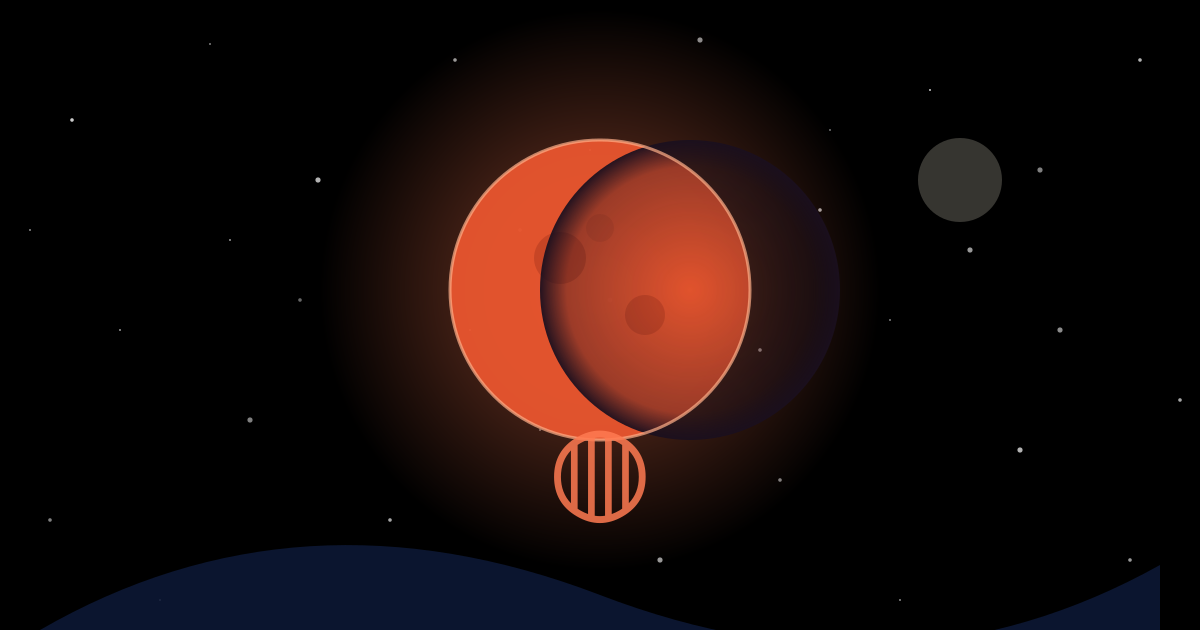
There is no lunar sight quite like it. You step outside on a full moon night to find the moon wrong — dimmer than it should be, half-swallowed by a curved shadow, and then, slowly, blushing into copper, brick red, and finally a smoldering crimson that hangs in the sky for nearly an hour. No telescope needed, no expertise required. The blood moon is the one lunar event that can make a whole neighborhood stop, step outside, and look up together.
For much of human history, this red moon was a portent — a sign to fear. Today we know exactly what it is: a total lunar eclipse, a piece of perfectly predictable celestial geometry that you can plan for, photograph with your phone, and watch with nothing more than a lawn chair and a clear sky. And because it is rare — only two or three happen per decade, and the next one is already on the calendar — it is worth knowing both the science and the stories. Here is the full guide: the astronomy, the March 3, 2026 blood moon, and what the red moon has meant to the people who watched it.
What Is a Blood Moon? The Astronomy
"Blood moon" is not an astronomer's official term — it is a nickname that won the public's imagination. The formal event is a total lunar eclipse, and it happens when three bodies line up with unusual precision: the Sun, the Earth, and a full moon. Earth sits directly between the Sun and the Moon, and the Moon passes fully into Earth's inner shadow, the umbra.
Naively, you might expect the moon to go black. It doesn't, because Earth's atmosphere is doing something clever with the light. Sunlight skimming through our atmosphere has its short blue wavelengths scattered away in every direction — the same physics that makes the sky blue and sunsets orange. What remains, the long red and orange wavelengths, bend around the limb of the Earth and fall onto the moon inside the shadow. During totality, the lunar surface is lit by all of Earth's sunrises and sunsets at once, which is why it glows that eerie copper-red.
The exact color is never the same twice, and astronomers actually grade it. The Danjon scale, developed by French astronomer André-Louis Danjon, runs from L=0 (a nearly invisible moon, dark gray-brown) to L=4 (a bright copper-orange moon). The shade depends on the state of Earth's stratosphere: after major volcanic eruptions, fine aerosols can darken a blood moon dramatically. In a sense, every blood moon is a snapshot of what our atmosphere looked like that night — a planetary self-portrait in red.
A total lunar eclipse has a rhythm worth knowing if you want to watch one. First comes the penumbral phase, a subtle dimming as the moon enters Earth's outer shadow — easy to miss. Then the partial phase, when the curved edge of the umbra creeps across the lunar disk like a bite being taken out of it. Then totality, roughly an hour when the whole moon burns red. Then the whole sequence runs in reverse. From first shadow to last light, the March 2026 eclipse will take about five and a half hours.
The March 3, 2026 Blood Moon: Dates and Visibility
The blood moon of March 3, 2026 is the only total lunar eclipse of 2026, and one worth planning around: the next one after it does not arrive until December 31, 2028, into New Year's Day 2029. Miss this one, and you are waiting nearly three years.
The full moon on the bill is March's Worm Moon, named for the tradition that earthworms begin emerging from thawing soil in early spring — a quiet signal that winter is loosening its grip. During totality, the full Worm Moon will reach peak illumination at 6:38 a.m. EST, hanging as a red disk where the bright white moon should be.
The timeline for U.S. viewers, according to NASA and Space.com: the penumbral phase begins at 3:44 a.m. EST, the partial eclipse at 4:50 a.m. EST, and totality runs from 6:04 a.m. to about 7:03 a.m. EST — roughly 58 minutes of full blood moon. The partial phases then reverse until the eclipse ends around 9:23 a.m. EST.
Visibility favors the West. Viewers in California, Oregon, and Washington will see the entire eclipse from beginning to end in the pre-dawn hours, the red moon hanging high. The Central time zone catches most of totality around sunrise. On the East Coast, the moon will be setting as totality begins — New York gets the blood moon low on the horizon, a dramatic last glimpse before moonset. The eclipse is also fully visible from Australia, New Zealand, Japan, Korea, and the Pacific; Europe and Africa miss it entirely. Unlike a solar eclipse, no glasses or filters are needed — it is perfectly safe to watch with the naked eye, and binoculars will show the glowing lunar craters inside the shadow.
Blood Moon vs. Lunar Eclipse: Clearing Up the Terms
A few terms get tangled around this event, so here is the quick glossary. A total lunar eclipse is the astronomical event; a blood moon is the nickname for how the moon looks during one. They describe the same night from different angles. A partial lunar eclipse is when only part of the moon enters the umbra — the classic "bite taken out of the moon," but no red glow.
You may also have heard of a lunar tetrad — four total lunar eclipses in a row with no partial eclipses between them, spanning about two years. Tetrads are rarer and were the reason the "blood moon" nickname surged into popular culture: the tetrads of 2014–2015 came with a wave of prophecy-themed books and headlines, and the name stuck to every red moon afterward. Enjoy the folklore, but know the astronomy underneath is the same every time: Earth's shadow, Earth's atmosphere, one red moon.
The Spiritual Meaning of a Blood Moon
Because the blood moon is dramatic and rare, spiritual traditions have never treated it as just another full moon. But read carefully, and the interpretations share a common thread — one that works best when kept in the honest, entertainment-first framing the event deserves: these are reflections, not predictions.
The most consistent reading is transformation through shadow. The moon — the familiar, reliable full moon — is briefly swallowed by darkness and then returns, altered in color. Many traditions use that as a meditation on the shadowed parts of our own lives: the feeling or situation we would rather not look at, given a dramatic visual debut and then a release. In that reading, the blood moon is the full moon's release-and-renew work turned mythic. Old patterns are named in the dark; new ones are welcomed when the copper moon returns.
A second thread is revelation. The red color itself does the work here: ordinary moonlight flatters everything, but red light is the color of alarms, of dawn, of things that cannot be unseen. Practitioners across folk magic and modern manifestation traditions describe the blood moon as a moment when hidden truths surface — a relationship's real shape, a habit's real cost, a desire's real weight. The advice that comes with it is gentle and practical: write down what feels suddenly obvious, and deal with it in daylight.
A third, quieter reading comes from the blood moon's position in the seasonal calendar. The March 2026 eclipse is a Worm Moon eclipse, arriving as winter thaws. In that company, the blood moon reads as a threshold: the last dramatic darkness before spring, a night for clearing emotional closets the way gardens get cleared in March. And the copper-red color, unlike the moon's usual silver, has its own symbolism in old lore — courage, passion, and the warm human blood that connects us to the earth under our feet.
The honest framing: a blood moon changes nothing in the sky that physics cannot explain, and it predicts nothing. But as a ritual prompt — a scheduled night for facing the shadow, writing it down, and letting it pass — it has genuine value. The astronomy is the fact; the meaning is the art you make with it.
Blood Moon Folklore: What the Old Stories Said
Before eclipse tables existed, a red moon was terrifying. The old beliefs are worth knowing, if only to appreciate how far we have come. In Mesopotamia, the moon's redness was read as a royal omen — the king himself might stand in for the moon's suffering in ritual. In parts of China and India, the red moon during eclipse was the work of a celestial creature swallowing the moon: in the Hindu tradition, the demon Rahu, decapitated for drinking the nectar of immortality, taking revenge by biting the moon out of the sky. Drums were beaten to frighten him off.
The ancient Greeks had perhaps the calmest take. They noticed that Earth's shadow on the moon was always curved — which meant the Earth itself was round, and Aristotle cited lunar eclipses as evidence for a spherical Earth. The Incas took the opposite view: the moon was under attack by a jaguar, and people shouted and shook spears to scare it away, terrified that the beast would turn its attention to Earth next. Across much of Europe, the blood moon fed into older moonlore of madness and change — the word "lunacy" comes from exactly this family of beliefs.
What is striking is that no tradition, anywhere, treated the red moon as boring. Fear, awe, ritual noise, philosophy: the blood moon has always been a night when human beings felt the sky was speaking to them. The 2026 version keeps the awe and drops the fear. Shouting at a jaguar is optional.
A Simple Blood Moon Ritual
A total lunar eclipse unfolds over hours, which makes it one of the easiest celestial events to ritualize: the phases of the eclipse give you a built-in script. You need nothing but a place to sit and a way to write. This ritual is for reflection and meaning-making — entertainment and personal practice, not a promise of outcomes.
1. Watch the shadow arrive (partial phase)
Step outside as the partial phase begins — for March 2026, that is 4:50 a.m. EST, but any blood moon's partial phase is visible for over an hour. Watch the curved bite of shadow creep across the moon. While it advances, name what it represents for you: the habit, worry, or unfinished business that is currently in shadow. Write it down. The shadow is doing its work slowly; let your thinking move at the same pace.
2. Sit with the red moon (totality)
During the 58 minutes of totality, the moon is at its reddest and dimmest. This is the traditional "release" window. Read your list back to yourself, then physically release one item — burn it safely outdoors, tear it into pieces, or simply cross it out and fold the page away. Let the red light be the backdrop: the shadow passed over the moon, and it passed through. So do things.
3. Welcome the moon's return (second partial phase)
As the shadow retreats and the moon brightens, write one intention for the season ahead — keep it concrete, the way March intentions should be: a project to start, a conversation to have, a patch of your life to thaw. This mirrors the old full-moon structure of release plus intention, stretched across the eclipse's arc.
4. Close with gratitude at moonrise or moonset
End with three things you are grateful survived the winter — literal or inner. The March eclipse is a Worm Moon eclipse, and gratitude for what is thawing is the season's native language. Then go back to bed. Blood moon watching at dawn is glorious; blood moon watching while sleep-deprived the next day is not.
Blood Moon Dreams: What to Watch For
Lunar-eclipse nights have their own dream lore, and it is richer than ordinary full-moon lore because the event itself is stranger. The recurring motifs are red skies, eclipsed lights, and blocked vision — dreams of the sun dimming, of red moons, of looking through smoked glass, of trying to see something that keeps sliding into shadow.
Modern dream traditions read these as the eclipse's themes rendered in sleep: something hidden is becoming visible. Dreams of a red moon itself are often treated as the psyche doing release work — a dramatic, cinematic version of processing an ending. Dreams of the shadow covering the moon, meanwhile, get read as anxiety about something being obscured: a truth not yet faced, a decision postponed. As always with moon dreams, treat them as reflections of what is already on your mind, amplified — not as predictions.
If you want to try it, keep a journal by the bed on the night of March 2–3, 2026. Write the dream down before checking your phone. The eclipse is safe, the moon will come back, and your notes will be there in the morning.
The blood moon will not come again over the Americas until the New Year's Eve eclipse of December 2028. On March 3, 2026, the shadow arrives at 4:50 a.m. EST, the moon burns red from 6:04 to 7:03, and then the ordinary silver moon returns — as if the whole drama had been a dream. Some nights, the sky puts on a show for everyone. This is one of them. Set the alarm, step outside, and watch the moon blush.
Frequently asked questions
What is a blood moon?
A blood moon is the popular name for the moon's appearance during a total lunar eclipse. The Earth passes directly between the Sun and the full moon, and Earth's atmosphere filters sunlight, scattering away blue wavelengths and bending red wavelengths onto the lunar surface. The result is a moon that glows copper, orange, or deep crimson for about an hour. The term is a nickname from skywatching culture, not an official astronomical term.
When is the next blood moon in 2026?
The next blood moon is on March 3, 2026, during the only total lunar eclipse of 2026 — the Worm Moon. Totality begins at 6:04 a.m. EST and lasts about 58 minutes. Western North America will see the full eclipse before dawn; the East Coast will catch the partial phases as the moon sets. The following total lunar eclipse, and the next chance at a blood moon, is not until December 31, 2028, into January 1, 2029.
Why does the moon turn red during a blood moon?
The red color comes from Rayleigh scattering, the same physics that makes sunsets red. Sunlight passing through Earth's atmosphere has its short blue wavelengths scattered away, while the longer red wavelengths bend around the edge of Earth and fall onto the moon inside Earth's shadow. The exact shade — bright copper, brick red, or dark gray-brown — depends on how much dust and aerosol is currently in Earth's stratosphere.
What is the spiritual meaning of a blood moon?
In spiritual and folk traditions, the blood moon is read as a symbol of transformation and revelation: a moment when the familiar moon is briefly swallowed by shadow and returns, which many practitioners treat as a meditation on endings, release, and renewal. These are interpretations for entertainment and reflection, not predictions — a blood moon is a safe, natural astronomical event.
Is it safe to watch a blood moon?
Yes. Unlike a solar eclipse, a lunar eclipse is completely safe to watch with the naked eye — no glasses, filters, or equipment are needed, because you are only looking at reflected sunlight on the moon, just as you would on any full moon night. Binoculars or a small telescope will simply show more of the red glow and the lunar craters inside the shadow.
Keep exploring
Supermoon Meaning: Spiritual Significance of the Year's Biggest Full Moon
What is a supermoon? The astronomy behind the year's biggest full moon, the 2026 supermoon dates, its spiritual meaning, and a simple supermoon ritual.
Read the meaning →
Blue Moon Spiritual Meaning: Rare Lunar Energy & How to Work With It
What is a blue moon? Discover the astronomy behind the rare second full moon, its spiritual significance, and a simple blue moon ritual.
Read the meaning →
The 8 Moon Phases & Their Meanings: A Complete Spiritual Guide
Explore the spiritual meaning of all 8 moon phases — from new moon intentions to full moon release — and learn how to align your rituals with each phase.
Read the meaning →
What Does It Mean to Dream About Flying?
Flying dreams rank among our happiest. Discover what dreaming about flying means — freedom, ambition, confidence — and what turbulence reveals.
Read the meaning →