
Flower Moon Meaning: Why May's Full Moon Is Called the Flower Moon
What Is a Flower Moon?
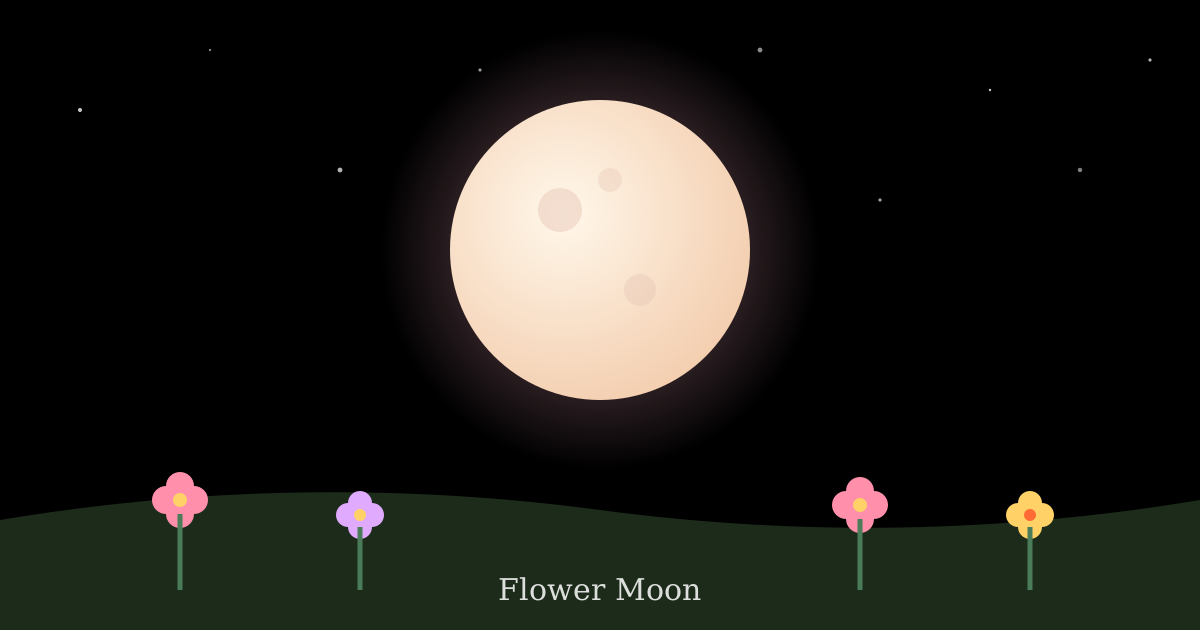
The Flower Moon is the full moon that falls in May, and its name is one of the most straightforward in the whole named-moon tradition. There is no riddle to solve and no rare alignment behind it. In May, across much of North America, the fields, meadows, and roadsides burst into flower. The moon that rises over that landscape took its name from what was happening on the ground below it, not from anything unusual happening in the sky above it.
That plainness is worth pausing on, because the named moons are often misunderstood as astronomical events. The Flower Moon is not a type of moon the way a supermoon or a blood moon is. A supermoon is a full moon near perigee, the closest point in its orbit, and it genuinely looks larger. A blood moon is a total lunar eclipse, and it genuinely turns red. The Flower Moon is neither. It is a full moon in May, given a seasonal nickname by the people who lived by the seasons. If you go outside on Flower Moon night, you will see a normal full moon, bright and round, rising around sunset and shining until dawn. Its magic, such as it is, is in the timing: the brightest night of the month arriving at the brightest moment of spring.
The name belongs to a system, not a single moon. The named full moons run through the year as a kind of folk calendar: the Wolf Moon in January, the Snow Moon in February, the Worm Moon in March, the Pink Moon in April, the Flower Moon in May, the Strawberry Moon in June, and on through Harvest, Hunter's, Beaver, and Cold. Each name marks what was happening in the natural world when that moon rose. The Flower Moon marks the month when spring stops being a promise and becomes visible everywhere at once.
Why Is It Called the Flower Moon?
The name comes from North American folk tradition, popularized in modern times by the Old Farmer's Almanac, which attributes many of these full moon names to Algonquin-speaking peoples and other Native nations of the northeastern United States. The attribution is general rather than precise: the Almanac's list blends names from several traditions into one popular calendar, and not every name can be traced to a single source. What is consistent across the tradition is the logic. May is the month when flowers appear in profusion, so May's moon is the Flower Moon.
Other names for May's moon tell the same story from slightly different angles, and they are worth knowing because you will meet them in older almanacs and regional folklore. The Corn Planting Moon marks the month for sowing corn. The Milk Moon, used in some European traditions, marks the month when cows and goats gave milk in abundance as pastures greened. The Hare Moon, another European name, marks the breeding season of hares in spring. Each name is a different community noticing the same thing: May is when life multiplies, visibly and fast.
One common confusion deserves clearing up before it spreads. The Flower Moon is not pink, and it is not named for a single flower. That honor, sort of, belongs to April's Pink Moon, which is named for the pink wild ground phlox, one of the earliest widespread flowers of spring in eastern North America. The Flower Moon is the general case that follows the specific one: April brings the first pink flower, May brings flowers everywhere. If you photograph the Flower Moon expecting a rosy disk, you will get a perfectly ordinary white-gold full moon — beautiful, but not floral. The flowers are on the ground, not in the sky.
When Is the Flower Moon?
The Flower Moon is the full moon that falls in May, and its exact date moves from year to year because the lunar cycle lasts about 29.5 days while calendar months run 28 to 31 days. Some years May holds a single full moon early in the month, some years late, and occasionally the calendar produces a second full moon in May, which would be a Blue Moon by the monthly definition. The Flower Moon is whichever full moon belongs to May in the seasonal naming system, so check a current moon-phase calendar for the precise night rather than memorizing a date.
Watching it needs no equipment and no special timing beyond the usual full moon advice. It rises around sunset in the east, climbs high through the night, and sets around sunrise. The most dramatic view is at moonrise, when the moon looks largest near the horizon — an optical illusion, but a lovely one — and takes on a warm golden color from the thick air near the horizon. If you can, watch it from somewhere with flowers in view: a garden, a meadow edge, a park at dusk. The name makes more sense when the moon is rising over something actually in bloom.
The Spiritual Meaning of the Flower Moon
In modern spiritual folklore, the Flower Moon gathers around one central image: growth that has finally become visible. The winter moons are about rest and the early spring moons about planting, but May is the month when you can no longer pretend nothing is happening. The seed has broken the surface. The project has a shape. The relationship, the skill, the version of yourself you have been quietly tending is now something other people can see. The Flower Moon's lore is about that threshold — the slightly vulnerable moment between growing in private and blooming in public.
Blooming
The first theme is blooming itself, understood as a process rather than a single moment. A flower does not bloom all at once; it opens over days, petal by petal, and it looks unfinished for most of that time. The Flower Moon's folklore borrows that patience. It reframes the awkward middle stage of any growth — the draft that is not ready, the practice that is not polished, the change that is visible but not yet impressive — as blooming, not failing. The reflective prompt is gentle: what in your life is mid-bloom right now, and are you judging it for not being finished yet?
Gratitude for growth
The second theme is gratitude, and it is more specific than generic thankfulness. Full moon lore in general leans toward gratitude and release, but the Flower Moon's gratitude is directed backward at the work itself: the watering, the waiting, the unglamorous months when nothing showed. The folklore suggests naming, concretely, what you actually did — the mornings you practiced, the conversations you had, the seeds you planted in the dark of winter — rather than thanking the universe in general. Gratitude that names the effort is harder to fake and more useful to repeat.
Showing your work
The third theme is the bravest one: letting the bloom be seen. Flowers do not bloom in a drawer. They open where pollinators, weather, and passersby can reach them, and that exposure is part of how they reproduce. The Flower Moon's lore takes that literally as a metaphor for creative and personal work. The question it asks is whether you are keeping something finished, or finished enough, hidden because showing it feels riskier than growing it. The folklore's answer is not to show everything to everyone, but to show one thing to one person, or to put one piece of work where it can be found. A bloom that nobody sees is still a bloom, but it does not get pollinated.
Romance and sweetness
A lighter theme runs alongside the others: romance, sweetness, and sensory pleasure. May has long been associated with courtship and celebration in European folk tradition, from May Day dances to the crowning of a May Queen, and the Flower Moon inherits that festive weather. Its lore is not about finding a soulmate under the moonlight, but about making room for pleasure that has no productive purpose: a long walk among flowers, a meal eaten outside, a bouquet bought for yourself. In a lunar calendar full of shadow work and release rituals, the Flower Moon is the one that says enjoyment counts as a spiritual practice too.
Flower Moon vs. Pink Moon vs. Strawberry Moon
The three spring and early summer flower-named moons are easy to mix up, so here is the clean distinction. The Pink Moon is April's full moon, named for the pink phlox flower, one of spring's earliest bloomers. The Flower Moon is May's full moon, named for flowers in general, at the height of spring bloom. The Strawberry Moon is June's full moon, named for the strawberry harvest season, not for the moon's color either. All three are ordinary full moons with seasonal folk names, and none of them changes the moon's appearance. The progression tells a story all by itself: first one pink flower, then flowers everywhere, then fruit ready to pick.
There is also a distinction worth making with the newer, internet-era names that sometimes get attached to May's moon. A Flower Moon is not a supermoon unless it also happens to fall near perigee, and it is not a blood moon unless a lunar eclipse coincides with it. Those labels describe astronomy; Flower Moon describes the calendar and the season. A single full moon can carry more than one label at once — a Flower Moon that is also a supermoon is simply a May full moon near perigee — but the names answer different questions, and keeping them separate keeps the folklore honest.
A Simple Flower Moon Ritual: The 15-Minute Bloom Walk
The Flower Moon's ritual is deliberately outdoors and deliberately simple: fifteen minutes, no supplies, no altar, no script. You will need somewhere with something growing — a garden, a park, a street with window boxes, or even a single potted plant on a balcony if that is what you have. The point is to look at real growth, not to visualize it.
First, walk slowly for five minutes and notice what is actually blooming around you, by name if you know the names and by color and shape if you do not. This is not a botany test; it is attention training. Most of us walk past flowers daily without registering a single one. The Flower Moon's folklore says that noticing is the ritual, because the bloom you ignore is the growth you ignore in yourself too.
Then stop beside one plant that is mid-bloom — not the perfect flower, but one still opening — and spend five minutes on the three Flower Moon questions. What in your life is mid-bloom right now? What effort from the dark months deserves naming with gratitude? And what one piece of finished-enough work could you show to one person this week? Answer in your head or in a notes app; the folklore does not require a journal, only honesty.
Finish with five minutes of pure enjoyment: sit or stand among the flowers, eat something sweet if you brought it, and do nothing productive at all. The folklore's instruction here is explicit, because the rest of lunar culture is so industrious. A ritual that ends in pleasure is not a failed ritual. It is the Flower Moon doing exactly what May does: making beauty for its own sake, and trusting that the bees will find it.
The Honest Fine Print
This is a mystical-entertainment site, and the usual honesty applies: the Flower Moon will not make your plans bloom, attract romance, or guarantee abundance. It is an ordinary full moon in May with a lovely folk name, and the folklore around it is modern storytelling layered over older seasonal naming, not a force of nature and not a prediction about your life. The internet's wilder claims about full moons in general — that they cause sleeplessness, accidents, or emotional chaos in everyone — are not supported by the evidence in any reliable way, and the Flower Moon is no exception.
What the Flower Moon genuinely offers is a well-timed excuse to notice growth. It arrives in the month when growth is hardest to miss, and a named, storied full moon is a better prompt to pause than a blank calendar square. Take the symbolism, leave the superstition, and go look at something blooming. The flowers are real regardless of what the Moon was doing, and noticing them is a practice worth keeping long after May ends.
Your Flower Moon Game Plan
May's full moon comes once a year, so it is worth marking rather than letting it pass unnoticed. If you want to catch it:
- When to look: on the May full moon night, at moonrise around sunset, when the moon looks largest and most golden near the horizon.
- Where to look: anywhere with flowers in view — a garden, a meadow edge, or a park at dusk — so the name makes sense in the landscape.
- The ritual night: take the 15-minute bloom walk on the full moon night itself, or any evening in the week around it — the folklore is generous about timing.
- The follow-through: the lore's real assignment comes after: show one piece of finished-enough work to one person, and name the effort that grew it. A full moon is a prompt; the month after is the answer.
The Flower Moon has been rising over May's blossoms for as long as people have named moons after the seasons. Go outside on the brightest night of spring, look at what is blooming, and let the visible growth remind you of your own: it took all winter to get here, and it is finally, unmistakably, in flower.
Frequently asked questions
What is a Flower Moon?
The Flower Moon is the traditional name for the full moon in May, given because May is when wildflowers bloom in abundance across North America. It is an ordinary full moon with a seasonal folk name, not a different kind of moon, and it does not look pink or floral in the sky.
Why is it called the Flower Moon?
The name comes from North American folk tradition, popularized by the Old Farmer's Almanac, which attributes many full moon names to Algonquin and other Native peoples. May's moon was named for the flowers that appear in profusion that month, marking the height of spring planting and blooming season.
What is the spiritual meaning of the Flower Moon?
In modern spiritual folklore, the Flower Moon symbolizes blooming, growth, gratitude, and showing your work. Where the new moon is about planting intentions and the winter moons are about rest, the Flower Moon is about the moment growth becomes visible — the project, relationship, or version of yourself that is finally ready to be seen. The practice is reflective entertainment, not a guaranteed result.
When is the Flower Moon?
The Flower Moon is the full moon that falls in May. Its exact calendar date moves each year because the lunar cycle is about 29.5 days, so check a current moon-phase calendar for the precise night. It is visible like any full moon, rising around sunset and shining all night.
Is the Flower Moon pink?
No. The Flower Moon looks like any other full moon — bright white or golden, especially near the horizon. Its name refers to the flowers blooming on Earth in May, not to the color of the moon itself. The Pink Moon in April gets its name from a flower too, the pink phlox, which causes the same confusion.
Keep exploring
Strawberry Moon Meaning: Why June's Full Moon Is Called the Strawberry Moon
Why is June's full moon called the Strawberry Moon? The Algonquin strawberry-harvest folklore behind the name, its spiritual symbolism of ripening, sweetness and gratitude, and a simple 15-minute berry gratitude ritual.
Read the meaning →
Blue Moon Spiritual Meaning: Rare Lunar Energy & How to Work With It
What is a blue moon? Discover the astronomy behind the rare second full moon, its spiritual significance, and a simple blue moon ritual.
Read the meaning →
Full Moon Ritual Guide: Release & Manifest Under the Full Moon
Learn exactly how to perform a powerful full moon ritual for release, gratitude, and renewal — step-by-step guide with supplies, timing, and intention ideas.
Read the meaning →
Supermoon Meaning: Spiritual Significance of the Year's Biggest Full Moon
What is a supermoon? The astronomy behind the year's biggest full moon, the 2026 supermoon dates, its spiritual meaning, and a simple supermoon ritual.
Read the meaning →