
Harvest Moon Meaning: Spiritual Significance of September's Full Moon
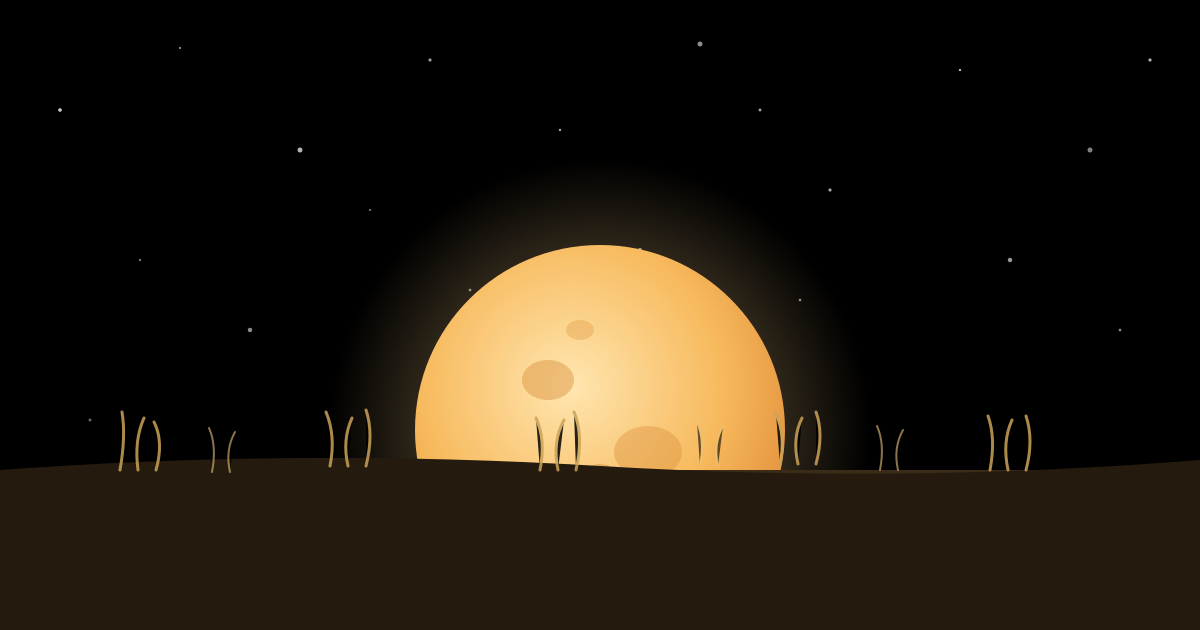
Every autumn, the most famous moon of the year climbs into the evening sky: enormous, amber-colored, and hanging impossibly low over the horizon. This is the Harvest Moon — the full moon nearest the September equinox — and it carries a history older than almost any other moon name in the sky. Long before streetlights, its bright, early-rising light let farming communities work past sunset to bring the crops in. An extra hour of moonlight could mean an extra wagonload of wheat before the rain.
Today most of us no longer bring in the harvest, but the Harvest Moon has kept its meaning: it is the moon of gathering what you grew. For spiritual practitioners, it is the strongest full moon of the year for gratitude rituals, for honoring the people who helped you, and for looking honestly at the season behind you before the dark of winter arrives. This guide covers the astronomy of the Harvest Moon, why it looks so extraordinary, what it symbolizes, and a simple gratitude ritual for working with it. As always, treat everything here as reflective, symbolic practice — entertainment and contemplation, not predictions.
What Is the Harvest Moon? The Astronomy, Simply
Most full moons rise roughly an hour later each night. Around the September equinox, something unusual happens: the full moon rises only about 20 to 30 minutes later than the sunset moonrise of the night before — several evenings in a row. This gives the illusion of several bright moons in a row, each arriving almost at dusk. For centuries of farmers, that was a working gift: light when it was needed most.
The Harvest Moon is defined as the full moon that falls closest to the September equinox (around September 22 each year), which is the start of autumn in the Northern Hemisphere. It usually lands in September, but occasionally in early October. In 2026, the Harvest Moon rose on September 25; in 2027 it arrives on September 15. The full moon after the Harvest Moon gets its own name — the Hunter's Moon — which continues the autumn story into October.
Why the short interval between moonrises? It comes down to the tilt of Earth and the angle of the ecliptic — the path the moon follows across the sky. Around the autumn equinox, the ecliptic makes its shallowest angle with the evening horizon in the Northern Hemisphere, so the rising moon climbs only slowly upward each night. The moon is still on schedule; it just appears to arrive earlier. It is a beautiful case of geometry posing as generosity.
Why Does the Harvest Moon Look So Big and Orange?
Part of the Harvest Moon's fame is how it looks — and both of its signature effects are optical, not lunar. First, the size: when any moon rises low over the horizon, the famous Moon illusion makes it appear much larger than the same moon overhead. Your brain compares the moon against the familiar scale of trees, buildings, and fields, and reads it as enormous. Measure it with your thumb and it is the same width all night — but try telling your eyes that.
Second, the color. Moonlight reaching you from near the horizon passes through far more of Earth's atmosphere than light from overhead. The atmosphere scatters the short blue wavelengths away and lets the long warm wavelengths through — the same physics that paints sunsets. The Harvest Moon hangs lower and longer than most full moons, so you get an extended version of that golden show: amber, copper, burnt orange. In autumn, haze from the season's harvest activity deepens the effect even further.
None of this diminishes the moon. If anything, knowing the optics makes the evening richer: you are watching Earth's atmosphere perform, with the moon as the lantern.
The Spiritual Meaning of the Harvest Moon
If the full moon's general meaning is culmination and illumination, the Harvest Moon's meaning is what you do with what culminated. Symbolically, it carries a full emotional harvest of its own:
- Gratitude as ritual. The strongest association, across nearly every tradition: the Harvest Moon is the night to name what the season gave you. Practitioners treat it as the natural full moon for thanksgiving — the gratitude list, the thank-you notes, the deliberate pause to count what worked.
- Gathering and completion. This is the moon of finishing the season's work: closing loops, paying debts, delivering what you promised. In folk readings, it is the wrong moon for starting something new and the right moon for bringing things home.
- Honoring the helpers. Harvests were never solo work, and the spiritual reading keeps that: the Harvest Moon is traditionally a night to honor the people — and the quieter forces — that carried you through the season. Ancestors, mentors, friends who showed up. Some traditions leave offerings or simply speak the names aloud.
- Releasing the spoiled crop. Not every harvest is good. The honest version of the ritual includes releasing what failed — the project that wilted, the plan that never ripened. The spiritual framing: let the field lie fallow where it needs to, without shame.
- Storing for winter. With the dark half of the year ahead, the Harvest Moon is also read as a call to prepare: to bank your strength, set your boundaries, and stock the inner pantry for the leaner months.
Treated as symbolism rather than prediction, the Harvest Moon is one of the warmest prompts in the lunar calendar: look at what you grew, thank who helped, and clear the field.
Harvest Moon vs. Hunter's Moon vs. Other Named Moons
People sometimes confuse the autumn's named moons, but they form a sequence. The Harvest Moon is the full moon nearest the equinox — the farmer's moon, about gathering the crop. The Hunter's Moon comes next, the full moon after it (usually October): the hunter's moon, about what the fields leave behind. Spiritually, the harvest is receiving what you grew; the hunt is seeking what you need next.
The other named full moons — the Blood Moon, the Blue Moon, the Supermoon — are different kinds of events. A Blood Moon is an eclipse phenomenon, a Blue Moon is a calendar quirk, and a Supermoon is about the moon's distance from Earth. The Harvest Moon is none of those: it is about position in the seasonal year. Occasionally the honors coincide — a September full moon can also be a supermoon, making a particularly spectacular Harvest Moon — but the name is about the season, not the size.
A Simple Harvest Moon Gratitude Ritual
The guiding principle of a Harvest Moon ritual is gathering: pull in the season's good, name it, and let the rest go. Follow the bones of a standard full moon ritual, then add the harvest layer:
1. Set the harvest table
Bring something seasonal to your space: an apple, a pumpkin, dried corn, a sprig of wheat — whatever reads as autumn where you live. Light an orange or gold candle. Many practitioners also set a small bowl of grains or seeds as a visual anchor for what was 'grown' this year.
2. Write the harvest list
On paper, list the season's genuine gains — not just achievements, but survivals, recoveries, kindnesses received, skills learned. Be specific: 'my sister's calls during the hard month' counts more than 'family'. Read the list aloud, slowly. Practitioners describe this as the emotional core of the whole ritual — gratitude that stays in the head is just inventory; spoken, it becomes an event.
3. Name what failed, and release it
On a separate slip of paper, write what withered: the goal that died, the habit that didn't stick, the relationship that ran its course. Burn it safely (or tear it into the recycling) with the words, 'I release what didn't grow.' The ritual logic: a field isn't punished for a bad crop, it's rested.
4. Store for winter
Write one sentence about what you are carrying into the darker months — a strength, a lesson, a person. Fold it into your journal, or tuck it with a stone from the evening. Under the Harvest Moon, practitioners treat this as 'putting up preserves': shelving your clarity where winter-you can find it.
5. Close with a shared table
If you can, end the evening with food shared — a harvest meal, however simple. The oldest Harvest Moon rites were feasts, and the ritual logic survives: gratitude tastes better together. Even a single piece of bread, eaten slowly in thanks, does the work.
Harvest Moon Traditions Around the World
The Harvest Moon is one of the few moon names recognized across cultures, because every farming society watched the same September sky. In East Asia, the full moon of the harvest season is the centerpiece of the Mid-Autumn Festival — celebrated in China, Vietnam, and beyond with mooncakes, lanterns, and family reunions under the moon. It is, in spirit, the Harvest Moon's great festival cousin.
In Britain and Ireland, the Harvest Moon anchored centuries of harvest-home celebrations: the last sheaf of wheat was carried home in ceremony, harvest suppers were held, and the moon's light was credited with helping finish the reaping. In parts of rural America, 'harvest moon' dances and barn raisings clustered around its dates. In Japan, the equivalent full moon, Jugoya, is honored with offerings of pampas grass and dango rice dumplings placed where the moon can see them.
The pattern is the same everywhere: the September moon is treated as the season's accountant — the night the books get balanced with gratitude.
Common Mistakes When Working With the Harvest Moon
First, don't force gratitude you don't feel. If the season was genuinely hard, the ritual isn't 'list ten blessings' — it's the honest version: survival counts, and the release of the spoiled crop may be the whole practice. Second, don't start new projects on it. Harvest energy is about gathering what exists; new moons are for new beginnings. Third, don't watch it only from indoors — the Harvest Moon's signature is the low, giant, orange rise, and that means stepping outside at moonrise, finding a clear eastern horizon, and letting your eyes do the work. And finally, don't skip the sharing part. A gratitude ritual kept entirely private is fine, but the harvest tradition is communal — even one text to someone who helped you completes the circuit.
Dreaming Under the Harvest Moon
Full moons carry a folk reputation for vivid dreams, and the Harvest Moon's harvest symbolism gives dreamers a useful lens. Dreams on this night are traditionally read through the gathering frame: dreams of feasts, barns, fields, baskets, or sorting are treated as the subconscious doing its own harvest — sorting what the season meant. Keep a journal by the bed and, on waking, ask the harvest questions: what did I gather, what did I lose, and what am I carrying into winter? The answers won't predict anything — but they may tell you, honestly, where you stand.
When the amber moon rises this September, step outside, find the horizon, and watch Earth's oldest autumn show. Count what grew. Thank who helped. Burn what didn't. Then go inside and eat something good — the Harvest Moon has always ended at the table.
Frequently asked questions
What is a Harvest Moon?
The Harvest Moon is the full moon that falls closest to the September equinox — the start of autumn in the Northern Hemisphere. It gets its name from farming tradition: its bright, low-hanging moonlight used to let farmers work late into the evening to bring in the harvest.
When is the Harvest Moon in 2026 and 2027?
In 2026, the Harvest Moon rises on September 25. In 2027 it falls on September 15. Exact timing shifts with your timezone, so check a lunar calendar for your location — but the visible moon will look full for the night before and after as well.
Why does the Harvest Moon look orange and huge?
The Harvest Moon rises low on the horizon, and two effects follow from that. The Moon illusion makes a low moon look larger against the landscape, and Earth's atmosphere scatters the blue wavelengths of its light, leaving the warm amber, orange, and copper tones we associate with autumn evenings.
What is the spiritual meaning of the Harvest Moon?
Spiritually, the Harvest Moon is read as the moon of gratitude, gathering, and completion: the season's work is done and it is time to take stock of what the year gave you. Traditions treat it as the strongest full moon for thanksgiving rituals, for honoring helpers and ancestors, and for releasing the season's unfinished business.
What is the difference between the Harvest Moon and the Hunter's Moon?
The Harvest Moon is the full moon nearest the September equinox; the Hunter's Moon is the next full moon after it, usually in October. The Harvest Moon traditionally served farmers finishing the harvest, while the Hunter's Moon served hunters preparing for winter. Spiritually, harvest energy is gratitude for what was gathered; hunter energy is preparation for what comes next.
Keep exploring
Hunter's Moon Meaning: Spiritual Significance of October's Full Moon
The Hunter's Moon is October's full moon of gratitude and preparation. Discover its folklore, spiritual meaning, the 2026 date, and a simple moonrise ritual.
Read the meaning →
Full Moon Ritual Guide: Release & Manifest Under the Full Moon
Learn exactly how to perform a powerful full moon ritual for release, gratitude, and renewal — step-by-step guide with supplies, timing, and intention ideas.
Read the meaning →
How to Make Moon Water: A Complete Guide to Lunar-Charged Water
Learn how to make moon water step by step — the best moon phases, jars, spoken intentions, crystal pairings, and 7+ ways to use your lunar-charged water.
Read the meaning →
What Does It Mean to Dream About Flying?
Flying dreams rank among our happiest. Discover what dreaming about flying means — freedom, ambition, confidence — and what turbulence reveals.
Read the meaning →